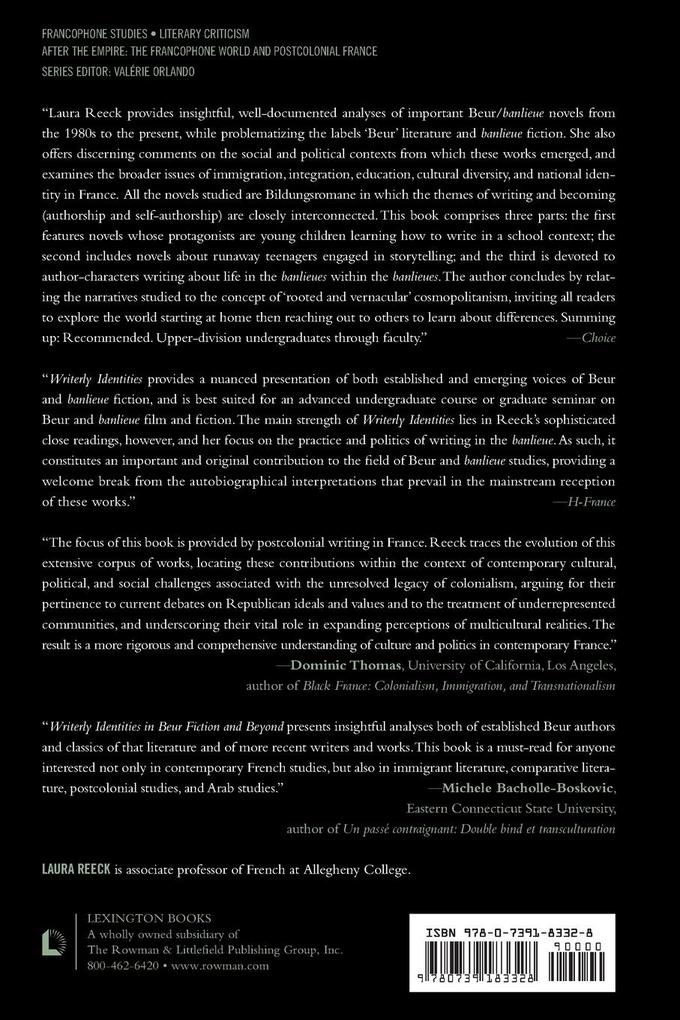
Writerly Identities in Beur Fiction and Beyond presents insightful analyses both of established Beur authors and classics of that literature and of more recent writers and works. This book is a must-read for anyone interested not only in contemporary French Studies, but also in immigrant literature, comparative literature, postcolonial studies, and Arab studies. -- Michele Bacholle-Boskovic, Eastern Connecticut State University, author of Un passe contraignant: double bind et transculturation The focus of this book is provided by postcolonial writing in France. Laura Reeck traces the evolution of this extensive corpus of works, locating these contributions within the context of contemporary cultural, political, and social challenges associated with the unresolved legacy of colonialism, arguing for their pertinence to current debates on Republican ideals and values and to the treatment of underrepresented communities, and underscoring their vital role in expanding perceptions of multicultural realities. The result is a more rigorous and comprehensive understanding of culture and politics in contemporary France. -- Dominic Thomas, UCLA, author of "Black France" and "Africa and France" Laura Reeck publie ici son premier ouvrage consacre a quelques ecrivains francais classes - relegues ? - par la doxa dans le rayon des auteurs "beurs" ou "ecrivains de banlieue". A chacun, elle consacre un chapitre. Elle ne se contente pas d'y analyser les oeuvres des uns et des autres mais se livre egalement a des mises en perspectives theoriques, sociales et biographiques. Elle illustre ainsi, avec rigueur et conviction, la fameuse opinion qui veut que la litterature en dise plus sur nos societes et sur leur devenir que nombre de doctes traites, lourdement lestes de statistiques. A l'ere du chiffre-roi, les poetes ne seraient pas tout a fait morts... -- Mustapha Harzoune, Cite nationale de l'histoire de l'immigration Reeck (Allegheny College) provides insightful, well-documented analyses of important Beur/banlieue novels from the 1980s to the present, while problematizing the labels 'Beur' literature and 'banlieue' fiction. She also offers discerning comments on the social and political contexts from which these works emerged, and examines the broader issues of immigration, integration, education, cultural diversity, and national identity in France. All the novels studied are Bildungsromane in which the themes of writing and becoming (authorship and self-authorship) are closely interconnected. The book comprises three parts: the first features novels whose protagonists are young children learning how to write in a school context; the second includes novels about runaway teenagers engaged in storytelling; the third is devoted to authors-characters writing about life in the banlieues within the banlieues. The author concludes by relating the narratives studied to the concept of 'rooted and vernacular' cosmopolitanism, inviting all readers to explore the world starting at home then reaching out to others to learn about differences. Summing Up: Recommended. Upper-division undergraduates through faculty. Writerly Identities provides a nuanced presentation of both established and emerging voices of Beur and banlieue fiction, and is best suited for an advanced undergraduate course or graduate seminar on Beur and banlieue film and fiction. The main strength of Writerly Identities lies in Reeck's sophisticated close readings, however, and her focus on the practice and politics of writing in the banlieue. As such, it constitutes an important and original contribution to the field of Beur and banlieue studies, providing a welcome break from the autobiographical interpretations that prevail in the mainstream reception of these works. H-France