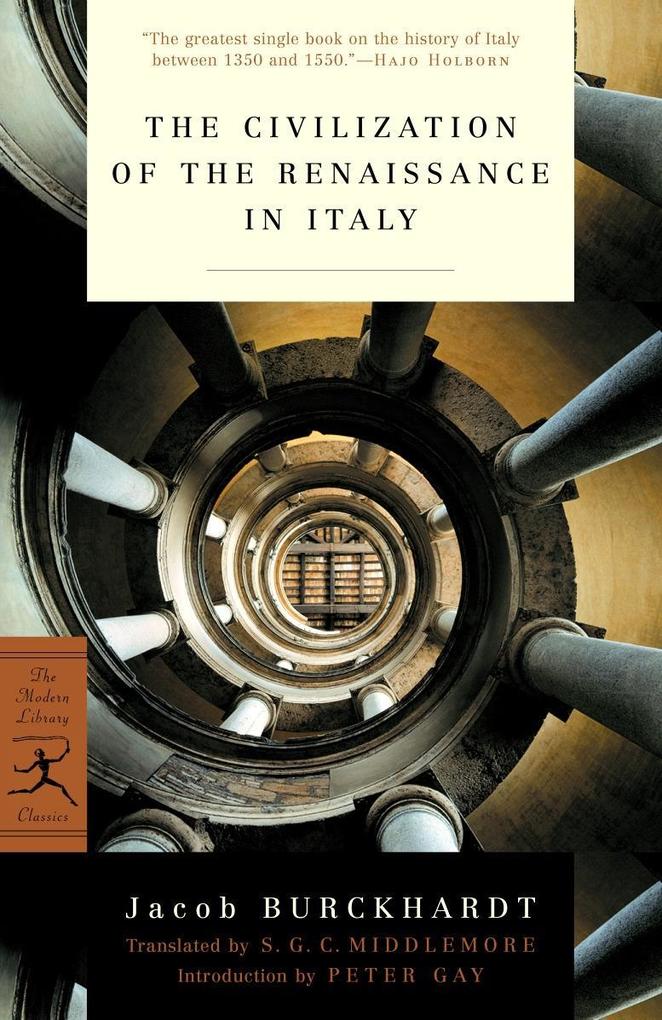
Jacob Burckhard's Civilization of the Renaissance in Italy was first published almost a century ago, in 1860. Its forty-two-year-old author, professor of history and the history of art at the small Swiss university of his native Basel, was already known to the learned world as the writer of a highly original book, The Age of Constantine the Great (1853), and of the Cicerone (1855)* which was to guide generations of enthusiastic pilgrims to the artistic monuments of Italy. But the Civilization of the Renaissance became the real foundation of his world-wide fame.
The first English translation of the Cicerone was published in 1873, that of Constantine appeared in New York in 1949.
In his own lifetime Jacob Burckhardt published only one more book, which was of a more specialized character, on Italian Renaissance architecture. It appeared in the same year, 1867, in which he reissued his Civilization of the Renaissance in a revised edition. During the remaining thirty years of his life he did not publish any of his writings and even turned over the preparation of new editions of his books to others. He devoted himself completely to the teaching of history at the university and before public audiences of his fellow-citizens. In 1898, a year after his death, his great History of Greek Civilization appeared. It was followed in 1905 by his absorbing Reflections on World History, ** originally a course of lectures intended to expose the fundamental pattern of historical development in its impact on man. Soon also the first collections of Burckhardt's private correspondence came to light and revealed one of the most profound and perspicacious critics of the social political trends of his times. No other nineteenth-century thinker was as clairvoyant about the potential dangers of future totalitarianism hidden in the growth of modern mass civilization.
** An American edition was published in New York in 1943 under the title Force and Freedom: Reflections on History.
Still, Burckhardt never aspired to the role of prophet nor, for that matter, to any public role. The great range of his mind and imagination, the intensity of his feelings, he managed to express in the sublimated form of objective creations of written history. They became alive through his genius but, like great works of art, they can be enjoyed whether or not one knows anything about the author. This was amply demonstrated by the history of the Civilization of the Renaissance. Well received by scholars of history and art, early translated into Italian, English, and French, it was already widely read all over the world in Burckhardt's own lifetime, but the fast-growing number of new editions after his death proves that it was the following generation that took the book fully to heart. The general cult of the Renaissance in the early decades of the twentieth century, to which undoubtedly Burckhardt had contributed, assisted in this growing esteem, although Burckhardt himself would have been disquieted by this popular exaggeration. The emulation of Renaissance forms in contemporary architecture and home decoration to which this enthusiasm for the Renaissance led was not to the liking of a man who cherished only the genuine and historically rooted human expressions. Burckhardt was also pained by Friedrich Nietzsche's praise of the amoral Renaissance man as the model of the future superman, for the historian was a strict moralist who never tired of pointing out that power was evil and that whatever happiness human beings might acquire could not be found in amoral action, but only in pure-hearted contemplation of eternal ideals.
The experiences of wars and revolutions in our own times make us look at Jacob Burckhardt's work with fresh eyes, and it is surprising to find that the Civilization of the Renaissance in Italy has not lost any of its radiance under this new questioning. It has remained the greatest single book written on the history of Italy between 1350 an