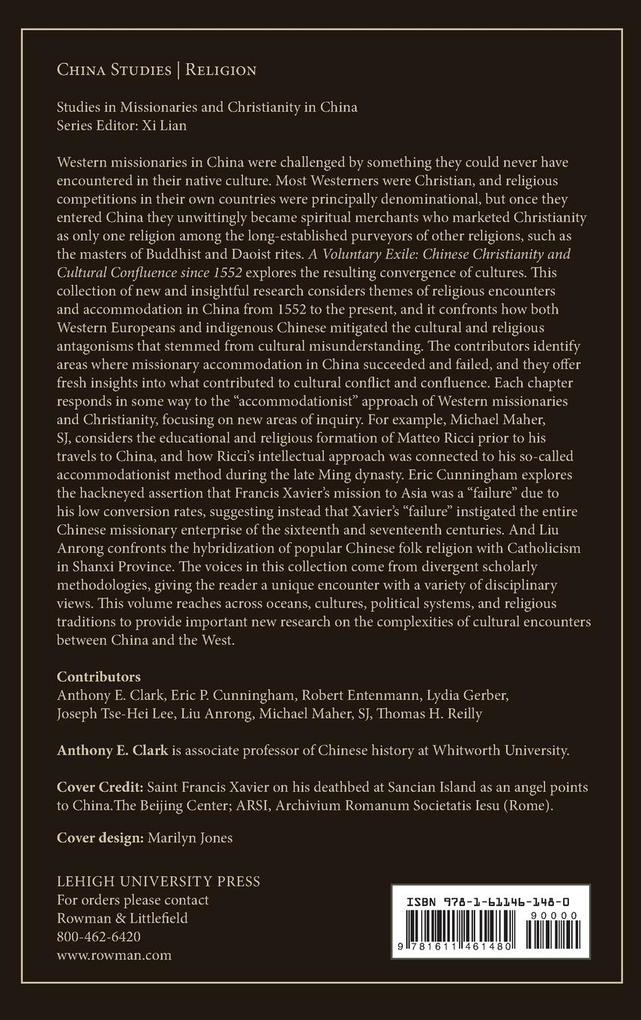
Western missionaries in China often considered themselves "voluntary exiles" in a distant land, while Chinese considered Christians either the demons of imperialism or the angels of modernization. This collection of new research provides insights into attempts to bridge the social and religious divide that separated China and the West, and serves as an artful and captivating history of how missionaries and native Christians confronted the sometimes violent antagonisms caused by cultural and linguistic difference.
Inhaltsverzeichnis
Contents
Illustrations
Acknowledgments
Introduction: A Voluntary Exile: Crisis, Conflict, and Accommodation After Matteo Ricci
Anthony E. Clark, Whitworth University
Chapter 1: A Glorious Failure: The Mission of Francis Xavier and its Consequences on the China Enterprise
Eric P. Cunningham, Gonzaga University
Chapter 2: Jesuit Formation and its Influence on the Methods of Matteo Ricci
Michael Maher, SJ, Gonzaga University
Chapter 3: The Lefebvre Incident of 1754: The Qing State, Chinese Catholics, and a European Missionary
Robert Entenmann, St. Olaf College
Chapter 4: Restoring the Ancient Faith: The Taiping Rebels and Their Mandate
Thomas H. Reilly, Pepperdine University
Chapter 5: Mandarins and Martyrs of Taiyuan, Shanxi in Late-Imperial China
Anthony E. Clark, Whitworth University
Chapter 6: Christianity for a Confucian Youth: Richard Wilhelm and His Lixian Shuyuan School for Boys in Qingdao, 1901-1912
Lydia Gerber, Washington State University
Chapter 7: Catholic and Chinese Folk Religion During the Republican Era in the Region of Taiyuan, Shanxi
Liu Anrong, Shanxi Administrative College
Chapter 8: Church-State Accommodation in China's "Harmonious Society"
Joseph Tse-Hei Lee, Pace University
Abbreviations
Works Cited
About the Contributors