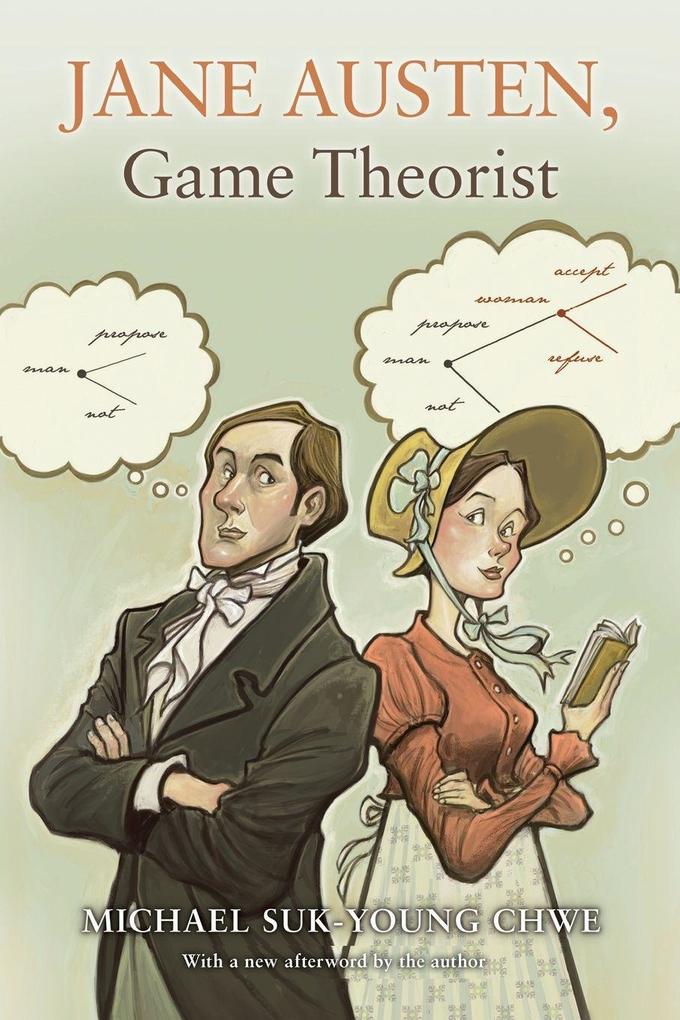
How the works of Jane Austen show that game theory is present in all human behavior
Game theory-the study of how people make choices while interacting with others-is one of the most popular technical approaches in social science today. But as Michael Chwe reveals in his insightful new book, Jane Austen explored game theory's core ideas in her six novels roughly two hundred years ago-over a century before its mathematical development during the Cold War. Jane Austen, Game Theorist shows how this beloved writer theorized choice and preferences, prized strategic thinking, and analyzed why superiors are often strategically clueless about inferiors. Exploring a diverse range of literature and folktales, this book illustrates the wide relevance of game theory and how, fundamentally, we are all strategic thinkers.
Inhaltsverzeichnis
Preface xi
Abbreviations xiii
CHAPTER ONE The Argument 1 CHAPTER TWO Game Theory in Context 9
Rational Choice Theory 9
Game Theory 12
Strategic Thinking 15
How Game Theory Is Useful 19
Criticisms 25
Game Theory and Literature 30 CHAPTER THREE Folktales and Civil Rights 35
CHAPTER FOUR Flossie and the Fox 43
CHAPTER FIVE Jane Austen's Six Novels 49
Pride and Prejudice 50
Sense and Sensibility 54
Persuasion 60
Northanger Abbey 67
Mansfield Park 75
Emma 86 CHAPTER SIX Austen's Foundations of Game Theory 97
Choice 97
Preferences 102
Revealed Preferences 105
Names for Strategic Thinking 107
Strategic Sophomores 111
Eyes 113 CHAPTER SEVEN Austen's Competing Models 115
Emotions 115
Instincts 119
Habits 121
Rules 124
Social Factors 127
Ideology 128
Intoxication 130
Constraints 130 CHAPTER EIGHT Austen on What Strategic Thinking Is Not 133
Strategic Thinking Is Not Selfish 133
Strategic Thinking Is Not Moralistic 134
Strategic Thinking Is Not Economistic 135
Strategic Thinking Is Not About Winning Inconsequential Games 137 CHAPTER NINE Austen's Innovations 141
Partners in Strategic Manipulation 141
Strategizing About Yourself 153
Preference Change 158
Constancy 167 CHAPTER TEN Austen on Strategic Thinking's Disadvantages 171
CHAPTER ELEVEN Austen's Intentions 179
CHAPTER TWELVE Austen on Cluelessness 188
Lack of Natural Ability 188
Social Distance 198
Excessive Self-Reference 200
High-Status People Are Not Supposed to Enter the Minds of Low-Status People 202
Presumption Sometimes Works 205
Decisive Blunders 205 CHAPTER THIRTEEN Real-World Cluelessness 211
Cluelessness Is Easier 211
Difficulty Embodying Low-Status Others 213
Investing in Social Status 217
Improving Your Bargaining Position 219
Empathy Prevention 224
Calling People Animals 225 CHAPTER FOURTEEN Concluding Remarks 228
References 235
Index 253