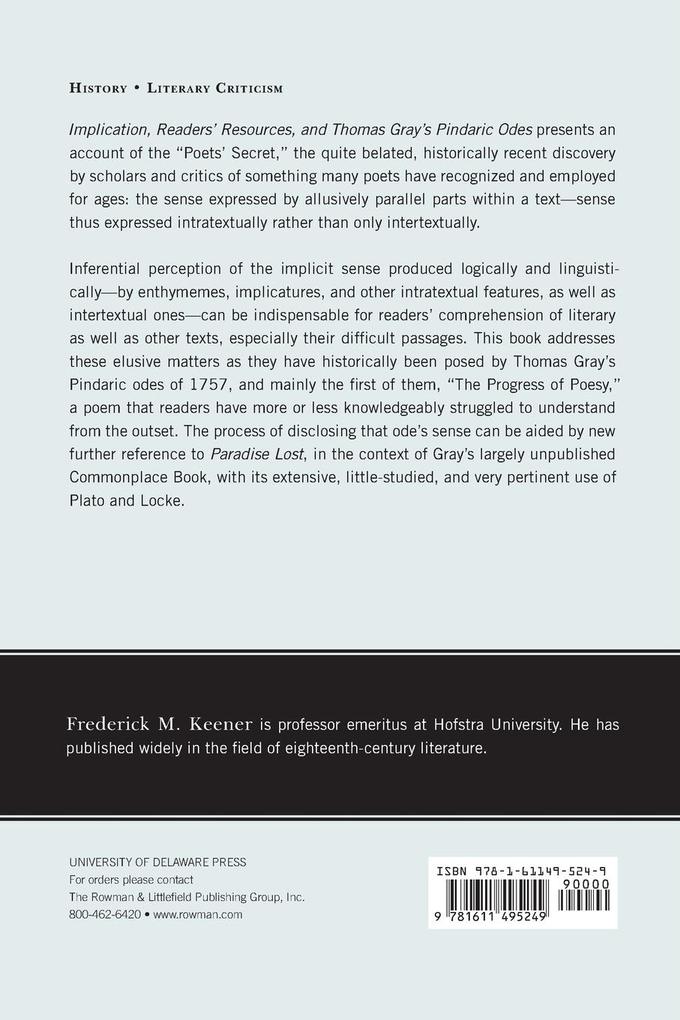
More radically than had any contemporary English author’s work, Thomas Gray’s two Pindaric odes of 1757, effectively challenged readers’ powers of comprehension, posing problems of reference as well as distinctly Pindaric problems of coherence. Solving those problems calls for knowledge not widely had then, now, or in between.
Inhaltsverzeichnis
Acknowledgments
Introduction: The Poets' Secret
Part I. The Cognitive Reception of Gray's Pindarics
Chapter 1: The "Unintelligible Obscure"
Chapter 2: Legacies Including Samuel Johnson's
Chapter 3: The Subsequent Progress of Elucidation
Part II. Further Implications of "The Progress of Poesy"
Chapter 4: Logic, Linguistic Semantics, and Pragmatics
Chapter 5: "But Far Above the Great"
Chapter 6: "Beneath the Good How Far"
Epilogue: Locke, Plato, and Gray's Inferring
About the Author
Bibliography
Index