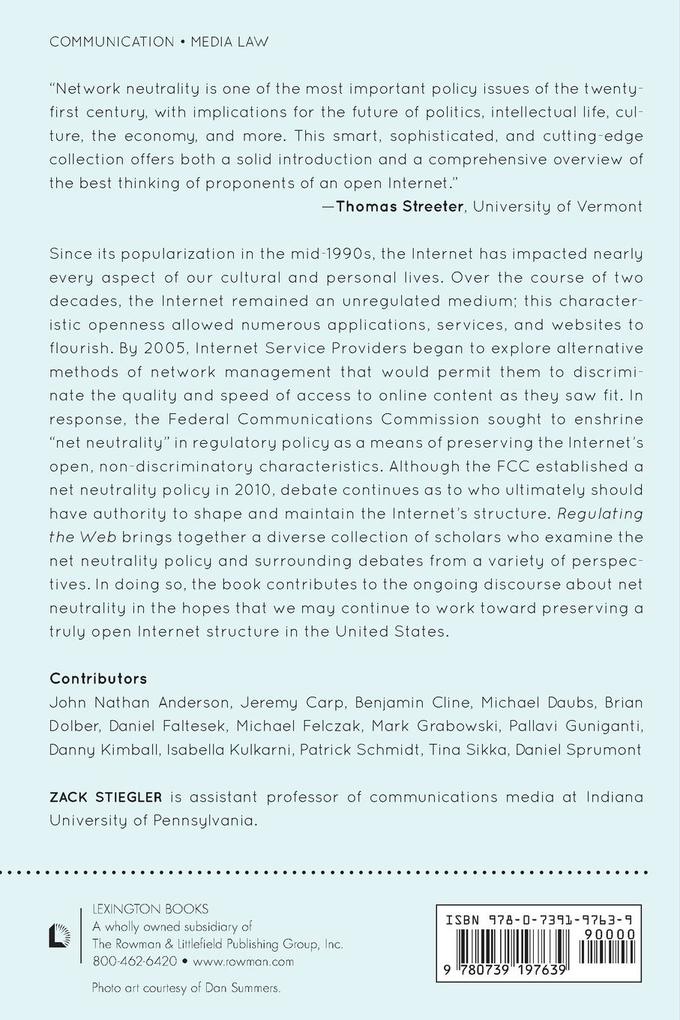
Although the FCC established a net neutrality policy in 2010, debate continues as to who ultimately should have authority to shape and maintain the Internet’s structure. Regulating the Web brings together a diverse collection of scholars who examine multiple the net neutrality policy and surrounding debates from a variety of perspectives.
Inhaltsverzeichnis
Regulating the Web: An Introduction
Zack Stiegler
Part I: Background and Principles1
Chapter 1: Visions of Modernity: Communication, Technology and Network Neutrality in Historical Perspective
Michael Felczak
Chapter 2: What We Talk About When We Talk About Net Neutrality: A Historical Genealogy of the Discourse of Net Neutrality
Danny Kimball
Chapter 3: Transparency, Consumers, and the Pursuit of an Open Internet: A Critical Appraisal
Jeremy Carp, Isabella Kulkarni, and Patrick Schmidt
Chapter 4: Applying Common Carriage to Network Neutrality
Pallavi Guniganti and Mark Grabowski
Part II: Institutional Perspectives
Imagining Equilibrium: The Figure of the Dynamic Market in the Net Neutrality Debate
Daniel Faltesek
Chapter 6: Axiology and the FCC: Regulation as Ideological Process
Benjamin Cline
Part III: Net Neutrality as Cultural and Political Debate
Chapter 7: Framing the Net Neutrality Debate
Zack Stiegler and Dan Sprumont
Chapter 8: Informationism as Ideology: Technological Myths in the Net Neutrality Debate
Brian Dolber
Part IV: Socio-Cultural Implications
Chapter 9: A Critical Theory of Technology Approach to the Study of Network Neutrality
Tina Sikka
Chapter 10: Network Neutrality, Mobile Networks, and User-Generated Activism
Michael Daubs
Chapter 11: Beyond the Series of Tubes: Strategies for Advancing Media Reform
John Nathan Anderson