








Das eBook.de Hörbuch Abo - jederzeit, überall, für nur 7,95 € monatlich!
Jetzt entdecken
mehr erfahren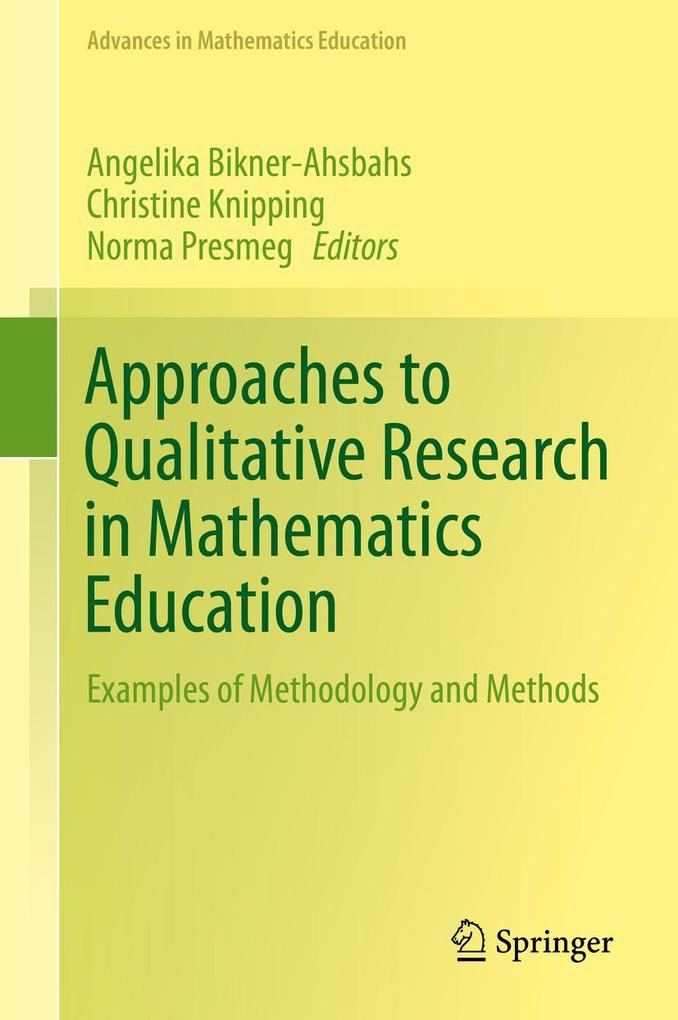
Inhaltsverzeichnis
Part 1: Grounded theory methodology. Chapter 1: Anne R. Teppo.
Grounded Theory Methods.
Chapter 2: Maike Vollstedt.
To see the wood for the trees: The development of theory from empirical interview data using grounded theory. -
Part 2: Approaches to reconstructing argumentation. Chapter 3: Götz Krummheuer.
Methods for reconstructing processes of argumentation and Chaptericipation in primary mathematics classroom interaction.
Chapter 4: Christine Knipping and David Reid.
Reconstructing argumentation structures: A perspective on proving processes in secondary mathematics classroom interactions. -
Part 3: Ideal type construction. Chapter 5:Angelika Bikner-Ahsbahs.
Empirically grounded building of ideal types. A methodical principle of constructing theory in the interpretive research in mathematics education.
Chapter 6:Angelika Bikner-Ahsbahs.
How ideal type construction can be achieved: An example. -
Part 4: Semiotic research
.
Chapter 7: Luis Radford and Cristina Sabena.
The question of method in a Vygotskian semiotic approach.
-Part 5: A theory on abstraction and its methodology. Chapter 8: Tommy Dreyfus, Rina Hershkowitz and Baruch Schwarz.
The nested epistemic actions model for Abstraction in Context: Theory as methodological tool and methodological tool as theory.
-
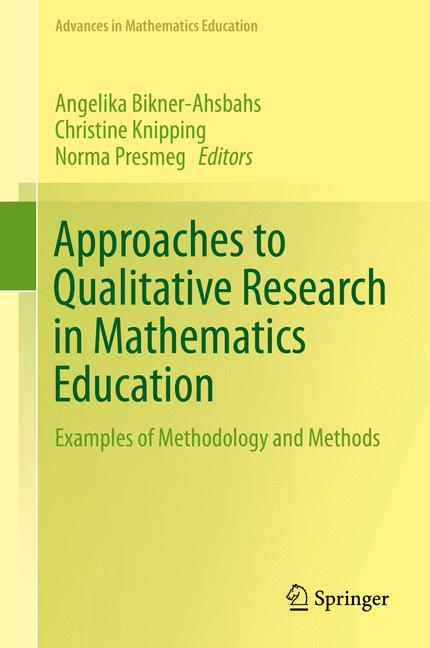
This book, Approaches to Qualitative Research in Mathematics Education: Examples of Methodology and Methods, edited by Angelika Bikner-Ahsbahs, Christine Knipping, and Norma Presmeg, is a timely and valuable addition to the research literature in mathematics education. The book is to be strongly recommended. (Keith Jones and Chronoula Voutsina, Educational Studies in Mathematics, Vol. 96, 2017)
Approaches to Qualitative Research in Mathematics Education: Examples of Methodology and Methods is a clever gift for the skeptics who believe that pursuing truth is only possible through traditional empirical research. The work of the contributors inspires researchers in the field of mathematics education to replicate thestudies and, more importantly, creates opportunities to further reflect on the ways theories inform qualitative research designs and methods. (Woong Lim, MAA Reviews, July, 2015)
Es wurden noch keine Bewertungen abgegeben. Schreiben Sie die erste Bewertung zu "Approaches to Qualitative Research in Mathematics Education" und helfen Sie damit anderen bei der Kaufentscheidung.