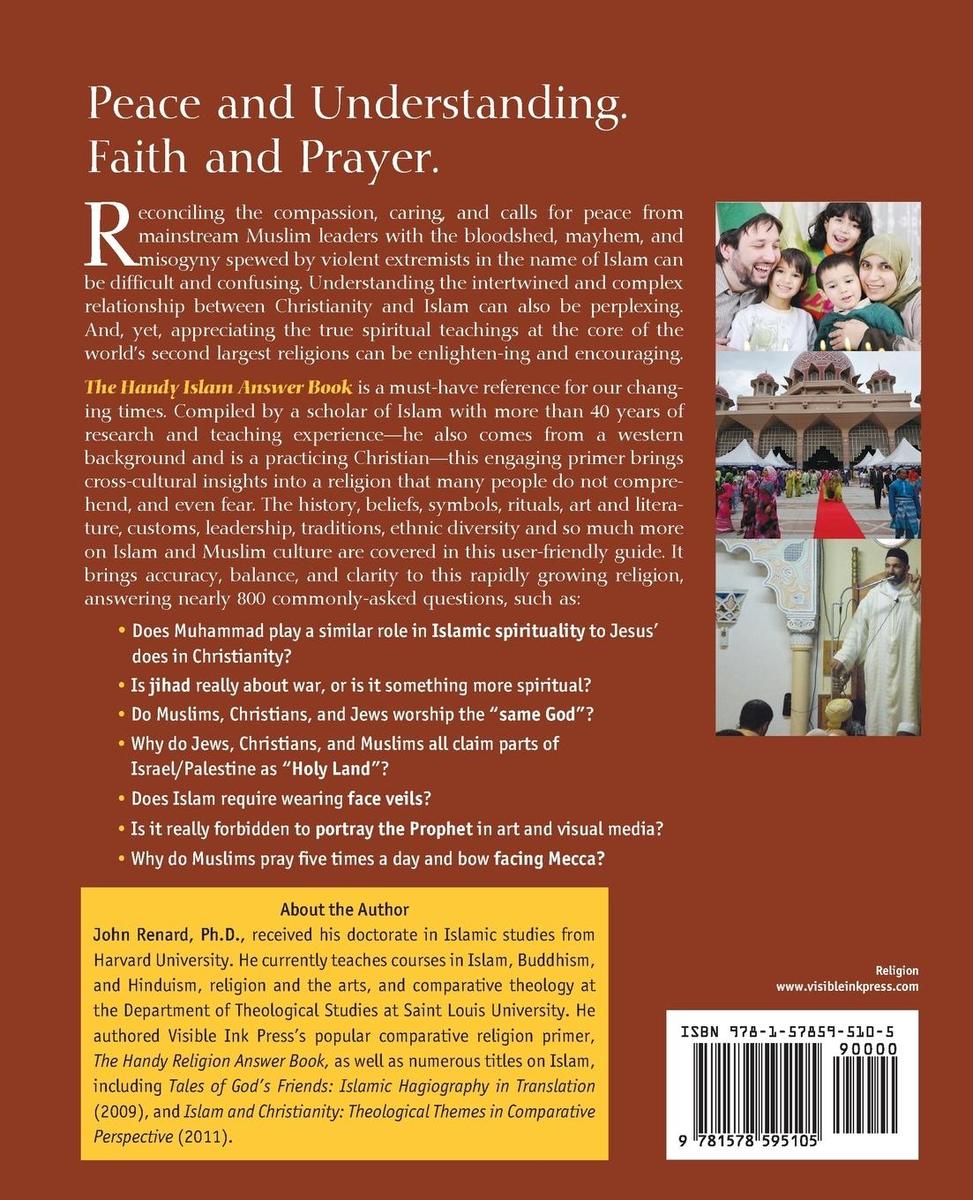
A western Islamic scholar demystifies and explains one of the world’s great religious traditions!
In an age of continued Middle East volatility, religious extremists, and terrorist threats, the mere mention of Islam and Muslims too often provokes misunderstanding and even rancor. Often overlooked are the important links between the Qur'an and the Bible. Also ignored are the significant historical overlap between Islamic interpretation of history with those of Christianity and Judaism. Islam is too often confusing and even opaque to those unfamiliar with it.Truly a must-have reference for our changing and trying times, The Handy Islam Answer Book, is clearly and eloquently written by John Renard, Ph.D., a scholar of Islam with more than 40 years of research and teaching experience. This user-friendly guide answers nearly 800 questions and offers fun facts that cover Islamic history, religious practices, and Muslim cultural perspectives, including …
When did Islam begin?
Why is Mecca a holy city for Muslims?
Do Muslims worship Muhammad?
What do Muslims mean by the term "Allah"?
What does the crescent moon and star symbol mean to Muslims?
What is the Muslim “call to prayer”? Is it similar to “church bells”?
Does Muhammad play a role in Islamic spirituality in a manner similar to Jesus’ role in Christianity?
Do Muslims, Christians, and Jews worship the “same God”?
Why do Jews, Christians, and Muslims all claim parts of Israel/Palestine as “Holy Land”?
Does Islam require wearing face veils?
Is there any similarity between Muslim and Christian art?
And many more!
Muslims are diverse, and they have a vast spectrum of views about Islam, and The Handy Islam Answer Book is a resource for reliable information about Islam and Muslims. This helpful book also provides a historic timeline, a glossary of commonly used terms, a genealogy from Adam to Muhammad and beyond, a calendar of major observances, an extensive index, and a bibliography help further exploration of one of the world’s largest religions.
Inhaltsverzeichnis
Preface and Acknowledgments
Introduction
Part One: Historical Perspectives
1. Origins and early expansion
2. Islam’s Growth into a Global Community
3. Politics and Contemporary Global Affairs
Part Two: Religious Perspectives
4. Sacred Sources and their Interpretation
5. Essential Beliefs
6. Symbols, Rituals, and Religious Observances
7. Themes in Islamic Spirituality
8. Authority, Law and Ethics
9. Islam and Other Faiths
Part Three: Cultural Perspectives – Learning and Communicating Islamic Values
10. Culture and Religion
11. Knowledge, Scholarship, and the Islamic Humanities
12. Aesthetics, Literature, the Visual and Spatial Arts
Suggestions for Further Reading
Global Timeline
Glossary
Index