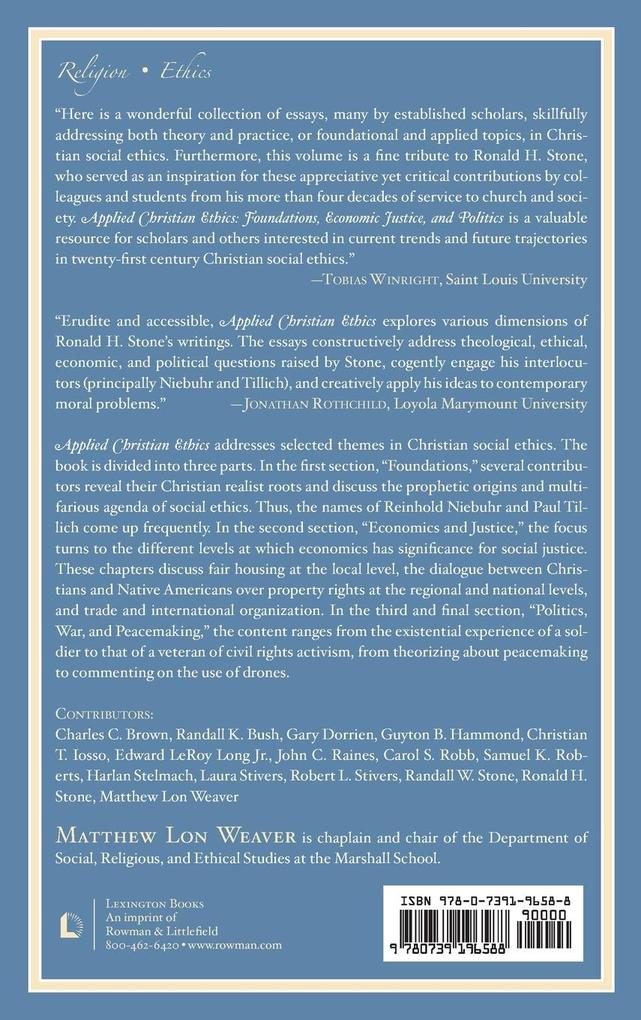
Applied Christian Ethics addresses selected themes in Christian social ethics. Part one shows the roots of contributors in the realist school; part two focuses on different levels of the significance of economics for social justice; and part three deals with both existential experience and government policy in war and peace issues.
Inhaltsverzeichnis
Introduction, Matthew Lon Weaver
Part I: Foundations
Chapter 1: Social Christianity, Niebuhrian Realism, and the Protestant Mainline, Gary Dorrien
Chapter 2: Paul Tillich and the Frankfurt School, Guyton B. Hammond
Chapter 3: Toward a Constructive "Religious Realism": Robert Bellah and Reinhold Niebuhr, Harlan Stelmach
Chapter 4: Paul Tillich and the Lingering Possibility of Prophetic Activity, Randall K. Bush
Chapter 5: Recent Books about Reinhold Niebuhr and Reflections on His Relevance Today, Charles C. Brown
Chapter 6: Calvin for Today: Breaking Out of the Iron Cage, Matthew Lon Weaver
Chapter 7: The Life and Practice of an Ethicist, Ronald H. Stone
Part II: Economics and Justice
Chapter 8: Cowboys, Indians, and Ethicists: A Conversation Stimulated by Robert Warrior, Carol S. Robb
Chapter 9: Justice, Power, and International Organizations, Randall W. Stone
Chapter 10: Making Global Capitalism More Just by Imposing an International Transaction Tax, John C. Raines
Chapter 11: Responding to "Not in My Backyard" Advocates: A Christian Feminist Justice Approach, Laura Stivers
Part III: Politics, War, and Peacemaking
Chapter 12: Redeeming Democracy: The Continuing Paradox of African-American Faith-Based Politics, Samuel K. Roberts
Chapter 13: The Development and Nature of the Peace Making Idea, Edward LeRoy Long, Jr.
Chapter 14: The Church Reformed and Always Resisting: Ronald H. Stone and Presbyterian Social Witness, Christian T. Iosso
Chapter 15: Vietnam: A Scar on the Soul, Robert L. Stivers
Chapter 16: Drones and Christian Morality, Ronald H. Stone
Afterword, Ronald H. Stone