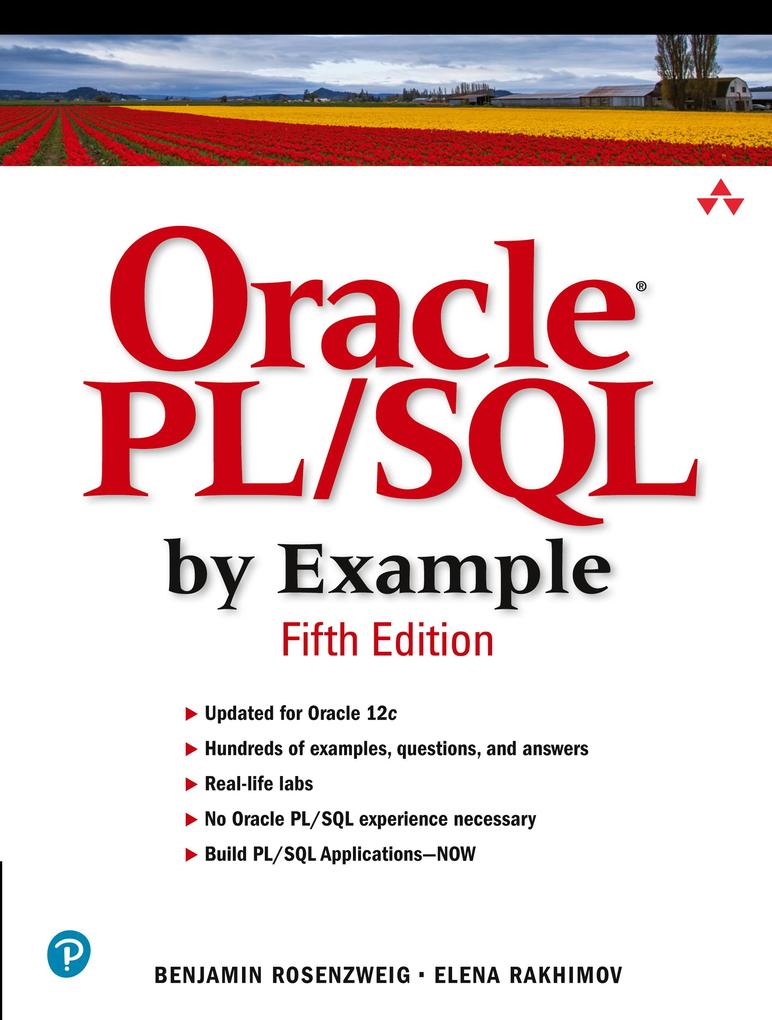
Using PL/SQL for Oracle Database 12c, you can build solutions that deliver unprecedented performance and efficiency in any environment, including the cloud. Oracle® PL/SQL by Example teaches all the PL/SQL skills you ll need, through real-world labs, extensive examples, exercises, and projects. Now fully updated for the newest version of PL/SQL, it covers everything from basic syntax and program control through the latest optimisation and security enhancements.
Step by step, you ll walk through every key task, mastering today s most valuable Oracle 12cPL/SQL programming techniques on your own.
This book s approach fully reflects the authors award-winning experience teaching PL/SQL to professionals at Columbia University. New database developers and DBAs can use it to get productive fast; experienced PL/SQL programmers will find it to be a superb Oracle Database 12csolutions reference.
Using PL/SQL for Oracle Database 12c, you can build solutions that deliver unprecedented performance and efficiency in any environment, including the cloud. Oracle® PL/SQL by Example, Fifth Edition, teaches all the PL/SQL skills you ll need, through real-world labs, extensive examples, exercises, and projects. Now fully updated for the newest version of PL/SQL, it covers everything from basic syntax and program control through the latest optimization and security enhancements.
Step by step, you ll walk through every key task, mastering today s most valuable Oracle 12cPL/SQL programming techniques on your own. Start by downloading projects and exercises from informit. com/title/0133796787. Once you ve done an exercise, the authors don t just present the answer: They offer an in-depth discussion introducing deeper insights and modern best practices.
This book s approach fully reflects the authors award-winning experience teaching PL/SQL to professionals at Columbia University. New database developers and DBAs can use it to get productive fast; experienced PL/SQL programmers will find it to be a superb Oracle Database 12csolutions reference.
New in This Edition
Other topics covered
Inhaltsverzeichnis
Preface xvii
Acknowledgments xxi
About the Authors xxiii
Introduction to PL/SQL New Features in Oracle 12c xxv
Invoker s Rights Functions Can Be Result-Cached xxvi
More PL/SQL-Only Data Types Can Cross the PL/SQL-to-SQL Interface Clause xxvii
ACCESSIBLE BY Clause xxvii
FETCH FIRST Clause xxviii
Roles Can Be Granted to PL/SQL Packages and Stand-Alone Subprograms xxix
More Data Types Have the Same Maximum Size in SQL and PL/SQL xxx
Database Triggers on Pluggable Databases xxx
LIBRARY Can Be Defined as a DIRECTORY Object and with a CREDENTIAL Clause xxx
Implicit Statement Results xxxi
BEQUEATH CURRENT_USER Views xxxii
INHERIT PRIVILEGES and INHERIT ANY PRIVILEGES Privileges xxxii
Invisible Columns xxxiii
Objects, Not Types, Are Editioned or Noneditioned xxxiv
PL/SQL Functions That Run Faster in SQL xxxiv
Predefined Inquiry Directives $$PLSQL_UNIT_OWNER and $$PLSQL_UNIT_TYPE xxxvi
Compilation Parameter PLSQL_DEBUG Is Deprecated xxxvii
Chapter 1: PL/SQL Concepts 1
Lab 1. 1: PL/SQL Architecture 2
Lab 1. 2: PL/SQL Development Environment 9
Lab 1. 3: PL/SQL: The Basics 18
Summary 25
Chapter 2: PL/SQL Language Fundamentals 27
Lab 2. 1: PL/SQL Programming Fundamentals 28
Summary 41
Chapter 3: SQL in PL/SQL 43
Lab 3. 1: DML Statements in PL/SQL 44
Lab 3. 2: Transaction Control in PL/SQL 49
Summary 55
Chapter 4: Conditional Control: IF Statements 57
Lab 4. 1: IF Statements 58
Lab 4. 2: ELSIF Statements 63
Lab 4. 3: Nested IF Statements 67
Summary 70
Chapter 5: Conditional Control: CASE Statements 71
Lab 5. 1: CASE Statements 71
Lab 5. 2: CASE Expressions 80
Lab 5. 3: NULLIF and COALESCE Functions 84
Summary 89
Chapter 6: Iterative Control: Part I 91
Lab 6. 1: Simple Loops 92
Lab 6. 2: WHILE Loops 98
Lab 6. 3: Numeric FOR Loops 104
Summary 109
Chapter 7: Iterative Control: Part II 111
Lab 7. 1: CONTINUE Statement 111
Lab 7. 2: Nested Loops 118
Summary 122
Chapter 8: Error Handling and Built-in Exceptions 123
Lab 8. 1: Handling Errors 124
Lab 8. 2: Built-in Exceptions 126
Summary 132
Chapter 9: Exceptions 133
Lab 9. 1: Exception Scope 133
Lab 9. 2: User-Defined Exceptions 137
Lab 9. 3: Exception Propagation 141
Summary 147
Chapter 10: Exceptions: Advanced Concepts 149
Lab 10. 1: RAISE_APPLICATION_ERROR 149
Lab 10. 2: EXCEPTION_INIT Pragma 153
Lab 10. 3: SQLCODE and SQLERRM 155
Summary 158
Chapter 11: Introduction to Cursors 159
Lab 11. 1: Types of Cursors 159
Lab 11. 2: Cursor Loop 165
Lab 11. 3: Cursor FOR LOOPs 175
Lab 11. 4: Nested Cursors 177
Summary 181
Chapter 12: Advanced Cursors 183
Lab 12. 1: Parameterized Cursors 183
Lab 12. 2: Complex Nested Cursors 185
Lab 12. 3: FOR UPDATE and WHERE CURRENT Cursors 187
Summary 190
Chapter 13: Triggers 191
Lab 13. 1: What Triggers Are 191
Lab 13. 2: Types of Triggers 205
Summary 211
Chapter 14: Mutating Tables and Compound Triggers 213
Lab 14. 1: Mutating Tables 213
Lab 14. 2: Compound Triggers 217
Summary 223
Chapter 15: Collections 225
Lab 15. 1: PL/SQL Tables 226
Lab 15. 2: Varrays 235
Lab 15. 3: Multilevel Collections 240
Summary 242
Chapter 16: Records 243
Lab 16. 1: Record Types 243
Lab 16. 2: Nested Records 250
Lab 16. 3: Collections of Records 253
Summary 257
Chapter 17: Native Dynamic SQL 259
Lab 17. 1: EXECUTE IMMEDIATE Statements 260
Lab 17. 2: OPEN-FOR, FETCH, and CLOSE Statements 271
Summary 280
Chapter 18: Bulk SQL 281
Lab 18. 1: FORALL Statements 282
Lab 18. 2: The BULK COLLECT Clause 291
Lab 18. 3: Binding Collections in SQL Statements 299
Summary 309
Chapter 19: Procedures 311
Benefits of Modular Code 312
Lab 19. 1: Creating Procedures 312
Lab 19. 2: Passing Parameters IN and OUT of Procedures 315
Summary 319
Chapter 20: Functions 321
Lab 20. 1: Creating Functions 321
Lab 20. 2: Using Functions in SQL Statements 327
Lab 20. 3: Optimizing Function Execution in SQL 329
Summary 331
Chapter 21: Packages 333
Lab 21. 1: Creating Packages 334
Lab 21. 2: Cursor Variables 344
Lab 21. 3: Extending the Package 353
Lab 21. 4: Package Instantiation and Initialization 366
Lab 21. 5: SERIALLY_REUSABLE Packages 368
Summary 371
Chapter 22: Stored Code 373
Lab 22. 1: Gathering Information about Stored Code 373
Summary 382
Chapter 23: Object Types in Oracle 385
Lab 23. 1: Object Types 386
Lab 23. 2: Object Type Methods 394
Summary 404
Chapter 24: Oracle-Supplied Packages 405
Lab 24. 1: Extending Functionality with Oracle-Supplied Packages 406
Lab 24. 2: Error Reporting with Oracle-Supplied Packages 419
Summary 429
Chapter 25: Optimizing PL/SQL 431
Lab 25. 1: PL/SQL Tuning Tools 432
Lab 25. 2: PL/SQL Optimization Levels 438
Lab 25. 3: Subprogram Inlining 444
Summary 453
Appendix A: PL/SQL Formatting Guide 455
Case 455
White Space 455
Naming Conventions 456
Comments 457
Other Suggestions 457
Appendix B: Student Database Schema 461
Table and Column Descriptions 461
Index 469
Es wurden noch keine Bewertungen abgegeben. Schreiben Sie die erste Bewertung zu "Oracle PL/SQL by Example" und helfen Sie damit anderen bei der Kaufentscheidung.








