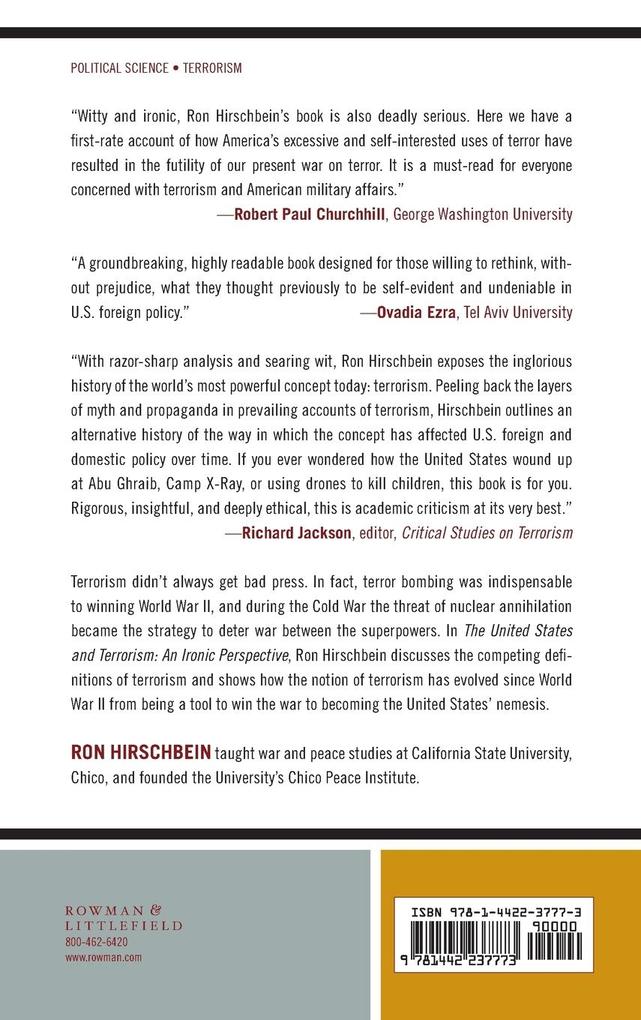
Terrorism didn’t always get bad press. In fact, terror bombing was indispensable to winning World War II, and during the Cold War the threat of nuclear annihilation became the strategy to deter war between the superpowers. In this work, Ron Hirschbein discusses the competing definitions of terrorism and shows how the notion of terrorism has evolved since World War II from being a tool to win the war to becoming the United States’ nemesis.
Inhaltsverzeichnis
Acknowledgments
Introduction: Quest for the Unholy Grail
Chapter 1: World War II: Theory And Practice Of Terrorism
From Cold-Blooded Isolationism to Hot-Blooded Warfare
Bad Japanese, Good Germans, and Russian Comrades
From Emnity To Amity: The Occupations Of Japan And Germany
Chapter 2: Celebrating Nuclear Terror-Irony Of The Cold War
A Nukespeak /Doublethink Primer
The Irony of American Nuclear Endeavors
Oldest Psychology/Newest Logic
When Deterrence Fails
Nuclear Terror And War Prevention
Retirement Wisdom
Chapter 3: Goodwill Toward Men Without Peace On Earth
A World without Enemies
Hubris: Promoting What You Would Prevent
Korea: The Forgotten War
Vietnam: The War We Can't Forget
Coda: A Lesson from Grand Fenwick
Chapter 4: The War on Terror
The Transmutation of Terrorism
Terrorism Experts
9/11 and Its Discontents
Iraq: A Never-Ending-Story
Drones: Terrorism-Lite
Chapter 5: Terrorism As Entertainment
Shock and Awe Becomes Aw Shucks
Daydreaming In the Aftermath of 9/11
The Present Is a Foreign Country
The Sacred and the Profane
Watching Homeland with President Obama
Bibliography
About the Author
Index