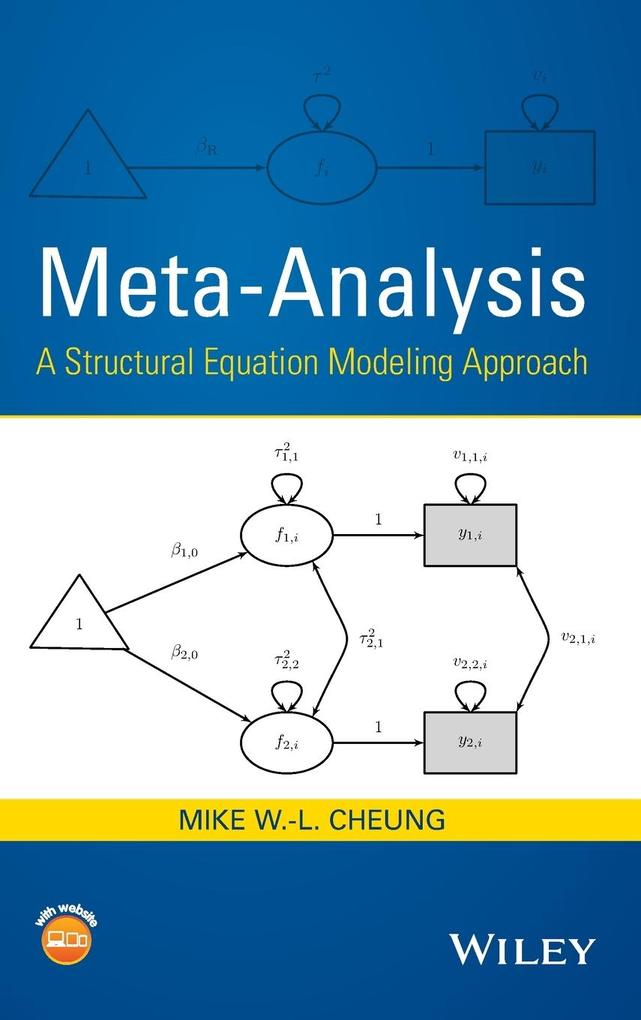
Presents a novel approach to conducting meta-analysis using structural equation modeling.
Structural equation modeling (SEM) and meta-analysis are two powerful statistical methods in the educational, social, behavioral, and medical sciences. They are often treated as two unrelated topics in the literature. This book presents a unified framework on analyzing meta-analytic data within the SEM framework, and illustrates how to conduct meta-analysis using the metaSEM package in the R statistical environment.
Meta-Analysis: A Structural Equation Modeling Approach begins by introducing the importance of SEM and meta-analysis in answering research questions. Key ideas in meta-analysis and SEM are briefly reviewed, and various meta-analytic models are then introduced and linked to the SEM framework. Fixed-, random-, and mixed-effects models in univariate and multivariate meta-analyses, three-level meta-analysis, and meta-analytic structural equation modeling, are introduced. Advanced topics, such as using restricted maximum likelihood estimation method and handling missing covariates, are also covered. Readers will learn a single framework to apply both meta-analysis and SEM. Examples in R and in Mplus are included.
This book will be a valuable resource for statistical and academic researchers and graduate students carrying out meta-analyses, and will also be useful to researchers and statisticians using SEM in biostatistics. Basic knowledge of either SEM or meta-analysis will be helpful in understanding the materials in this book.
Inhaltsverzeichnis
Preface xiii
Acknowledgments xv
List of abbreviations xvii
List of figures xix
List of tables xxi
1 Introduction 1
1. 1 What is meta-analysis? 1
1. 2 What is structural equation modeling? 2
1. 3 Reasons for writing a book on meta-analysis and structural equation modeling 3
1. 4 Outline of the following chapters 6
1. 5 Concluding remarks and further readings 8
2 Brief review of structural equation modeling 13
2. 1 Introduction 13
2. 2 Model specification 14
2. 3 Common structural equation models 18
2. 4 Estimation methods, test statistics, and goodness-of-fit indices 25
2. 5 Extensions on structural equation modeling 38
2. 6 Concluding remarks and further readings 42
3 Computing effect sizes for meta-analysis 48
3. 1 Introduction 48
3. 2 Effect sizes for univariate meta-analysis 50
3. 3 Effect sizes for multivariate meta-analysis 57
3. 4 General approach to estimating the sampling variances and covariances 60
3. 5 Illustrations Using R 68
3. 6 Concluding remarks and further readings 78
4 Univariate meta-analysis 81
4. 1 Introduction 81
4. 2 Fixed-effects model 83
4. 3 Random-effects model 87
4. 4 Comparisons between the fixed- and the random-effects models 93
4. 5 Mixed-effects model 96
4. 6 Structural equation modeling approach 100
4. 7 Illustrations using R 105
4. 8 Concluding remarks and further readings 116
5 Multivariate meta-analysis 121
5. 1 Introduction 121
5. 2 Fixed-effects model 124
5. 3 Random-effects model 127
5. 4 Mixed-effects model 134
5. 5 Structural equation modeling approach 136
5. 6 Extensions: mediation and moderation models on the effect sizes 140
5. 7 Illustrations using R 145
5. 8 Concluding remarks and further readings 174
6 Three-level meta-analysis 179
6. 1 Introduction 179
6. 2 Three-level model 183
6. 3 Structural equation modeling approach 188
6. 4 Relationship between the multivariate and the three-level meta-analyses 195
6. 5 Illustrations using R 200
6. 6 Concluding remarks and further readings 210
7 Meta-analytic structural equation modeling 214
7. 1 Introduction 214
7. 2 Conventional approaches 218
7. 3 Two-stage structural equation modeling: fixed-effects models 223
7. 4 Two-stage structural equation modeling: random-effects models 233
7. 5 Related issues 235
7. 6 Illustrations using R 244
7. 7 Concluding remarks and further readings 273
8 Advanced topics in SEM-based meta-analysis 279
8. 1 Restricted (or residual) maximum likelihood estimation 279
8. 2 Missing values in the moderators 289
8. 3 Illustrations using R 294
8. 4 Concluding remarks and further readings 309
9 Conducting meta-analysis with Mplus 313
9. 1 Introduction 313
9. 2 Univariate meta-analysis 314
9. 3 Multivariate meta-analysis 327
9. 4 Three-level meta-analysis 346
9. 5 Concluding remarks and further readings 353
A A brief introduction to R, OpenMx, and metaSEM packages 356
A. 1 R 357
A. 2 OpenMx 362
A. 3 metaSEM 364
References 368
Index 369