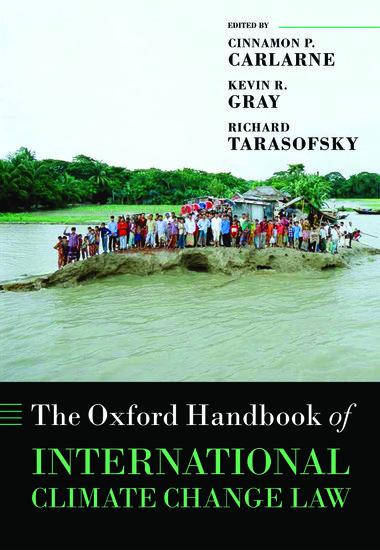
As the threats posed by changing weather patterns are becoming more apparent, climate change law has emerged as an important area of law in its own right. This Handbook provides a comprehensive understanding of this growing subject, setting out the key institutions and processes, and featuring interdisciplinary insights from leading experts.
Climate change presents one of the greatest challenges of our time, and has become one of the defining issues of the twenty-first century. The radical changes which both developed and developing countries will need to make, in economic and in legal terms, to respond to climate change are unprecedented. International law, including treaty regimes, institutions, and customary international law, needs to address the myriad challenges and consequences of climate change, including variations in the weather patterns, sea level rise, and the resulting migration of peoples.
The Oxford Handbook of International Climate Change Law provides an unprecedented and authoritative overview of all aspects of international climate change law as it currently stands, with guidance for how it should develop in the future. Over forty leading scholars and practitioners set out a comprehensive understanding of the legal issues that surround this vitally important but still emerging area of international law. This book addresses the major legal dimensions of the problems caused by climate change: not only in the content and nature of the international legal frameworks, which need implementation at the national level, but also the development of carbon trading systems as a means of reducing the costs of meeting emission reduction targets. After an introduction to the field, the Handbook assesses the relevant institutions, the key applicable principles of international law, the international mitigation regime and its consequences, and climate change litigation, before providing perspectives focused upon specific countries or regions.
The Handbook will be an invaluable resource for scholars, students, and practitioners of international climate change law. It provides readers with diverse perspectives, bringing together interpretations from different disciplines, countries, and cultures.
Inhaltsverzeichnis
- Part I - Introduction
- 1: Cinnamon P. Carlarne, Kevin R. Gray and Richard G. Tarasofsky: International Climate Change Law - Mapping the Field
- 2: Alan Boyle and Navraj Singh Ghaleigh: Climate Change and International Law beyond the UNFCCC
- 3: Navraj Singh Ghaleigh: Science and Climate Change Law - The Role of the IPPC in International Decision-Making
- 4: Navraj Singh Ghaleigh: Economics and International Climate Change Law
- Part II - Institutional
- 5: David Freestone: The United Nations Framework Convention on Climate Change - The Basis for the Climate Change Regime
- 6: Sebastian Oberthür: Compliance under the Evolving Climate Regime
- 7: Alexander Thompson: The Global Regime for Climate Finance: Political and Legal Challenges
- Part III - Climate Change - Principles and Emerging Norms Concepts in International Law
- 8: Jonathan B. Wiener: Precaution and Climate Change
- 9: Catherine Redgwell: Principles and Emerging Norms in International Law - Intra- and Inter-generational Equity
- 10: Friedrich Soltau: Common Concern of Humankind
- 11: John H. Knox: Human Rights Principles and Climate Change
- Part IV - Setting Up the International Mitigation Regime: Contents and Consequences
- 12: Shi-Ling Hsu: International Market Mechanisms
- 13: Michael A. Mehling: Legal Frameworks for Linking National Emissions Trading Systems
- 14: Andrew Shoyer, Jung-ui Sul and Colette van der Ven: Carbon Leakage and the Migration of Private CO2 Emitters to other Jurisdictions
- 15: Francesco Sindico: National Measures and WTO Consistency - Border Measures and other Instruments to Prevent Carbon Leakage and Level the Carbon Playing Field
- 16: Harro van Asselt: The Design and Implementation of Greenhouse Gas Emmissions Trading
- 17: Martijn Wilder Am and Lauren Drake: International Law and the Renewable Energy Sector
- 18: Joshua D. Sarnoff: Intellectual Property and Climate Change, with an Emphasis on Patents and Technology Transfer
- Part V - Climate Change Litigation
- 19: Roda Verheyen and Cathrin Zengerling: International Dispute Settlement
- 20: Timothy Meyer: Institutions and Expertise: The Role of Science in Climate Change Lawmaking
- 21: Christina Voigt: Climate Change and Damages
- 22: Philippe Cullet: Human Rights and Climate Change - Broadening the Right to Environment
- Part VI - Living with Climate Change and Climate Change Adaptation Measures
- 23: Jane McAdam: Climate Change-related Displacement of Persons
- 24: Josh Eagle and U. Rashid Sumaila: Climate, Oceans, and the Law of Special and General Adaptation
- 25: Charlotte Streck and Darragh Conway: Forestry and Agriculture under the UNFCCC: A Jigsaw Waiting to be Assembled?
- 26: Daniel Farber: Climate Change and Disaster Law
- Part VII - Regional and Country-Specific Perspectives
- 27: Michael B. Gerrard: United States Climate Change Law
- 28: Alex L. Wang: Climate Change Policy and Law in China
- 29: Sanja Bogojevi¿: Climate Change Law and Policy in the European Union
- 30: Deepa Badrinarayana: Climate Change Law and Policy in India
- 31: Anna Korppoo, Max Gutbrod, and Sergei Sitnikov: Russian Law on Climate Change
- 32: Karen Alvarenga de Oliveira: Brazilian Climate Change Law
- 33: Joyeeta Gupta: The Least Developed Countries and Climate Change Law
- 34: Espen Ronneberg: Small Islands and the Big Issue: Climate Change and the Role of the Alliance of Small Island States