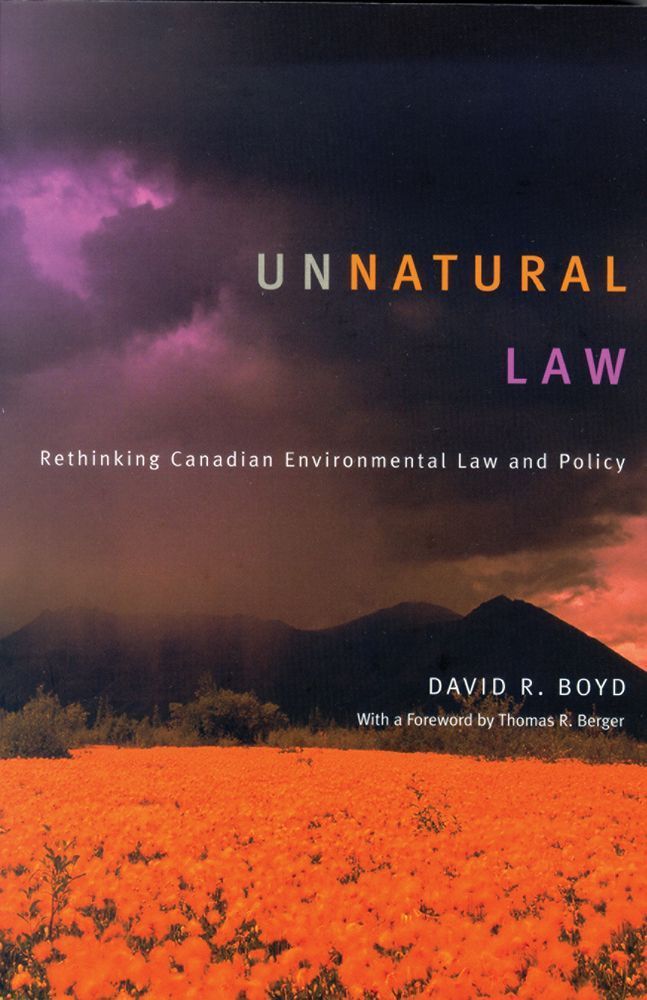
While governments assert that Canada is a world leader in sustainability, Unnatural Law provides extensive evidence to refute this claim. A comprehensive assessment of the strengths and weaknesses of Canadian environmental law, the book provides a balanced, critical examination of Canada's record, focusing on laws and policies intended to protect water, air, land, and biodiversity. Three decades of environmental laws have produced progress in a number of important areas, such as ozone depletion, protected areas, and some kinds of air and water pollution. However, Canada's overall record remains poor. In this vital and timely study, David Boyd explores the reasons why some laws and policies foster progress while others fail. He ultimately concludes that the root cause of environmental degradation in industrialized nations is excessive consumption of resources. Unnatural Law outlines the innovative changes in laws and policies that Canada must implement in order to respond to the ecological imperative of living within the Earth's limits. The struggle for a sustainable future is one of the most daunting challenges facing humanity in the 21st century. Everyone - academics, lawyers, students, policy-makers, and concerned citizens - interested in the health of the Canadian and global environments will find Unnatural Law an invaluable source of information and insight. For more information on Unnatural Law visit David Boyd's site, www. unnaturallaw. com.
Inhaltsverzeichnis
Foreword by Thomas R. Berger, O. C. , Q. C. Preface and AcknowledgmentsAcronymsPart One: Examination1. Canada's Environmental Record2. Water2. 1. Drinking Water2. 2. Water Pollution2. 3. Water Use and Conservation2. 4. Water Exports3. Air3. 1. Ozone Depletion3. 2. Climate Change3. 3. Air Pollution4. Land4. 1. Pesticide Regulation4. 2. Forest Management4. 3. Environmental Assessment5. Biodiversity5. 1. Parks and Protected Areas5. 2. Endangered Species5. 3. Marine BiodiversityPart Two: Diagnosis6. The Strengths and Weaknesses of Canadian Environmental Law and Policy7. Reasons for Environmental Progress8. Systemic Weaknesses9. Obstacles to Further Progress10. Root Causes of Environmental DegradationPart Three: Prescription11. New Directions for Canadian Environmental Law and Policy12. A New Role Model for Canada13. Reducing Consumption14. Population Growth and Sustainable Development15. ConclusionNotesReferencesIndex