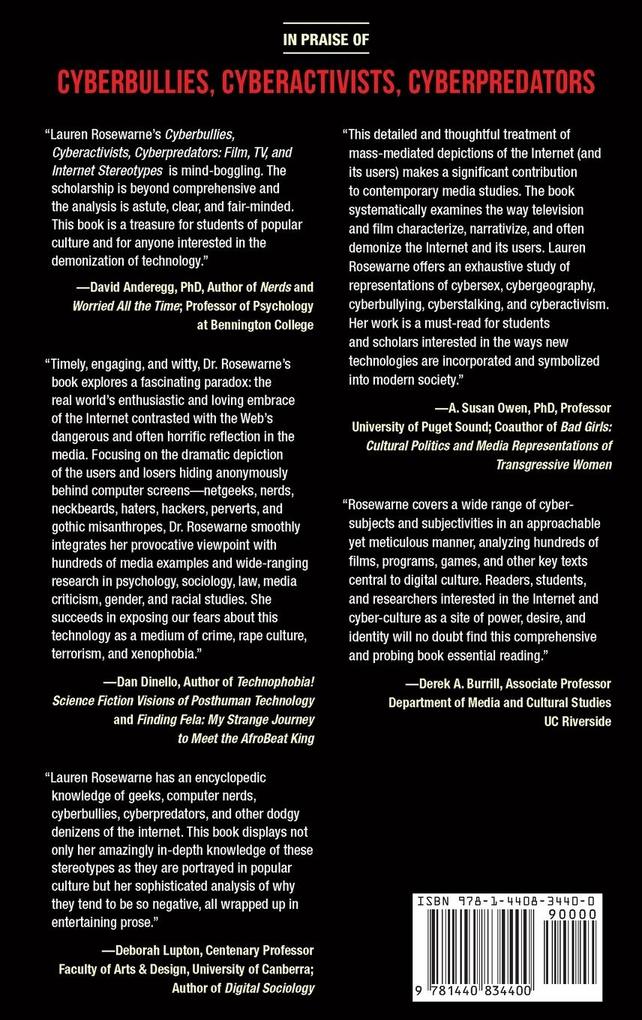
Written by an expert in media, popular culture, gender, and sexuality, this book surveys the common archetypes of Internet users-from geeks, nerds, and gamers to hackers, scammers, and predators-and assesses what these stereotypes reveal about our culture's attitudes regarding gender, technology, intimacy, and identity.
The Internet has enabled an exponentially larger number of people-individuals who are members of numerous and vastly different subgroups-to be exposed to one other. As a result, instead of the simple "jocks versus geeks" paradigm of previous eras, our society now has more detailed stereotypes of the undesirable, the under-the-radar, and the ostracized: cyberpervs, neckbeards, goths, tech nerds, and anyone with a non-heterosexual identity. Each chapter of this book explores a different stereotype of the Internet user, with key themes-such as gender, technophobia, and sexuality-explored with regard to that specific characterization of online users.
Author Lauren Rosewarne, PhD, supplies a highly interdisciplinary perspective that draws on research and theories from a range of fields-psychology, sociology, and communications studies as well as feminist theory, film theory, political science, and philosophy-to analyze what these stereotypes mean in the context of broader social and cultural issues. From cyberbullies to chronically masturbating porn addicts to desperate online-daters, readers will see the paradox in popular culture's message: that while Internet use is universal, actual Internet users are somehow subpar-less desirable, less cool, less friendly-than everybody else.
Inhaltsverzeichnis
Introduction
He's a little strange but he's a genius: The Netgeek
The worse you look the smarter they think you are: The Neckbeard
I only typed words on a computer: The Cyberbully
They prefer to describe themselves as cyberactivists: The Hacker
You can meet creepazoids from all over the world without leaving the comfort of your own home: The Cyberpredator
Billions of dollars have gone into inventing the Internet and filling it with pictures of naked women so we don't have to peep through windows: The Cyberperv
Conclusion
Notes
Bibliography
Media References
Index