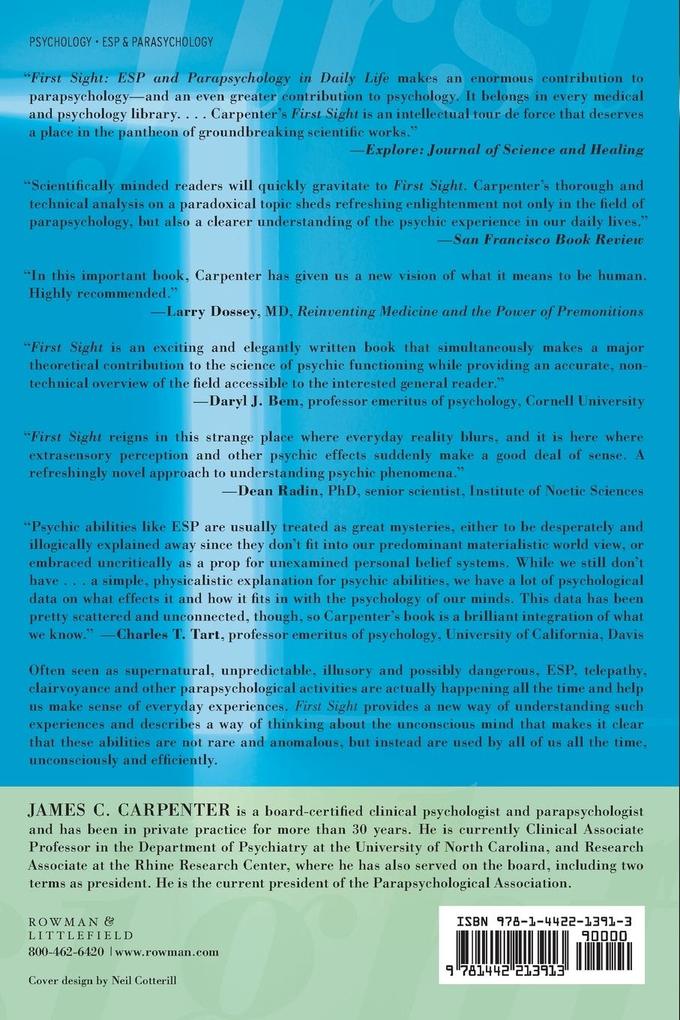
Carpenter offers a new way of looking at ESP, telepathy, clairvoyance, precognition and other parapsychological activities that affect our everyday lives. Often seen as supernatural, anomalous, unpredictable, illusory and possibly dangerous, these activities are shown, instead, to be normal, continuous, lawful, and as real and useful as breathing.
Inhaltsverzeichnis
Preface
Section I: A Point of View
1: A New Conception Guided by Two Analogies
2: A Model and a Theory of Psi
Section II: Elaborations of the Model and the Theory
3: A Model of the Mind and of the Place of Psi in Mental Functioning
4: Psi and Consciousness
5: The Vicissitudes of the Extrasensory: To Be Known or Not to Be Known 59
6: Some Implicit Assumptions That Need to Be Changed
7: Psychokinesis: First Sight and First Act
8: Precursors of the Model
9: A Reiteration of Essential Points
Section III: Psi and Other Preconscious Processes
10: Psi and Ambiguous or Unconscious Sensory Information
11: Psi and Memory: Are the Processes Similar?
12: Psi and Memory: How Do They Affect One Another?
13: Psi and Creativity
Section IV: First Sight and Other Research Findings
14: Fear and Psi
15: Extraversion and Psi
16: Other Individual and Situational Factors
17: Two Vexing Problems: Experimenter Effects and Decline Effects
Section V: First Sight beyond the Laboratory
18: Ordinary Nonpsychic Experience
19: The More Psychic Person
20: First Sight and Personal Exploration of Psi
21: First Sight in the Consulting Room
Section VI: Prospects for Parapsychology
22: Recent Research Pertinent to First Sight
23: Applications of First Sight
24: Suggested Directions for Future Research
25: First Sight, Parapsychology, and Other Branches of Science
26: Psi and a New Science of the Mind
Acknowledgments
References
Index
About the Author