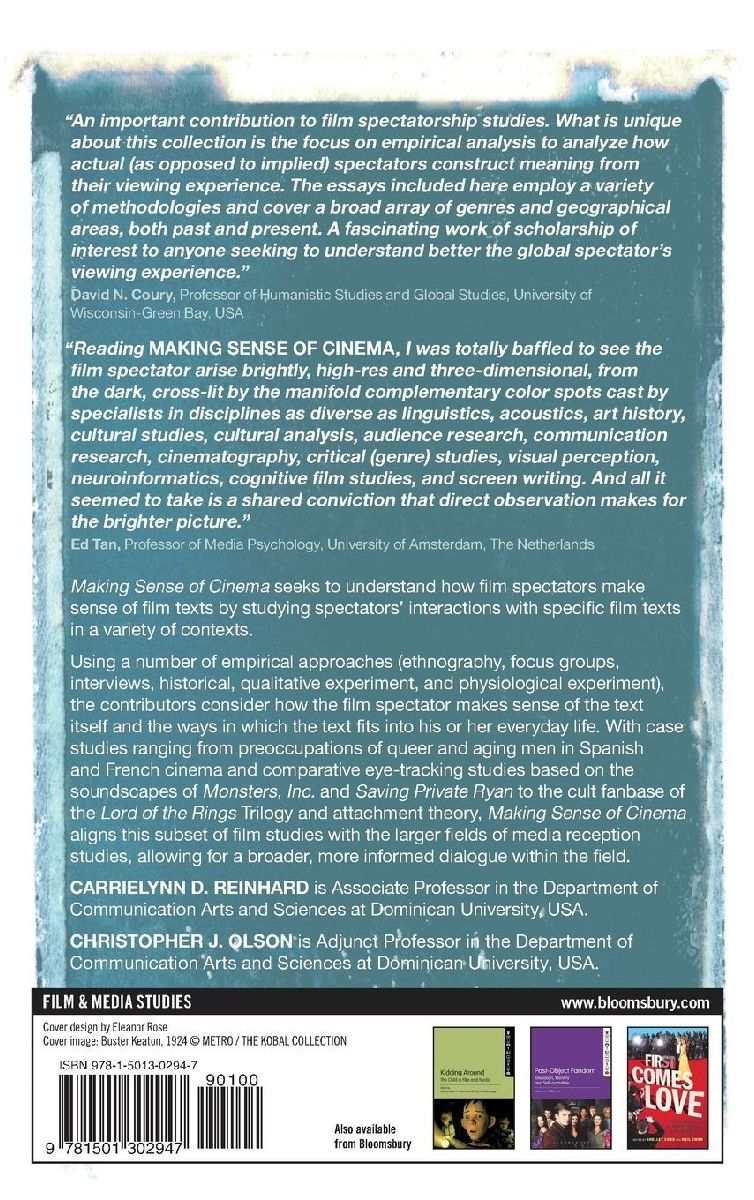
There are a variety of theoretical and methodological approaches to researching how film spectators make sense of film texts, from the film text itself, the psychological traits and sociocultural group memberships of the viewer, or even the location and surroundings of the viewer. However, we can only understand the agency of film spectators in situations of film spectatorship by studying actual spectators' interactions with specific film texts in specific contexts of engagement. Making Sense of Cinema: Empirical Studies into Film Spectators and Spectatorship uses a number of empirical approaches (ethnography, focus groups, interviews, historical, qualitative experiment and physiological experiment) to consider how the film spectator makes sense of the text itself or the ways in which the text fits into his or her everyday life. With case studies ranging from preoccupations of queer and ageing men in Spanish and French cinema and comparative eye-tracking studies based on the two completely different soundscapes of Monsters Inc. and Saving Private Ryan to cult fanbase of the Lord of the Rings Trilogy and attachment theory to its fictional characters, Making Sense of Cinema aligns this subset of film studies with the larger fields of media reception studies, allowing for dialogue with the broader audience and reception studies field.
Inhaltsverzeichnis
List of Figures< BR> < BR> List of Tables< BR> < BR> List of Contributors< BR> < BR> Acknowledgments < BR> < BR> Chapter 1: Introduction: Empirical approaches to film spectators and spectatorship < BR> -CarrieLynn D. Reinhard and Christopher J. Olson< BR> < BR> Chapter 2: Spectatorship in public space: The moving image in public art < BR> -Annie Dell'Aria< BR> < BR> Chapter 3: The festival collective: Cult audience and Japanese Extreme Cinema < BR> -Jessica Hughes < BR> < BR> Chapter 4: Transnational investments: Aging in Les Invisibles (Sébastien Lifshitz, 2013) and its reception < BR> -Darren Waldron< BR> < BR> Chapter 5: Preferred readings and dissociative appropriations: Group discussions following and challenging the tradition of cultural studies< BR> -Alexander Geimer< BR> < BR> Chapter 6: "Legolas, he's cool . and he's hot!": The meanings and implications of audiences' favorite characters < BR> -Martin Barker< BR> < BR> Chapter 7: In search of the child spectator in the late silent era < BR> -Amanda C. Fleming< BR> < BR> Chapter 8: Seeing, sensing sound: Eye tracking soundscapes in Saving Private Ryan and Monsters, Inc. < BR> -Andrea Rassell, Sean Redmond, Jenny Robinson, Jane Stadler, Darrin Verhagen, and Sarah Pink< BR> < BR> Chapter 9: Seeing animated worlds: Eye tracking and the spectator's experience of narrative< BR> -Craig Batty, Adrian Dyer, Claire Perkins, and Jodi Sita< BR> < BR> Chapter 10: Focalization, attachment, and film viewers' responses to film characters: Experimental design with qualitative data collection < BR> -Katalin Bálint and András Bálint Kovács< BR> < BR> Chapter 11: Making sense of the American superhero film: Experiences of entanglement and detachment < BR> -CarrieLynn D. Reinhard< BR> < BR> Chapter 12: Indexing the events of an art film by audiences with different viewing backgrounds < BR> -Sermin Ildirar< BR> < BR> Chapter 13: Exploring the role of narrative contextualization in film interpretation: Issues and challenges for eye tracking methodology < BR> -Thorsten Kluss, John Bateman, Heinz-Peter Preußer and Kerstin Schill< BR> < BR> Chapter 14: Conclusion: A methodological toolbox for film reception studies< BR> -Christopher J. Olson