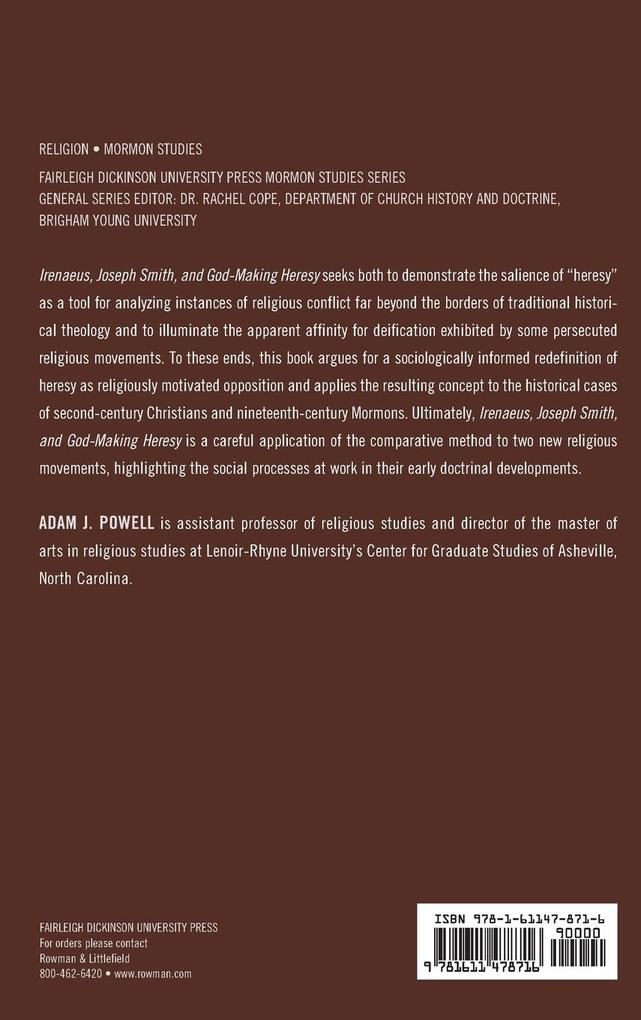
Irenaeus, Joseph Smith, and God-Making Heresy analyzes the relationship between experiences of religious persecution and the development of complex belief systems entailing deification. By examining the histories of early Christians and early Mormons, the study not only highlights social processes at work in the first stages of these new religious movements but also demonstrates the enduring viability of the comparative method for research on religious communities and their beliefs.
Inhaltsverzeichnis
Acknowledgments< BR> Introduction< BR> Approaching Answers< BR> Outline< BR> < BR> Part One< BR> Heresy as Opposition: Debates and DefinitionsAvailable Definitions< BR> Relativity and Heresy< BR> The Ideal Type< BR> Toward a Sociology of Heresy< BR> Heresy and Soteriology: The Process of Interaction< BR> < BR> The Heretical Process: Its Assumptions and PredictionsThe Sociology of Knowledge< BR> Hans Mol's Adaptation/Identity Dialectic< BR> When Position becomes Confession< BR> From Opposition to Salvation< BR> < BR> Part Two< BR> Locating Heresy: The Threefold AttackPagans, Jews, Gnostics, and Rome: The Irenaean Antecedent< BR> Ministers, Mobs, Apostates, and "Gentile" (Protestant) America: The Early Mormon Example< BR> Ferment and Fecundity< BR> < BR> Resolving Heresy: Soteriological SchemasToward Resolution< BR> Order and Salvation< BR> Group and Self in the Soteriological Schema< BR> God, Humanity, Resolution, and Adaptation< BR> < BR> Conclusion: Salvation and Success< BR> God-making Heresy< BR> Finale< BR> < BR> Bibliography< BR> Index< BR> About the Author