






Das eBook.de Hörbuch Abo - jederzeit, überall, für nur 7,95 € monatlich!
Jetzt entdecken
mehr erfahren
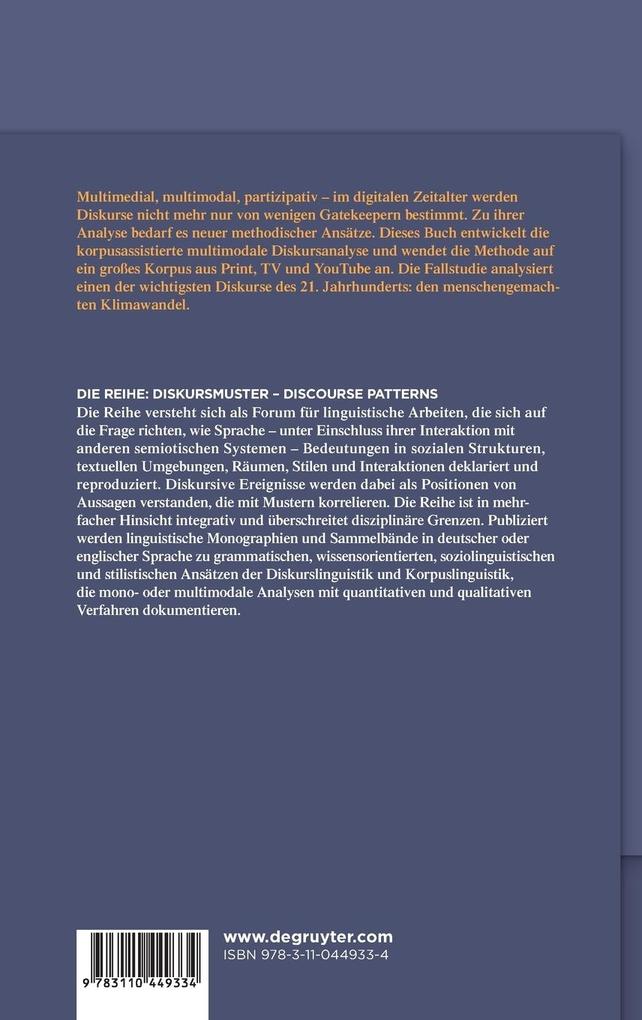
Language in Text and Discourse is an innovative state-of-the-art interdisciplinary series of monographs and edited collections that focus on cutting-edge linguistic studies at the interface between discourse and society including corpus approaches. This series is a forum for studies of language in interaction with other semiotic modes which address the question of how meanings are activated, remade or re-shaped within a variety of contexts and interactions, such as social or textual structures, places, styles, or discursive moments. These are considered to be resources for placemaking or positioning, which correlate and are indexically linked with repetitive semiotic patterns. Verbal and non-verbal positioning as well as conventionalised forms of patterning determine, construe and reflect historically variable concepts of social reality. These are part of a complex network of discursive realities, power relations and voices. The series incorporates studies of social styling and language usage as well as processes of position-ing in a number of different linguistic as well as social, cultural, aesthetic and historical contexts.
By transcending disciplinary boundaries the series is integrative in a number of ways. We will publish linguistic studies written in English or German about grammatical, knowledge-oriented, stylistic and sociolinguistic approaches within the fields of discourse analy-sis or corpus linguistics. These studies com-bine quantitative and qualitative investigations or represent mono- or multi-modal analyses. All submissions will be peer-reviewed.
Editors:
Beatrix Busse, professor of English linguistics, is Vice-rector for teaching and learning at the University of Köln (Germany).
Ingo H. Warnke holds the chair of German linguistics and interdisciplinary linguistics at the University of Bremen (Germany).
Um medienübergreifend geführte komplexe Diskurse im digitalen Zeitalter einer Analyse zugänglich zu machen, benötigt die Diskurswissenschaft neue Methoden. Aufbauend auf Ansätze der Kritischen und der Linguistischen Diskursanalyse entwirft dieses Buch das Programm der korpusassistierten multimodalen Diskursanalyse. Die Methode wird auf eine große Datenmenge - insgesamt sechs Millionen Wörter und über 100 Stunden Videomaterial - von deutschsprachigen Print-, Fernseh- und YouTube-Beiträgen zum anthropogenen Klimawandel angewandt. Mithilfe der Kombination quantitativer und qualitativer Methoden gibt die Arbeit Aufschluss über die historische Entwicklung und die spezifische Dynamik des Diskurses. Dazu werden diskursive Muster mit einem Fokus auf Metaphern/Metonymien, Argumentationsstrukturen und Modalisierung herausgearbeitet. Ein besonderes Interesse gilt der diskursiven Rolle der sogenannten "Klimaskeptiker" und verschiedenen Strategien, den gesellschaftlichen Konsens zu unterlaufen. Das Buch versteht sich somit nicht nur als Beitrag zur linguistischen und interdisziplinären Diskursforschung, sondern ist auch für Forschende und Studierende in den Bereichen Klimakommunikation und Wissenschaftskommunikation relevant.
Es wurden noch keine Bewertungen abgegeben. Schreiben Sie die erste Bewertung zu "Klimawandel im Diskurs" und helfen Sie damit anderen bei der Kaufentscheidung.