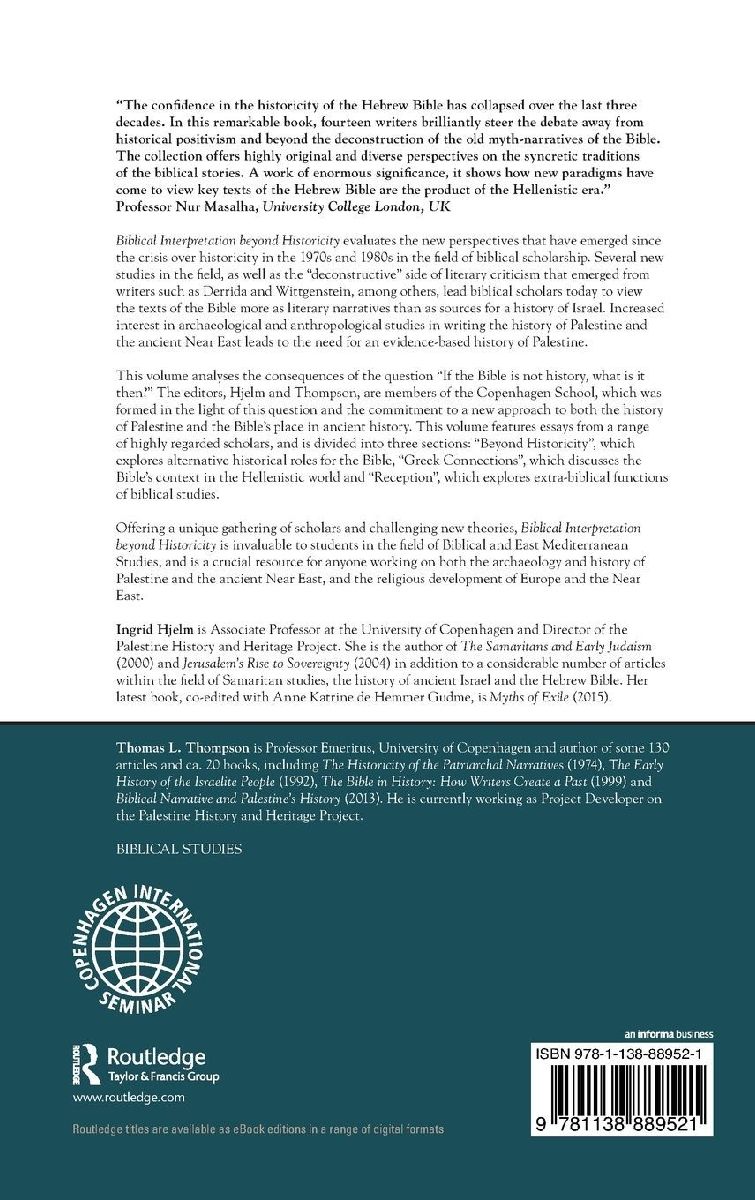
Biblical Interpretation beyond Historicity evaluates the new perspectives that have emerged since the crisis over historicity in the 1970s and 80s in the field of biblical scholarship. This volume analyses the consequences of the question: "If the Bible is not history, what is it then?" and features essays from a range of highly regarded scholars. Offering a unique gathering of scholars and challenging new theories, this book is invaluable to students in the field of Biblical and East Mediterranean Studies, and is a crucial resource for anyone working on both the archaeology and history of Palestine and the ancient Near East, and the religious development of Europe and the Near East.
Inhaltsverzeichnis
Introduction
Part I: Beyond Historicity
- A New 'Biblical Archaeology'
Philip R. Davies
- Old and New Ways of Interpreting Isaiah 40-55
Frederik Poulsen
- Sociolinguistic Perspectives on the Hebrew Bible as Memory Work: Seeing Redactional Work as Entextualization
Trine Bjørnung Hasselbach
Part II: Greek Connections
- Is the Old Testament Still a Hellenistic Book?
Niels Peter Lemche
- From Plato to Moses: Genesis-Kings as a Platonic Epic
Philippe Wajdenbaum
- Greek Genres and the Hebrew Bible
Russel Gmirkin
- When the Septuagint Came in from the Cold
Mogens Müller
Part III: Reception
- Of Qumran, the Canon and the History of the Bible Text
Fred Cryer
- Deconstructing the Continuity of Qumran Ib and II with Implications for Stabilizing the Biblical Texts
Gregory Doudna
- Canon Formation, Canonicity and the Qumran library
Jesper Høgenhaven
- New Children of Abraham in Greenland-The Creation of a Nation
Flemming A. J. Nielsen
- Whose Mythic, Rhythmic, Theological and Cultural Memory is it Anyway?
Jim West