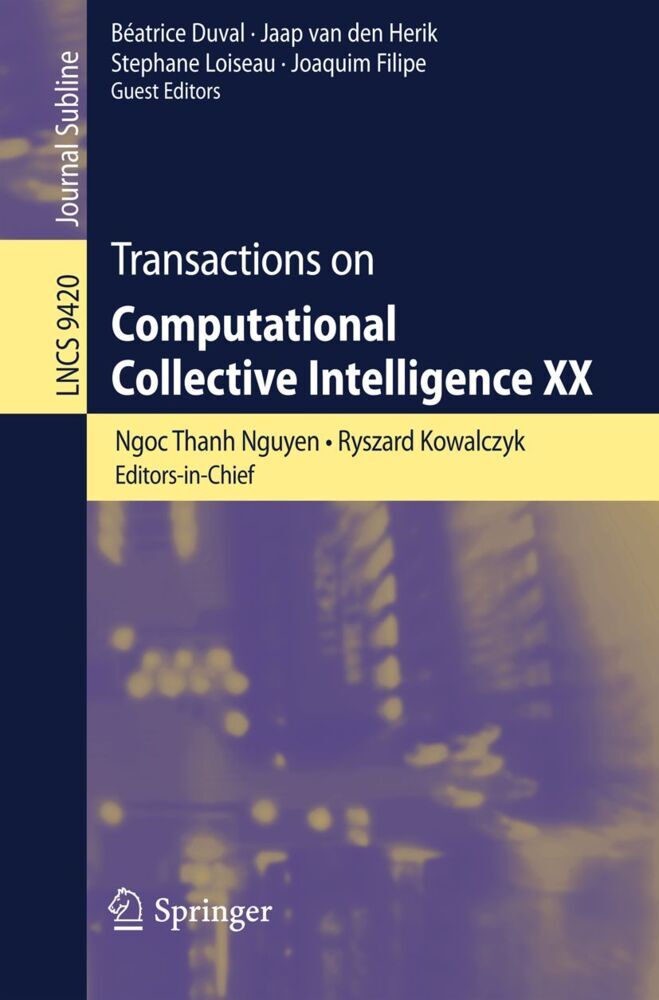
These transactions publishresearch in computer-based methods of computational collective intelligence(CCI) and their applications in a wide range of fields such as the semanticWeb, social networks, and multi-agent systems. TCCI strives to cover newmethodological, theoretical and practical aspects of CCI understood as the formof intelligence that emerges from the collaboration and competition of manyindividuals (artificial and/or natural). The application of multiplecomputational intelligence technologies, such as fuzzy systems, evolutionarycomputation, neural systems, consensus theory, etc. , aims to support human andother collective intelligence and to create new forms of CCI in natural and/orartificial systems. This twentieth issue contains 11 carefully selected andrevised contributions.
Inhaltsverzeichnis
Developing
Embodied Agents for Education Applications with Accurate Synchronization of
Gesture and Speech. - Abstraction of Heterogeneous Supplier Models in
Hierarchical Resource Allocation. - Shape Recognition through Tactile Contour
Tracing - a simulation study. - Real-time tear film classification through
cost-based feature selection. - Scalarized and Pareto Knowledge Gradient for
Multi-objective Multi-armed Bandits. - Extensibility Based Multiagent Planner
with Plan Diversity Metrics. - Concurrent and Distributed Shortest-Path Searches
in Multiagent-based Transport Systems. - SAJaS: Enabling JADE-based Simulations. -
Strategic Negotiation and Trust in Diplomacy -The DipBlue Approach. - Overcoming
Limited Onboard Sensing in Swarm. - A Question of Balance: The Benefits of
Pattern-Recognition when Solving Problems in a Complex Domain.