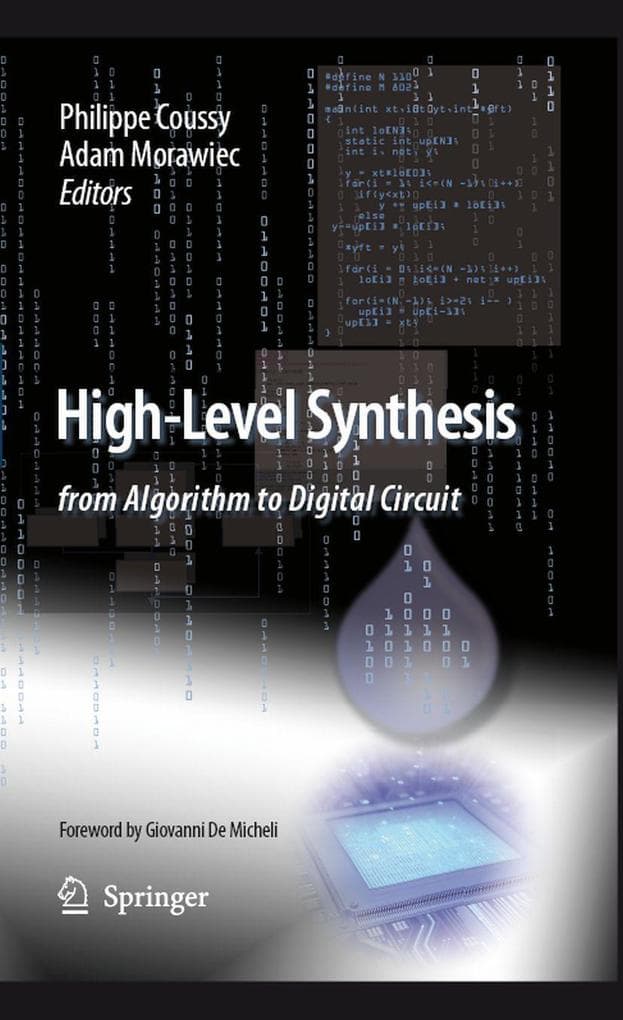
Research on high-level synthesis started over twenty years ago, but lower-level tools were not available to seriously support the insertion of high-level synthesis into the mainstream design methodology. Since then, substantial progress has been made in formulating and understanding the basic concepts in high-level synthesis. Although many open problems remain, high-level synthesis has matured.
High-Level Synthesis: Introduction to Chip and System Design presents a summary of the basic concepts and results and defines the remaining open problems. This is the first textbook on high-level synthesis and includes the basic concepts, the main algorithms used in high-level synthesis and a discussion of the requirements and essential issues for high-level synthesis systems and environments. A reference text like this will allow the high-level synthesis community to grow and prosper in the future.
Inhaltsverzeichnis
1 Introduction. - 1. 1 The Need for Design Automation on Higher Abstraction Levels. - 1. 2 Levels of Abstraction. - 1. 3 Definition of Synthesis. - 1. 4 Languages, Designs and Technologies. - 1. 5 Essential Issues in Synthesis. - 1. 6 Status and Future of High-Level Synthesis. - 1. 7 Summary. - 1. 8 Exercises. - 2 Architectural Models in Synthesis. - 2. 1 Design Styles and Target Architectures. - 2. 2 Combinatorial Logic. - 2. 3 Finite State Machines. - 2. 4 Finite State Machine with a Datapath. - 2. 5 System Architecture. - 2. 6 Engineering Considerations. - 2. 7 Summary and Future Directions. - 2. 8 Exercises. - 3 Quality Measures. - 3. 1 Introduction. - 3. 2 The Relationship between Structural and Physical Designs. - 3. 3 Area Measures. - 3. 4 Performance Measures. - 3. 5 Other Measures. - 3. 6 Summary and Future Directions. - 3. 7 Exercises. - 4 Design Description Languages. - 4. 1 Introduction to HDLs. - 4. 2 Language Models vs. Architectural Styles. - 4. 3 Programming Language Features for HDLs. - 4. 4 Hardware-Specific HDL Features. - 4. 5 HDL Formats. - 4. 6 A Discussion of Some HDLs. - 4. 7 Matching Languages to Target Architectures. - 4. 8 Modeling Guidelines for HDLs. - 4. 9 Summary and Future Directions. - 4. 10 Exercises. - 5 Design Representation and Transformations. - 5. 1 Introduction. - 5. 2 Design Flow in High-Level Synthesis: An Example. - 5. 3 HDL Compilation. - 5. 4 Representation of HDL Behavior. - 5. 5 Representation of HLS Outputs. - 5. 6 Design Views and Complete Representation Schemes for High- Level Synthesis. - 5. 7 Transformations. - 5. 8 Summary and Future Directions. - 5. 9 Exercises. - 6 Partitioning. - 6. 1 Introduction. - 6. 2 Basic Partitioning Methods. - 6. 3 Partitioning in High-Level Synthesis. - 6. 4 Summary and Future Directions. - 6. 5 Exercises. - 7 Scheduling. - 7. 1 Problem Definition. - 7. 2 Basic Scheduling Algorithms. - 7. 3 Scheduling with Relaxed Assumptions. - 7. 4 Other Scheduling Formulations. - 7. 5 Summary and Future Directions. - 7. 6 Exercises. - 8 Allocation. - 8. 1 Problem Definition. - 8. 2 Datapath Architectures. - 8. 3 Allocation Tasks. - 8. 4 Greedy Constructive Approaches. - 8. 5 Decomposition Approaches. - 8. 6 Iterative Refinement Approach. - 8. 7 Summary and Future Directions. - 8. 8 Exercises. - 9 Design Methodology for High-Level Synthesis. - 9. 1 Basic Concepts in Design Methodology. - 9. 2 Generic Synthesis System. - 9. 3 System Synthesis. - 9. 4 Chip Synthesis. - 9. 5 Logic and Sequential Synthesis. - 9. 6 Physical-Design Methodology. - 9. 7 System Database. - 9. 8 Component Database. - 9. 9 Conceptualization environment. - 9. 10 Summary and Further Research. - 9. 11 Exercises.