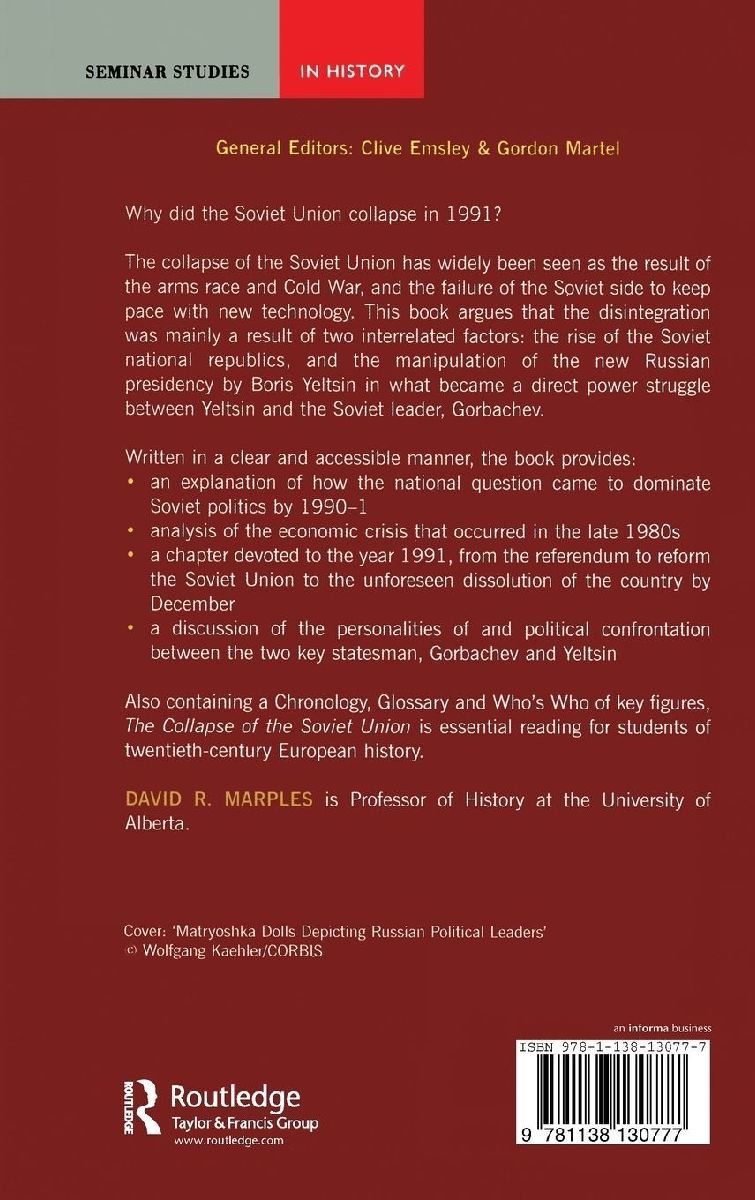
The collapse of the Soviet experiment was one of the major turning points in twentieth century history. During the period of 'perestroika' the Soviet Union took the first steps to becoming a civil society and started to re-examine it's Stalinist past. This new text examines the Gorbachev years, asks why the Soviet Union collapsed in 1991, and offers a succinct and accessible interpretation of the remarkable events that led to the collapse.
Inhaltsverzeichnis
INTRODUCTION < BR> PART ONE: BACKGROUND< BR> 1. GORBACHEV COMES TO POWER< BR> Political Overview < BR> Glasnost < BR> Social, Environmental, and Nuclear Power Issues < BR> PART TWO: THE YEARS OF PERESTROIKA< BR> 2. THE ECONOMY AND FOREIGN POLICY< BR> The Economy, 1985-90< BR> Acceleration and Anti-Alcohol Campaigns< BR> Coal Miners' Strike< BR> Economic Reform Programmes< BR> Stagnation< BR> The Pavlov Programme < BR> Foreign Policy< BR> Ideology and Propaganda < BR> Arms Control< BR> Architects of Soviet Foreign Policy< BR> Eastern Europe< BR> Ending the Cold War< BR> 3. THE NATIONAL QUESTION < BR> The Submerged Dilemma < BR> Nagorno-Katabakh < BR> The Baltic States < BR> Georgia, Ukraine, and Belarus < BR> The Plenum on National Policy, September 1989 < BR> 4. DOMESTIC POLITICS, 1989-MID-AUGUST 1991 < BR> The Congress of People's Deputies and New Presidency < BR> The 28th Party Congress and Aftermath < BR> The Referendum of 17 March 1991 < BR> Toward a New Union Treaty < BR> 5. THE PUTSCH AND THE COLLAPSE OF THE USSR < BR> The Putsch, 18-21 August 1991 < BR> Administrative Changes < BR> The Failure of the Union Treaty < BR> Yeltsin Consolidates His Power < BR> The Belavezha Agreement < BR> PART THREE: ASSESSMENT< BR> 6. WHY DID THE SOVIET UNION COLLAPSE? < BR> PART FOUR: DOCUMENTS< BR> Chronology< BR> Glossary< BR> Who's Who< BR> Guide to Further Reading