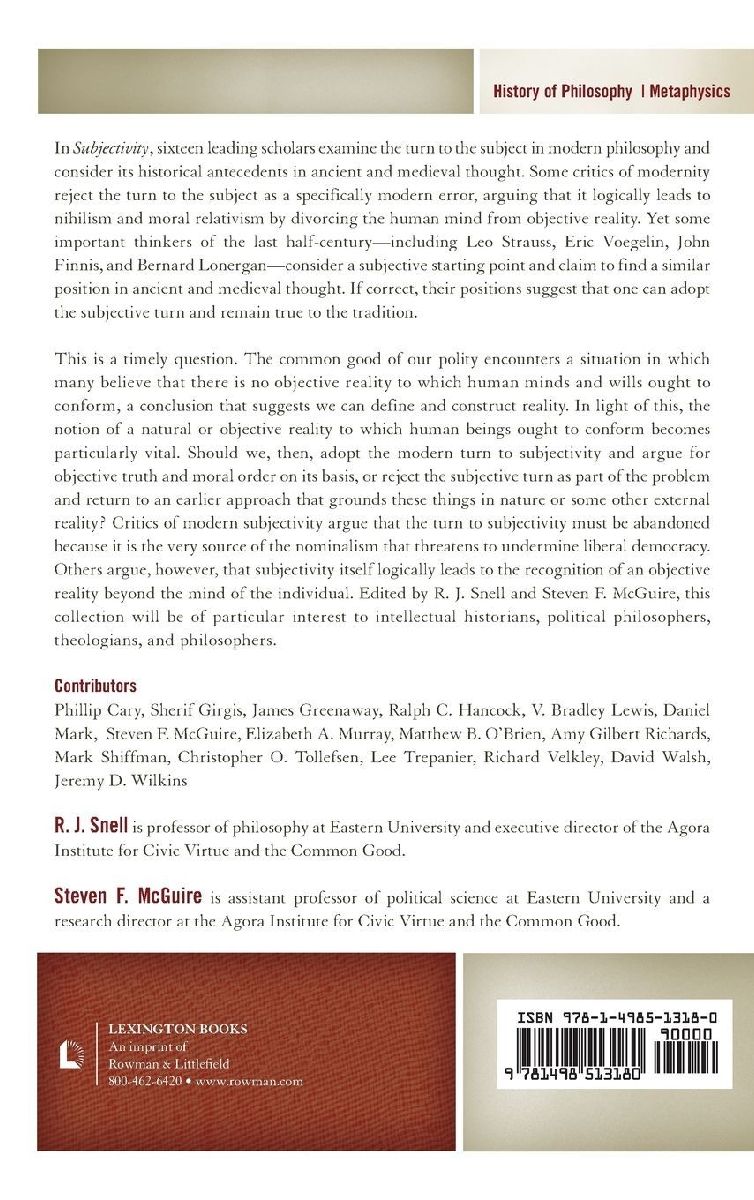
Modern thought is sometimes presented as introducing a "turn to the subject" absent from ancient and medieval thought, although the schools of thought associated with Bernard Lonergan, Eric Voegelin, Leo Strauss, and the new natural law theory often find subjectivity already operative in the older forms. In this volume, sixteen leading scholars examine the turn to the subject in modern philosophy and consider its historical antecedents in ancient and medieval thought.
Inhaltsverzeichnis
Introduction< BR> < BR> 1. Subjectivity and Metaphysics in Voegelin's Reading of Aristotle< BR> Steven F. McGuire< BR> < BR> Response by Lee Trepanier< BR> < BR> 2. Objectivity as Authentic Subjectivity< BR> Elizabeth A. Murray< BR> < BR> Response by Matthew B. O'Brien< BR> < BR> 3. Subjectivity without Subjectivism: Revisiting the Is/Ought Gap< BR> Sherif Girgis< BR> Response by Mark Shiffman< BR> 4. First and Third Person Standpoints in the New Natural Law Theory< BR> < BR> Christopher O. Tollefsen< BR> < BR> Response by Amy Gilbert Richards< BR> < BR> 5. The Claims of Subjectivity and the Limits of Politics < BR> Ralph C. Hancock< BR> Response by Richard Velkley< BR> 6. The Turn to the Subject as the Turn to the Person< BR> David Walsh< BR> < BR> Response by Phillip Cary< BR> < BR> 7. Personalism and Common Good: Thomistic Political Philosophy and the Turn to Subjectivity< BR> V. Bradley Lewis< BR> < BR> Response by Daniel Mark< BR> < BR> 8. Existential Authority, Belonging, and the Commissioning that is Subjectivity: A Medieval Philosophical Anthropology < BR> James Greenaway< BR> Response by Jeremy D. Wilkins