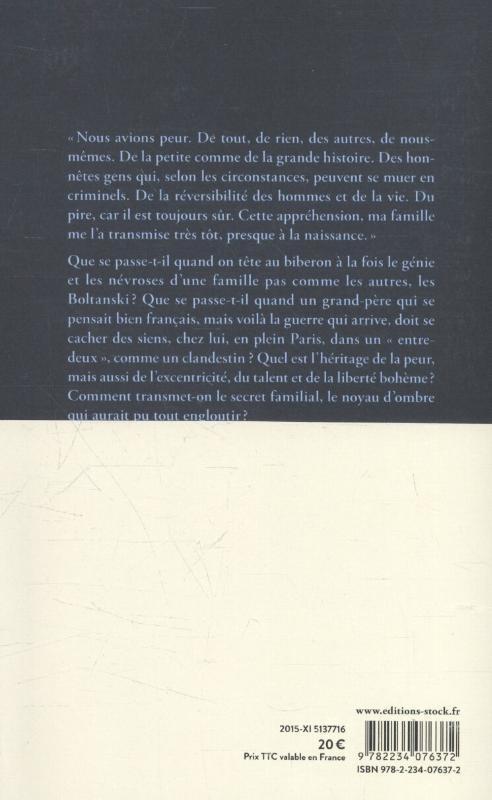
La famille Boltanski, ses artistes, sociologues et romanciers. Une balade dans un logement dévoile des personnages, comme le grand-père. Pendant la Seconde Guerre mondiale, il a vécu deux ans dans une minuscule cachette, contraint à adopter une position ni debout ni couchée. Prix de la rentrée (Forêt des livres 2015), prix Transfuge du meilleur premier roman 2015, prix Femina 2015.
Rights sold to Germany (Hanser)
What's the trade secret of one very different family? In short: weird and wonderful. Who wouldn't want to know? This is the family of the visual artist Christian Boltanski, one of the most famous artists in the world, of the sociologist Luc Boltanski, and of the author himself who carries in him the traces of his heritage: an obsession with privacy and a preference for confinement. First and foremost, this is the story of one man, his grandfather, a Jewish doctor who hid in his home in the heart of Paris during World War 2. In this "in-between" space carved out of the apartment's walls, you could neither stand up nor lie down. It went on for two years. He wouldn't have survived without the iron will and leadership of his wife, "Mother-Grand", a novelist who had had polio as a child. The Bolthole is the story of a family with a hard and eccentric sort of cheerfulness (no point going to school because the teachers are "torturers with degrees"), and a reinvented sense of freedom (the children build towns that encroach on the whole apartment, and dream up a republic crippled by endless coups).
As you venture into successive rooms of the "Rue-de-Grenelle", you meet one character after another and the mystery of the "Bolts" is unveiled.
Christophe Boltanski is a special correspondent for L'Observateur. The Bolthole is his first novel.
"A magnificent Perec-like book." Nouvel Obs
"The incarnate portrait of the Boltanski family, both peculiar and fascinating." Livres Hebdo
"Subtle and precise." Liberation