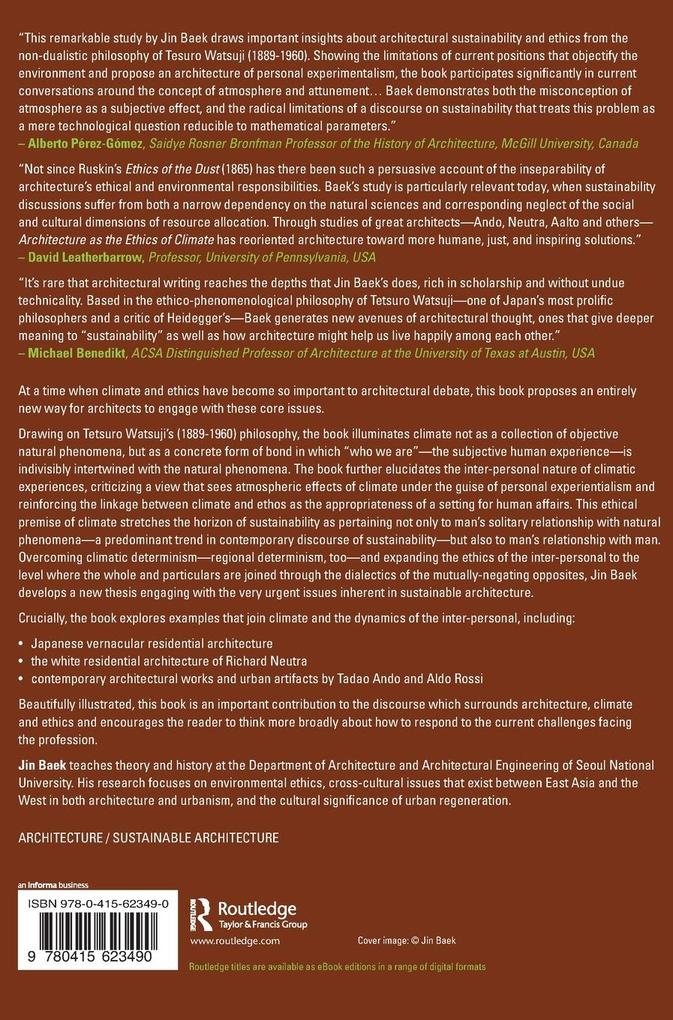
This book explores the notion of climate itself, its relationship with human culture, and its significance to architecture and urbanism by referring to the environmental philosophy of Tetsuro Watsuji, a leading thinker of modern Japan.
Inhaltsverzeichnis
Introduction 1. Tetsuro Watsuji's Notion of Fudo and Its Cultural Significance 1. 1 Beyond Heidegger's Dasein 1. 2 What is Fudo? 1. 3 Ex-sistere and Reflection 1. 4 Beyond Regional Determinism 1. 5 Ethics of the Inter-personal 1. 6 Inter-Fudos and the Subject transcending the Insularity of a Fudo 2. "Self-less Openness" and Fudo: Renewed Sustainable Significance of Japanese Vernacular Architecture 2. 1 Criticism of the Traditional Japanese House 2. 2 Corridor and Individualism 2. 3 The Wall, Fan and the Wind Conduit 2. 4 "Self-less Openness" of Japanese Vernacular Housing 2. 5 Modernity and the Duality between the Inside and Outside 2. 6 Joint Measure and the Spatiality of Japanese Vernacular Housing 2. 7 From Collectivity to Privacy 2. 8 Contemporary Fudo-sensitive House 3. The Ecology of "We" and Ambient Warmth: Richard Neutra's Ecological Architecture 3. 1 Beyond Psychoanalysis and Positivism 3. 2 Coordinated Balance of Different Forces 3. 3 Anchorage and the Coordination of Forces 3. 4 Illumination 3. 5 Warmth and the Inter-personal in Japanese Tradition 3. 6 Facing and the Ecology of "We" 3. 7 Ecos and the Inter-personal 4. Dialectics between the Regional and the Trans-Regional 4. 1 Fudo and Beyond Critical Regionalism 4. 2 Criticism of Regionalism 4. 3 Fudo and the Resuscitation of the Corporeal Efficacy of a Code 4. 4 Fudo and the Dialectics of Opposites 4. 5 Dialectics of Opposites and Human Praxis 4. 6 Beyond Regional Confines 4. 7 The Regional and the Trans-Regional 4. 8 Type and Differences Conclusion Index