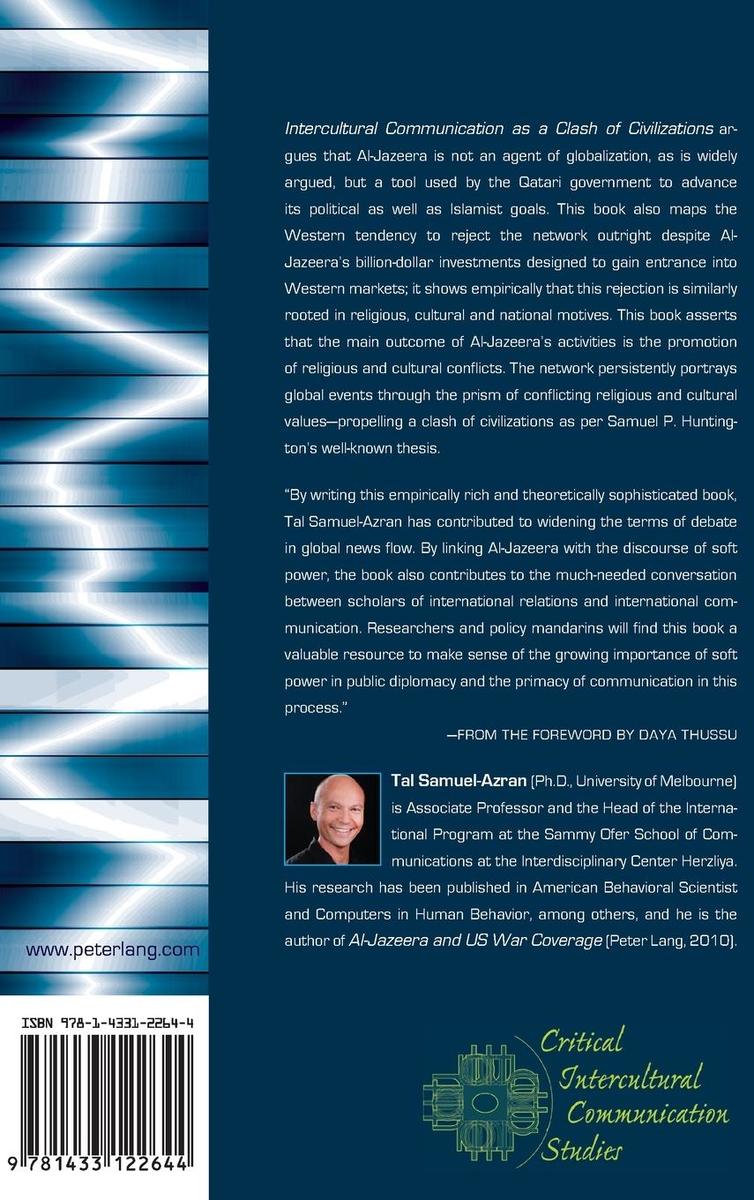
Intercultural Communication as a Clash of Civilizations argues that Al-Jazeera is not an agent of globalization, as is widely argued, but a tool used by the Qatari government to advance its political as well as Islamist goals. This book also maps the Western tendency to reject the network outright despite Al-Jazeera's billion-dollar investments designed to gain entrance into Western markets; it shows empirically that this rejection is similarly rooted in religious, cultural and national motives. This book asserts that the main outcome of Al-Jazeera's activities is the promotion of religious and cultural conflicts. The network persistently portrays global events through the prism of conflicting religious and cultural values - propelling a clash of civilizations as per Samuel P. Huntington's well-known thesis.
Inhaltsverzeichnis
Contents: The Qatar-Al-Jazeera Nexus Qatar Invents the Most Effective Contemporary State-Sponsored Broadcasting Network Qatar s Soft Power: A Macro Perspective Qatar Operates Al-Jazeera as a Smart Power Tool in Its Relationship With Saudi Arabia Al-Jazeeräs Role in Qatar s Race to Become a «Core State» in the Muslim World During the Arab Spring Al-Jazeeräs Obsession With the Clash-of-Civilizations Theory and Its Contribution to Qatar s Core-State Ambition Part II: Al-Jazeeräs Soft Power Strategies in the West Al-Jazeera in the US Al-Jazeeräs Soft Power and Israel Putting It All Together: The Al-Jazeera Effect and What It Means for International and Intercultural Studies.