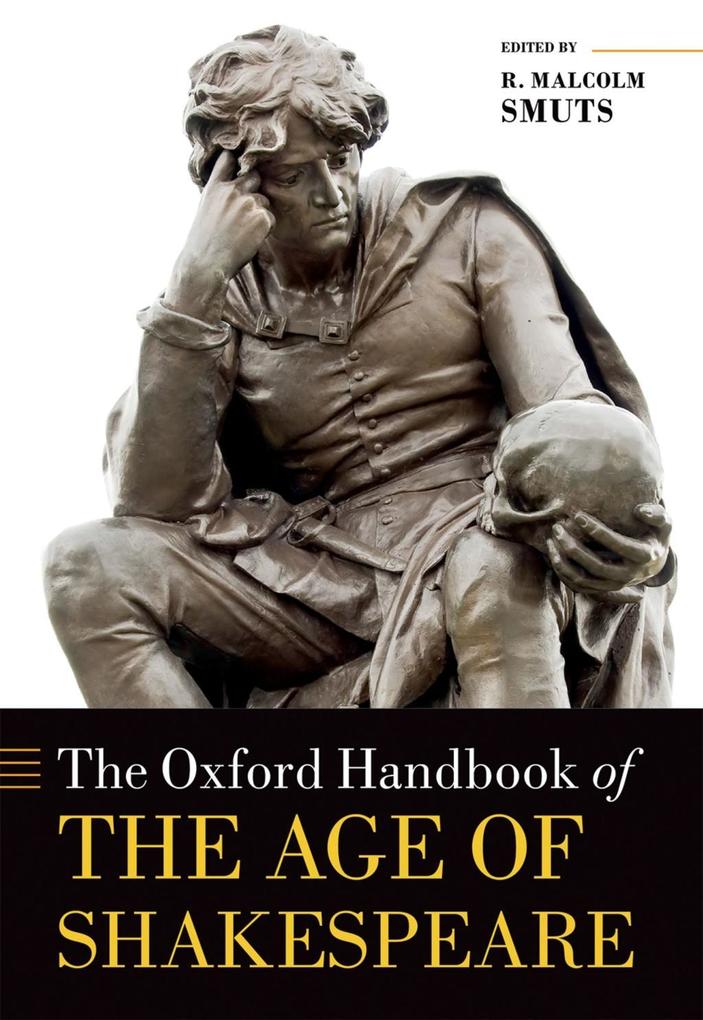
The Oxford Handbook of the Age of Shakespeare presents a broad sampling of current historical scholarship on the period of Shakespeare's career that will assist and stimulate scholars of his poems and plays. Rather than merely attempting to summarize the historical 'background' to Shakespeare, individual chapters seek to exemplify a wide variety of perspectives and methodologies currently used in historical research on the early modern period that can inform close analysis of literature. Different sections examine political history at both the national and local levels; relationships between intellectual culture and the early modern political imagination; relevant aspects of religious and social history; and facets of the histories of architecture, the visual arts, and music. Topics treated include the emergence of an early modern 'public sphere' and its relationship to drama during Shakespeare's lifetime; the role of historical narratives in shaping the period's views on the workings of politics; attitudes about the role of emotion in social life; cultures of honour and shame and the rituals and literary forms through which they found expression; crime and murder; and visual expressions of ideas of moral disorder and natural monstrosity, in printed images as well as garden architecture.
Inhaltsverzeichnis
Malcolm Smuts: Introduction: Reflections on Interdisciplinary Frontiers; Part I: Politics; Norman Jones: William Cecil Lord Burghley and the Management of Elizabeth's England; Paul Hammer: The Earl of Essex; Pauline Croft: Robert Cecil and the Transition from Elizabeth to James I; Malcolm Smuts: James I and the Consolidation of British Monarchy?; David Trim: War, Soldiers and High Politics under Elizabeth I; Rory Rapple: Shakespeare, the Irish and Military Culture; Glyn Parry: Catholicism and Tyranny in Shakespeare's Warwickshire; Dan Beaver: Ancient Liberties, Royal Honour and the Politics of Commonweal in English Forests; Part II: Intellectual Culture and Political Thought and Imagination; Tim Wilks: Poets, Patronage and the Prince's Court; Peter Lake: The Theatre and the 'Post-Reformation Public Sphere'; Peter Mack: Rhetorical Training and the Elizabethan Grammar School; Daniel Woolf and Jane Wong Yeang Chui: English Vernacular Historical Writing and Holinshed's Chronicles; Nicholas Popper: European Historiography in English Political Culture; Paulina Kewes: Roman History, Essex and Late Elizabethan Political Culture; Debora Shuger: Other Republicanisms; Alexandra Gajda: The Gordian Knot of Policy: Statecraft and the Prudent Prince; Curtis Perry: Seneca and English Political Culture; Arthur Williamson: David Hume, Richard Verstegan and the Battle for Britain; Brendan Kane and Malcolm Smuts: The Politics of Race in England, Scotland and Ireland; Part III: Aspects of Religious Culture; Katy Gibbons: English Catholics and the Continent; Naomi Tadmor: The Bible in English Culture: The Age of Shakespeare; Ethan Shagan: Religious Nonconformity and the Quality of Mercy: The Merchant of Venice in Reformation Context; Tom Webster: Protestantism and the Devil; Part IV: Social Beliefs and Practices; Linda Pollock: The Affective Life in Shakespearean England; Richard Cust: Chivalry and the English Gentleman; Alan Bryson: Elizabethan Verse Libel; James Daybell: Gender, Writing Technologies and Early Modern Epistolary Communications; Brian Weiser: The Shamings of Falstaff; Susan D. Amussen: Cuckold's Haven: Gender Inversion in Popular Culture; K. J. Kesselring: Murder's Crimson Badge': Homicide in the Age of Shakespeare; Alastair Bellany: Thinking with Poison; Paul Griffiths: Criminal London: Fear and Danger in Shakespeare's City; Vanessa Harding: Families and Households in Early Modern London; Christopher Highley: Theatre, Church and Neighbourhood in Early Modern Blackfriars; Roze Hentschell: The Cultural Geography of St Paul's Precinct; Part V: Visual Culture and Music; Robert Tittler: Art and Architecture in Provincial England; Luke Morgan: Garden Design and Experience in Shakespeare's England; Elizabeth Goldring: Art Collecting and Patronage in Shakespeare's England; Helen Pierce: Graphic Satire and the Printed Image in Shakespeare's England; Ross Duffin: Music and the Stage in the Time of Shakespeare