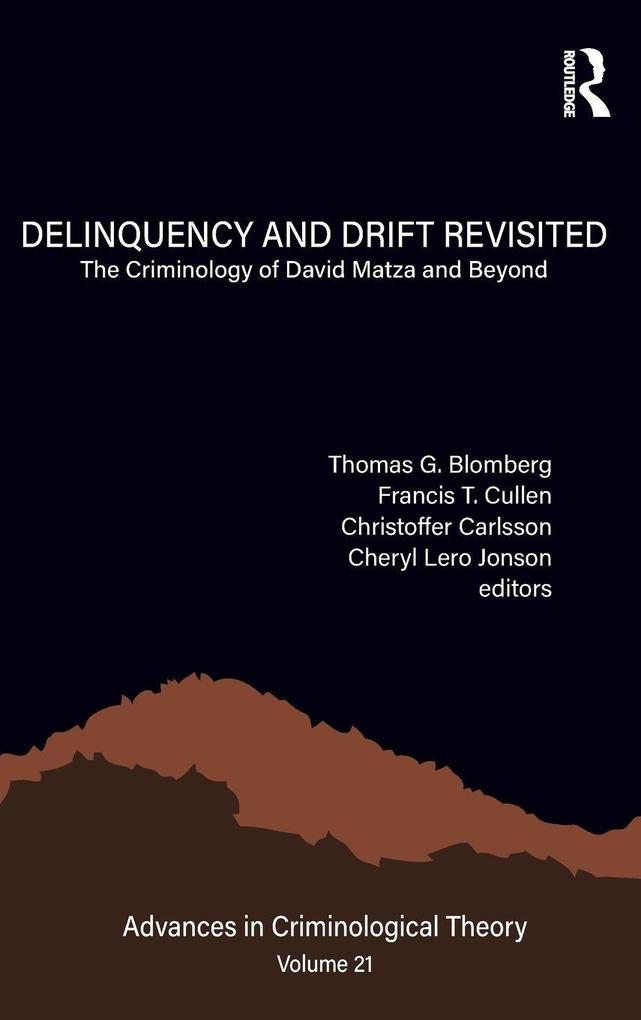
Fifty years ago, David Matza wrote Delinquency and Drift, challenging the ways people thought about the development of criminals. Today, Delinquency and Drift Revisited reminds criminologists that they ignore Matza's writings on culture and criminality, human agency and offending, and propensity and peer influences on criminal involvement at their own intellectual peril. This volume was not written to pay homage to Matza, but to show how his ideas remain relevant to criminology today by continuing to question conventional wisdom, by making us pay attention to realities we have overlooked, and by inspiring us to theorize more innovatively.
Inhaltsverzeichnis
Contents
Preface
Part I. Origins
1. David Matza-Criminologist: With New Reflections from David Matza
Thomas G. Blomberg
2. Delinquency and Drift: Challenging Criminology Then and Now
Travis C. Pratt
Part II. Techniques of Neutralization
3. Techniques of Neutralization [reprint]
Gresham M. Sykes and David Matza
4. The Current Status of Neutralization Theory
Shadd Maruna and Heith Copes
Part III. Subterranean Values
5. Juvenile Delinquency and Subterranean Values [reprint]
David Matza and Gresham M. Sykes
6. Juvenile Delinquency and Subterranean Values Revisited
Timothy Brezina and Robert Agnew
7. White-Collar Crime and Subterranean Values
Michael L. Benson and Francis T. Cullen
Part IV. Delinquency and Drift
8. Cognitions and Crime: Matza's Ideas in Classic and Contemporary Context
Peggy C. Giordano and Jennifer Copp
9. Drifting Out of Crime: Criminal Careers, Maturational Reform, and Desistance
Christoffer Carlsson
Part V. Becoming Deviant
10. Revisiting Matza's Concepts of Affinity and Affiliation:
Lessons for the Study of Peer Influences in Criminology
Jean Marie McGloin and Kyle J. Thomas
11. Signification: The State as a Source of Crime
Daniel P. Mears and Cheryl Lero Jonson