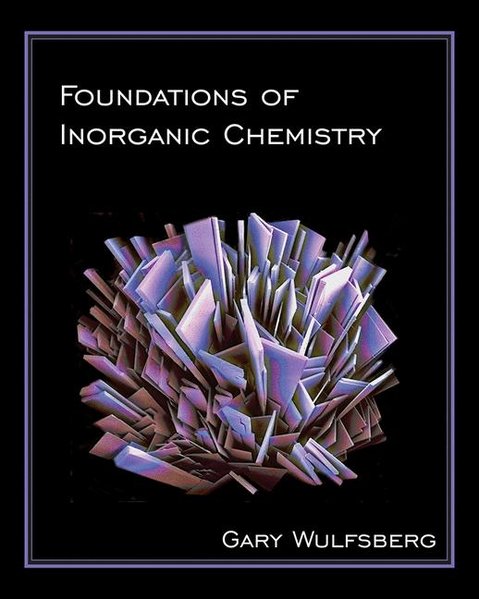
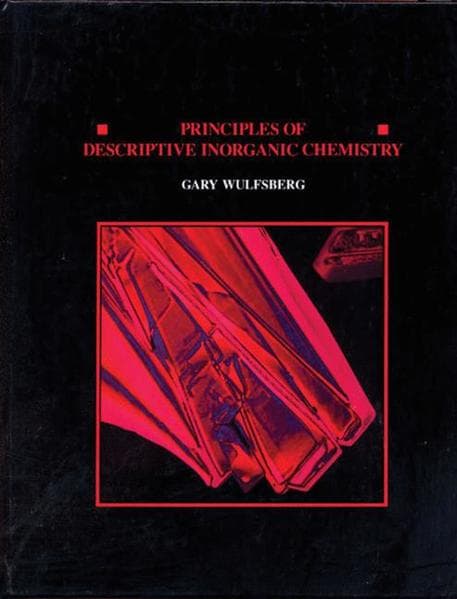
Foundations of Inorganic Chemistry by Gary Wulfsberg is our newest entry into the field of Inorganic Chemistry textbooks, designed uniquely for a one-semester stand alone course, or to be used in a full year inorganic sequence.
Foundations of Inorganic Chemistry by Gary Wulfsberg is our newest entry into the field of Inorganic Chemistry textbooks, designed uniquely for a one-semester stand alone course, or to be used in a full year inorganic sequence. By covering virtually every topic in the test from the 2016 ACS Exams Institute, this book will prepare your students for success. The new book combines careful pedagogy, clear writing, beautifully rendered two-color art, and solved examples, with a broad array of original, chapter-ending exercises. It assumes a background in General Chemistry, but reviews key concepts, and also assumes enrollment in a Foundations of Organic Chemistry course. Symmetry and molecular orbital theory are introduced after the student has developed an understanding of fundamental trends in chemical properties and reactions across the periodic table, which allows MO theory to be more broadly applied in subsequent chapters. Use of this text is expected to increase student enrollment, and build students' appreciation of the central role of inorganic chemistry in any allied field.Key Features:Over 900 end-of-chapter exercises, half answered in the back of the book.Over 180 worked examples.Optional experiments & demos.Clearly cited connections to other areas in chemistry and chemical sciences.Chapter-opening biographical vignettes of noted scientists in Inorganic Chemistry.Optional General Chemistry review sections.Originally rendered two-color illustrations throughout.
Inhaltsverzeichnis
Chapter 1 Periodic Trends in Fundamental Properties of Atoms and Simple Ions
Chapter 2 Monatomic Ions and Their Acid–Base Reactivity
Chapter 3 Polyatomic Ions: Their Structures and Acid–Base Properties
Chapter 4 Ionic Compounds in the Solid State, in Minerals, and in Solution 1
Chapter 5 Trends in Coordination Equilibria
Chapter 6 Principles of Oxidation–Reduction Reactivity
Chapter 7 Introduction to Transition Metal Complexes
Chapter 8 Oxides and Silicates as Materials
Chapter 9 The Underlying Reasons for Periodic Trends
Chapter 10 Symmetry
Chapter 11 Molecular Orbital Theory: A Bridge Between Foundational and Advanced Inorganic Chemistry
Chapter 12 The Elements as Molecules and Materials
Appendix: Answers to Odd-Numbered Exercises
Photo and Figure Credits
Index