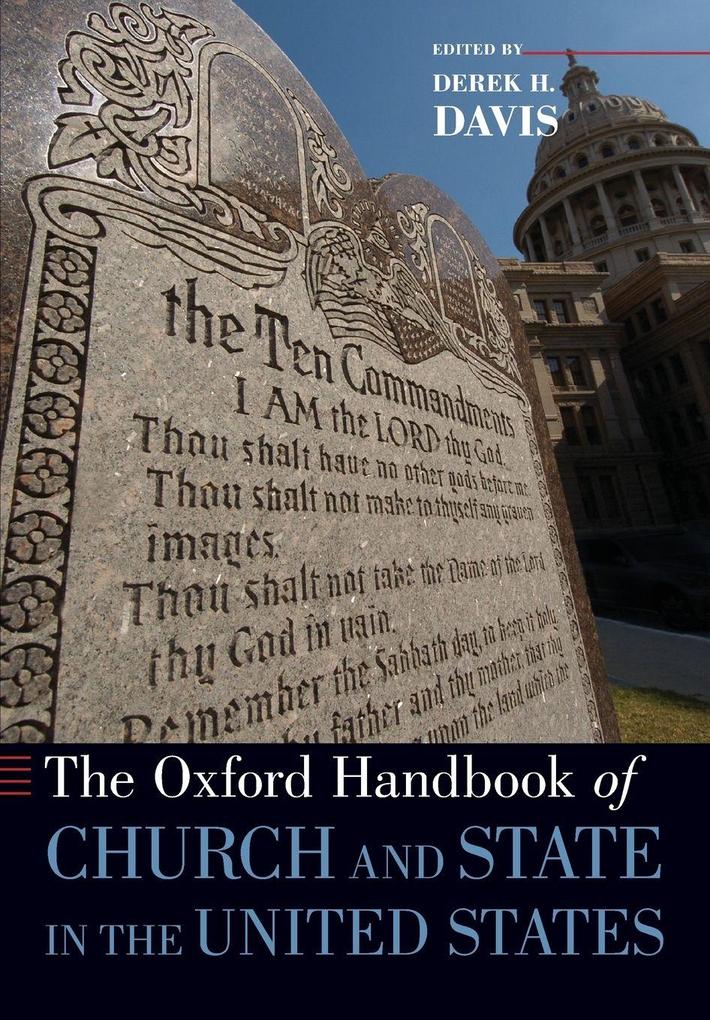
A comprehensive overview of the study of church and state, the twenty-one essays included in this Handbook present a scholarly look at the intricacies and past and current debates that frame the American system of church and state, within five main areas: history, law, theology/philosophy, politics, and sociology. These essays provide factual accounts, but also examine issues, problems, debates, controversies, and, where appropriate, suggest resolutions. They also offer analysis of the range of interpretations of the relationship between church and state offered by various American scholars.
Study of church and state in the United States is incredibly complex. Scholars working in this area have backgrounds in law, religious studies, history, theology, and politics, among other fields. Historically, they have focused on particular angles or dimensions of the church-state relationship, because the field is so vast. The results have mostly been monographs that focus only on narrow cross-sections of the field, and the few works that do aim to give larger perspectives are reference works of factual compendia, which offer little or no analysis.
Inhaltsverzeichnis
- Part One: Introduction
- 1. Religious Pluralism as the Essential Foundation of America's Quest for Unity and Order, Derek H. Davis
- Part Two: Historical Dimensions
- 2. The Founding Era (1774-1797) and the Constitutional Provision for Religion, John F. Wilson
- 3. Eighteenth-Century Religious Liberty: The Founding Generation's Protestant-Derived Understanding, Barry Alan Shain
- 4. Church and State in Nineteenth-Century America, Steven K. Green
- 5. Religious Advocacy by American Religious Institutions: A History, Melissa Rogers
- Part Three: Constitutional Dimensions
- 6. Constitutional Language and Judicial Interpretations of the Free Exercise Clause, Bette Novitt Evans
- 7. The U.S. Supreme Court and Non-First Amendment Religion Cases, Ronald B. Flowers
- 8. The Meaning of the Separation of Church and State: Competing Views, Daniel L. Dreisbach
- 9. Managed Pluralism: The Emerging Church-State Model in the United States? Nicholas Gvosdev
- Part Four: Theological and Philosophical Dimensions
- 10. Religious Liberty and Religious Minorities in the United States, Elizabeth A. Sewell
- 11. Religious Symbols and Religious Expression in the Public Square, T. Jeremy Gunn
- 12. Religious Liberty as a Democratic Institution, Ted G. Jelen
- 13. Pursuit of the Moral Good and the Church-State Conundrum in the United States: The Politics of Sexual Orientation beyond Lawrence, Andrew R. Murphy and Caitlin Kerr
- Part Five: Political Dimensions
- 14. Monitoring and Surveillance of Religious Groups in the United States, James T. Richardson and Thomas Robbins
- 15. The U.S. Congress: Protecting and Accommodating Religion, Allen D. Hertzke
- 16. The Christian Right and Church-State Issues, Clyde Wilcox and Sam Potolicchio
- 17. American Religious Liberty in International Perspective, John Witte, Jr.
- Part Six: Sociological Dimensions
- 18. Supply-Side Changes in American Religion: Exploring the Implications of Church-State Relations, Roger Finke
- 19. Peeking through Jefferson's Wall: A Sociological Assessment of U.S. Church-State Relations, N.J. Demerath, III
- 20. The Role of Civil Religion in American Society, Richard V. Pierard
- Part Seven: Conclusion
- 21. The Interplay of Law, Religion, and Politics in the United States, Derek H. Davis