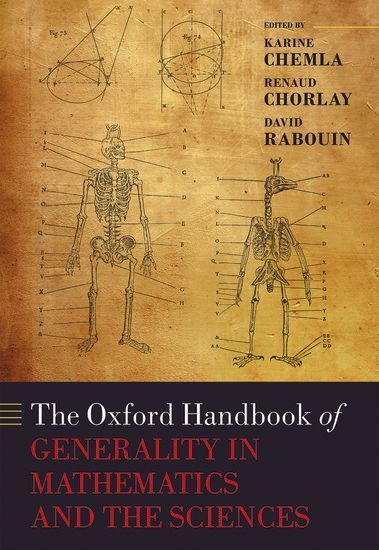
This collection of original essays aims to inquire into the diversity of Generality. Through case studies taken from the history of mathematics, physics and the life sciences, the book provides evidence of different ways of understanding the general in various contexts.
Generality is a key value in scientific discourses and practices. Throughout history, it has received a variety of meanings and of uses. This collection of original essays aims to inquire into this diversity. Through case studies taken from the history of mathematics, physics and the life sciences, the book provides evidence of different ways of understanding the general in various contexts. It aims at showing how collectives have valued generality and how they have worked with specific types of "general" entities, procedures, and arguments.
The books connects history and philosophy of mathematics and the sciences at the intersection of two of the most fruitful contemporary lines of research: historical epistemology, in which values (e.g. "objectivity", "accuracy") are studied from a historical viewpoint; and the philosophy of scientific practice, in which conceptual developments are seen as embedded in networks of social, instrumental, and textual practices. Each chapter provides a self-contained case-study, with a clear exposition of the scientific content at stake. The collection covers a wide range of scientific domains - with an emphasis on mathematics - and historical periods. It thus allows a comparative perspective which suggests a non-linear pattern for a history of generality. The introductory chapter spells out the key issues and points to the connections between the chapters.
Inhaltsverzeichnis
- 1: Karine Chemla, Renaud Chorlay, David Rabouin: Prologue: Generality as a Component of an Epistemological Culture
- Part I: The Meaning of Value of Generality
- 2: Karine Chemla: The Value of Generality in Michel Chasles's Historiography of Geometry
- 3: Eberhard Knobloch: Generality in Leibniz's Mathematics
- 4: David Rabouin: The Problem of a "General" Theory in Mathematics: Aristotle and Euclid
- 5: Igor Ly: Generality and Generalization in Poincaré's Philosophy
- Part II: Statements and Concepts: The Formulation of the General
- 6: Anne Robadey: Elaboration of a Statement on the Degree of Generality of a Property: Poincaré's Work on Recurrence Theorem
- 7: Frédéric Jaëck: Structures in Functional Analysis and Generality in Banach's Ph.D. Dissertation
- 8: Yves Cambefort: How General are Genera? The Genus in Systematic Zoology
- 9: Stéphane Schmitt: Homology: An Expression of Generality in the Life Sciences
- 10: Tatiana Roque: Different Notions of Genericity in the Classification Problem of Dynamical Systems
- Part III: Practices of Generality
- 11: Emily Grosholz: Leibnizian Analysis, Canonical Objects, and Generlization
- 12: Olivier Darrigol: Models, Structure and the Generality in Clerk Maxwell's Theory of Electromagnetism
- 13: Jean-Gaël Barbara: Biological Generality: General Anatomy from Xavier Bichat to Louis Ranvier
- 14: Renaud Chorlay: Questions of Generality as Probes into Nineteenth Century Analysis
- 15: Evelyne Barbin: Universality versus Generality: An Interpretation of the Dispute over Tangents between Descartes and Fermat
- 16: Frédéric Brechenmacher: Algebraic Generality versus Arithmetic Generality in the Controversy between C. Jordan and L. Kronecker (1874)
- 17: Evelyn Fox Keller: Practices of Generalization in Mathematical Physics, in Biology, and in Evolution
- 18: Jacqueline Boniface: Kummer's Generalization of Arithmetical Properties as Applied to Certain Complex Numbers