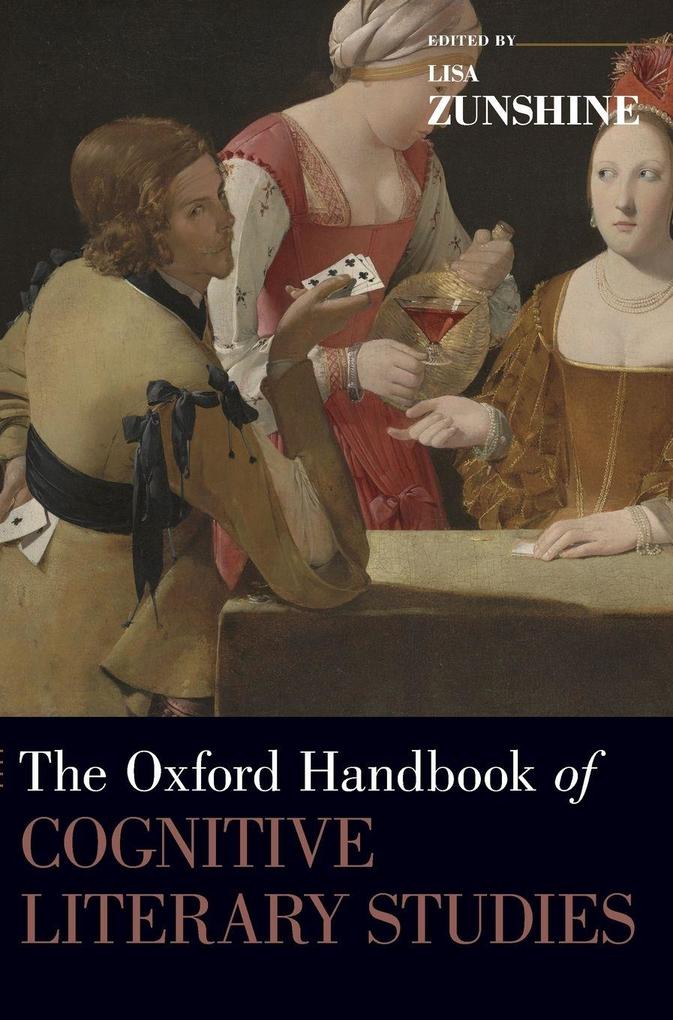
The Oxford Handbook of Cognitive Literary Studies considers, via a variety of methodologies and combinations of interdisciplinary approaches, how the architecture that enables human cognitive processing interacts with cultural and historical contexts. Organized into five parts (Narrative, History, Imagination; Emotions and Empathy; The New Unconscious; Empirical and Qualitative Studies of Literature; and Cognitive Theory and Literary Experience), the volume uses case studies from a wide range of historical periods (from the fourth century BCE to the twenty-first century) and national literary traditions (including South Asian, postcolonial anglophone and francophone, Chinese, Japanese, English, Iranian, Russian, Italian, French, German, and Spanish).
Inhaltsverzeichnis
- Lisa Zunshine, "Introduction to Cognitive Literary Studies"
- Part I: Narrative, History, Imagination
- Cognitive Historicism
- 1. Mary Thomas Crane, "Cognitive Historicism: Intuition in Early Modern Thought"
- 2. Ellen Spolsky, "The Biology of Failure, the Forms of Rage, and the Equity of Revenge"
- 3. Natalie M. Phillips, "Literary Neuroscience and History of Mind: An Interdisciplinary fMRI Study of Attention and Jane Austen"
- Cognitive Narratology
- 4. Peter Rabinowitz, "Toward a Narratology of Cognitive Flavor"
- 5. H. Porter Abbott, "How Do We Read What Isn't There to Be Read? Shadow Stories and Permanent Gaps"
- 6. James Phelan, "Rhetorical Theory, Cognitive Theory, and Morrison's 'Recitatif': From Parallel Play to Productive Collaboration"
- 7. Alan Palmer, "Listen to the Stories!:" Narrative, Cognition and Country and Western Music"
- 8. Monika Fludernik, "Blending in Cartoons: The Production of Comedy"
- 9. Lisa Zunshine, "From the Social to the Literary: Approaching Cao Xueqin's The Story of the Stone from a Cognitive Perspective"
- Cognitive Queer Theory
- 10. J. Keith Vincent, "Sex on the Mind: Queer Theory Meets Cognitive Theory"
- Neuroaesthetics
- 11. Alan Richardson, "Imagination: Literary and Cognitive Intersections"
- 12. Gabrielle Starr, "Theorizing Imagery, Aesthetics and Doubly-Directed States"
- Part II: Emotions and Empathy
- Emotions in Literature, Film, and Theater
- 13. Patrick Colm Hogan, "What Literature Teaches Us About Emotion: Synthesizing Affective Science and Literary Study"
- 14. Carl Plantinga, "Facing Others: Close-ups of Faces in Narrative Film and in The Silence of the Lambs"
- 15. Noël Carroll, "Theater and the Emotion"
- Cognitive Postcolonial Studies
- 16. Patrick Colm Hogan, "The Psychology of Colonialism and Postcolonialism: Cognitive Approaches to Identity and Empathy"
- 17. Suzanne Keen, "Human Rights Discourse and Universals of Cognition and Emotion: Postcolonial Fiction"
- Decision Theory and Fiction
- 18. William Flesch, "Reading and Bargaining"
- Cognitive Disability Studies
- 19. Ralph James Savarese, "What Some Autistics Can Teach Us About Poetry: A Neurocosmopolitan Approach"
- Moral Emotions
- 20. Margrethe Bruun Vaage, "On the Repulsive Rapist, and the Difference Between Morality in Fiction and Real Life"
- 21. Fritz Alwin Breithaupt, "Empathic Sadism. How Readers Get Implicated"
- Part III: The New Unconscious
- 22. Blakey Vermeule, "The New Unconscious: A Literary Guided Tour"
- 23. Jeff Smith, "Filmmakers as Folk Psychologists: How Filmmakers Exploit Cognitive Biases as an Aspect of Film Narration, Characterization and Spectatorship"
- Part IV: Empirical and Qualitative Studies of Literature
- 24. Laura Otis, "The Value of Qualitative Research for Cognitive Literary Studies"
- 25. Marisa Bortolussi and Peter Dixon, "Revisiting the Metaphor of 'Transportation'"
- 26. Peter Dixon and Marisa Bortolusi, "Fluctuation in Literary Reading: The Neglected Dimension of Time"
- Part V: Cognitive Theory and Literary Experience
- 27. Joshua Landy, "Mental Calisthenics and Self-Reflexive Fiction"
- 28. Elaine Auyoung, "Rethinking the Reality Effect: Detail and the Novel"
- 29. Mark Bruhn, "Time as Space in the Structure of (Literary) Experience: The Prelude"
- 30. Nancy Easterlin, "Thick Context: Novelty in Cognition and Literature"