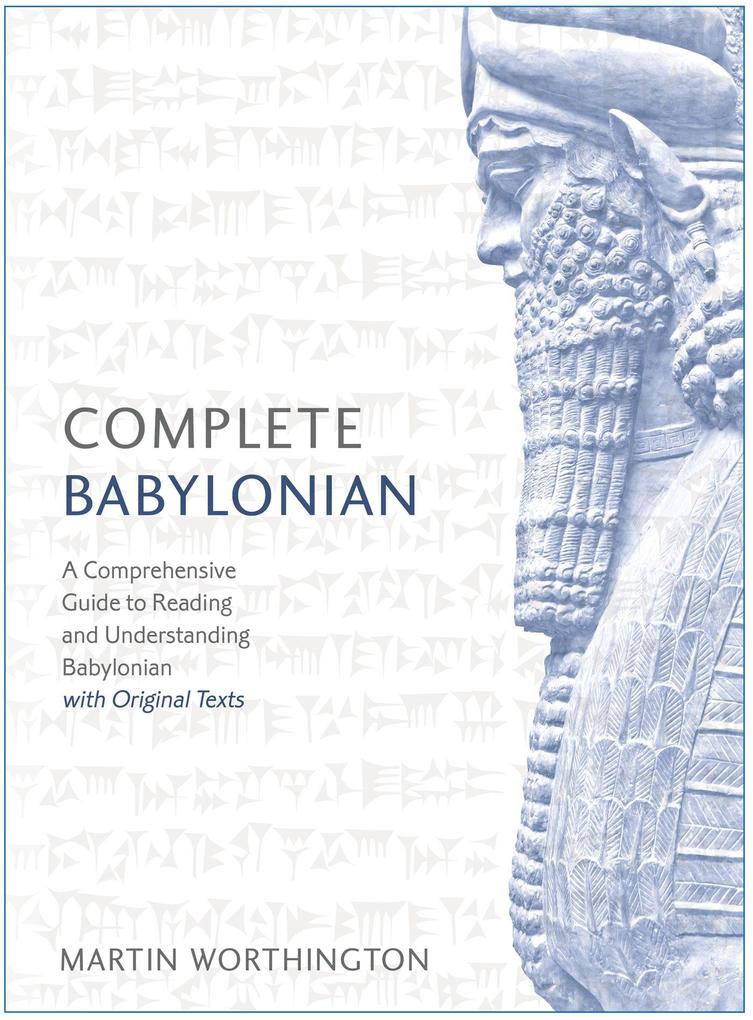
Designed for complete beginners, and tested for years with real learners, Complete Babylonian offers a bridge from the textbook to the real world, enabling you to learn the grammar, understand the vocabulary and even how to translate the inscriptions and texts from this ancient cradle of civilization.
Structured around authentic material, and introducing cuneiform script for those who wish to take their understanding further, this course also features:
-47 short learning units plus glossary and reference section
-Authentic materials - language taught through key texts
-Teaches the key skills - reading and understanding Babylonian grammar and vocabulary
-Covers cuneiform script - one of the earliest written forms
-Self tests and learning activities - see and track your own progress
"A book at once lucid, reliable and exciting. No other teacher in the world could have managed it. All his pupils are fortunate."
Irving Finkel, The British Museum
Rely on Teach Yourself, trusted by language learners for over 75 years.
Inhaltsverzeichnis
- : INTRODUCTION
- : The Language’s Relatives and Development
- : What about Assyrian?
- : A note on Sumerian
- : Pronunciation
- : About the exercises
- : THE CUNEIFORM SCRIPT, TRANSLITERATION AND NORMALIZATION
- : Phonetic writing
- : Sumerographic writing and phonetic complements
- : Determinatives
- : The cuneiform script: how it evolved
- : Transliteration
- : Which sign is being used to write a syllable?
- : Normalization
- : SOME GENERAL FEATURES OF THE LANGUAGE
- : Roots and patterns
- : Position of the verb within the sentence
- : Articles
- : Pronouns as subjects of verbs
- : Sound changes
- : Syllables and division into syllables (‘syllabification’)
- : Sound change 1: vowel elision
- : Sound change 2: vowel contraction
- : Sound change 3: assimilation of consonants
- : OVERVIEW OF NOUNS AND ADJECTIVES
- : Case
- : Gender
- : Number
- : Words functioning as nouns
- : NOUNS AND ADJECTIVES, SINGULAR
- : The second millennium BC
- : The first millennium BC
- : NOUNS AND ADJECTIVES, PLURAL
- : The second millennium BC
- : Masculine nouns:
- : Masculine adjectives:
- : Feminine nouns and adjectives:
- : The first millennium BC
- : HOW TO SAY ‘OF’: THE ‘CONSTRUCT STATE’
- : Origin of ‘construct’ forms
- : Formation of the ‘construct state’ in the singular
- : Formation of the ‘construct state’ in the plural
- : Use of the singular and plural construct forms
- : ADVERBS AND LOCATIVES
- : OVERVIEW OF VERBS
- : The four verb systems
- : The sub-systems: tn and t
- : ‘Weak’ verbs
- : Verbs with ‘a’ and verbs with ‘e’
- : Tenses
- : Pronouns and gender
- : Summary
- : THE PRESENT
- : Forming the present for non-weak verbs s
- : Forming the present for weak verbs
- : THE PRETERITE
- : THE PERFECT
- : THE STATIVE
- : VERBAL FORMS FOR ALL PERSONS
- : HOW TO EXPRESS WISHES AND COMMANDS
- : SUBORDINATE CLAUSES
- : VERBS AND THE DIRECTION OF MOTION
- : PRONOUNS
- : THE DUAL
- : A FEW TRICKS OF THE TRADE
- : Sandhi spellings
- : Puns
- : Unorthodox syllable divisions
- : Special sign readings
- : Alphabetic influence
- : Rebus writings
- : Scribal errors resulting from copying
- : Scribal errors resulting from dictation
- : The structure of poetic lines
- : Structural parallelism
- : FURTHER READING
- : APPENDIX: GLOSSED CUNEIFORM READINGS
- : GLOSSARY