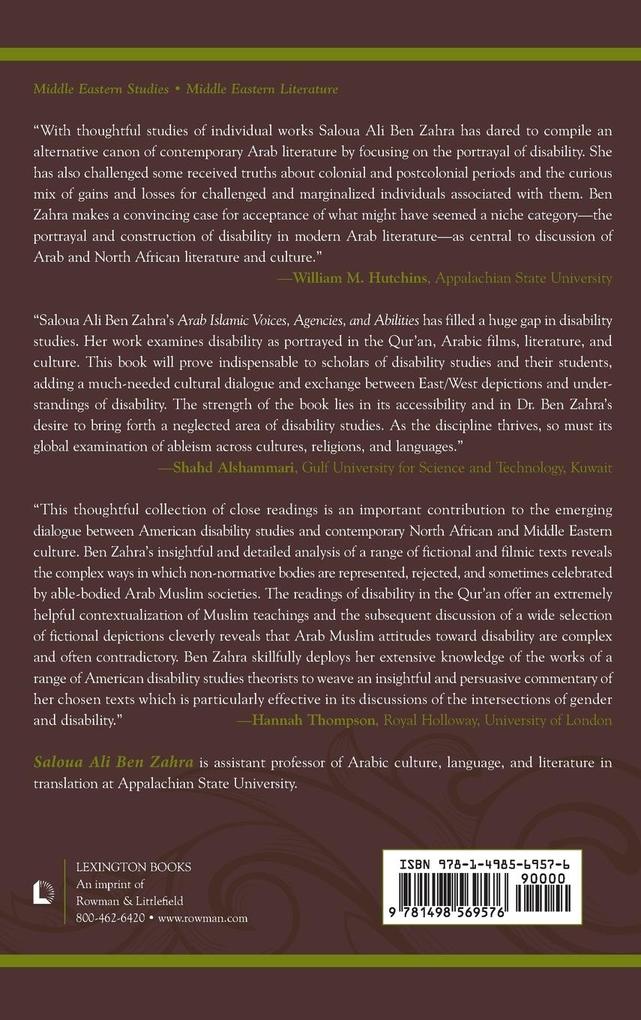
This book explores portrayals of the disabled in Arab/Muslim post-colonial North African and Middle Eastern societies in genres ranging from classical Arabic scripture to secular popular culture. Arab/Muslim characters in Arab, Islamic, Islamist, Francophone, and global societies are explored.
Inhaltsverzeichnis
Introduction
Chapter 1: Al Qur'an's Teachings with Respect to the Disabled
Chapter 2: The Tunisian Deaf Mute through the Lens of American Orientalism
Chapter 3: Tunisian Camera's Treatment of Disability
Chapter 4: The Disabled Native: Ressource Humaine for the French: A Literary Study of Algerian Rachid Mimouni's Tombéza
Chapter 5: The Case of Female Characters with Disabilities: Moroccan Fatima vs. "Cure or Kill": A Disability Study of Tabar Ben Jelloun's l'Enfant de Sable [Sand Child]
Chapter 6: Disability and Shame in Salman Rushdie's novel Shame: What it means to be a Pakistani Disabled Postcolonial Woman
Chapter 7: The Egyptian Visually-Challenged Sheikh Husni's Treatment of Blindness in the Egyptian Film Al Kitkat
Chapter 8: Iraqi in Paris: Speaking Volumes: the Bond in Deafness of an Iraqi Father and Son
Conclusion
Bibliography