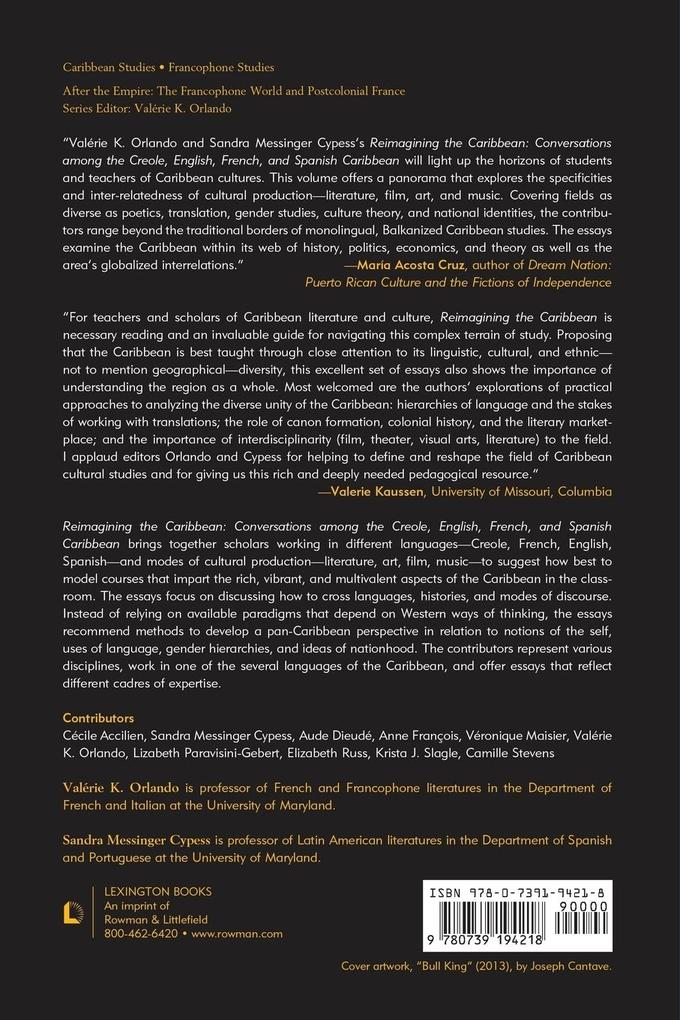
This volume brings together scholars working in different languages—Creole, French, English, Spanish—and modes of cultural production—literature, art, film, music—to suggest how best to model courses that impart the rich, vibrant, and multivalent aspects of the Caribbean in the classroom.
Inhaltsverzeichnis
Table of Contents
Acknowledgements
Introduction: "Situating the Caribbean: Texts and Contexts,"
Valérie Orlando
Chapter 1: "Approaching the Caribbean from a Latin American Perspective,"
Sandra Cypess
Chapter 2: "Teaching the Caribbean across Borders: the Web Approach,"
Véronique Maisier
Chapter 3: "Islands without Borders: Teaching the Caribbean across Languages and Cultures,"
Anne François and Cécile Accilien
Chapter 4: "Islands without Borders: Analyzing the Caribbean through the Vehicle of Translation Studies,"
Krista Slagle
Chapter 5: "Caribbean Drama: A Stage for Cross-Cultural Poetics,"
Camille Stevens
Chapter 6: "Plantation Portraits: Teaching the Hispanic Caribbean through the Arts,"
Lizabeth Paravisini-Gebert
Chapter 7: "'A Hispaniola Conspiracy': Edwidge Danticat and Junot Díaz Performing
(in) the Caribbean Public Sphere,"
Elizabeth Russ
Chapter 8: "Defending Freedom and Human Rights: Teaching Toussaint Louverture
and Haiti's History,"
Aude Dieudé
Bibliography of Useful Resources and Texts
Glossary of Selected Terms
Index
Notes on Contributors