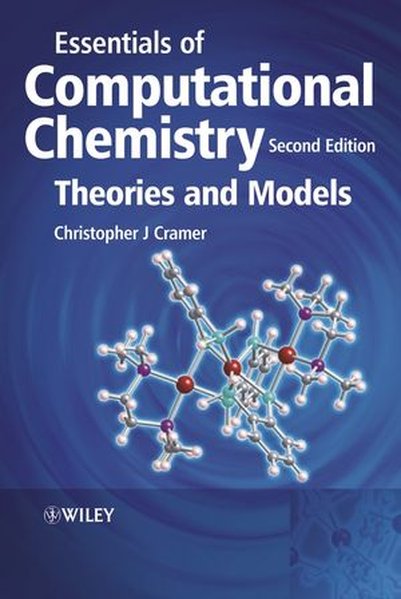
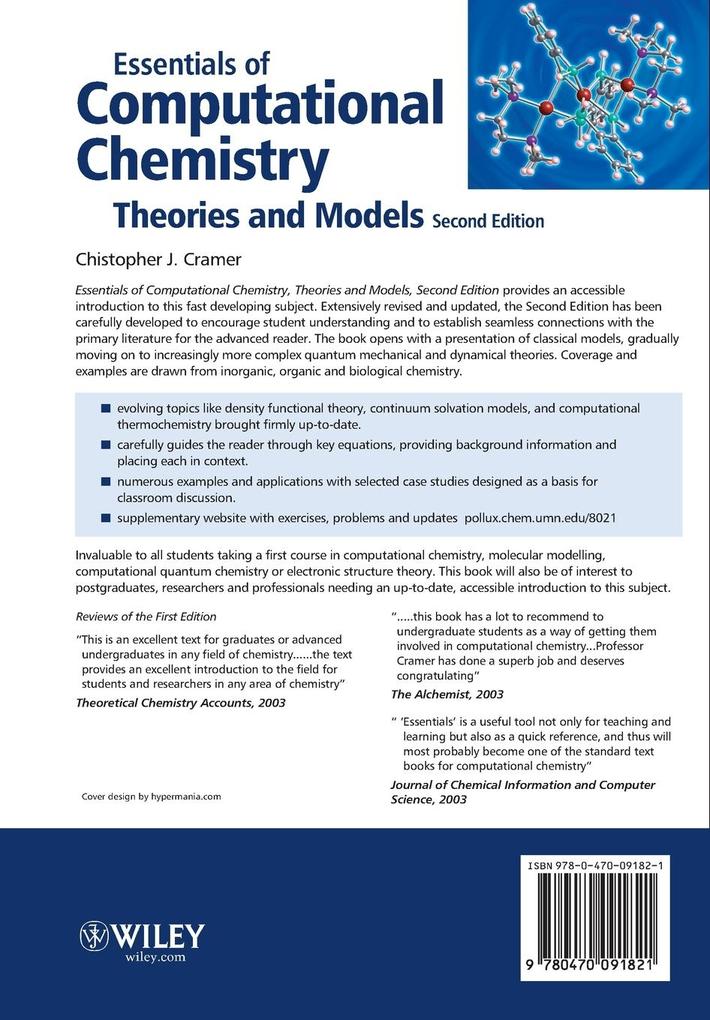
Ohne Computational Chemistry kommen heutzutage weder Physikochemiker noch Synthetiker oder Analytiker aus. Entsprechend wichtig ist es, diesem Gebiet bereits während des Studiums gebührenden Raum zu widmen. Dieses Lehrbuch hilft vor allem bei der Vermittlung grundlegender Konzepte anhand zahlreicher Beispiele aus der organischen, anorganischen und Biochemie, während die theoretischen und mathematischen Hintergründe weniger ausführlich behandelt werden.
Throughout chemistry, computational techniques are becoming increasingly important. Problem solving and modelling is quickly achievable but as the power of computers increases so does the complexity of the tasks and the speed at which they are solved.
A basic understanding of the theory and concepts underpinning computational chemistry is therefore essential to all chemical science students, and Essentials of Computational Chemistry: Theory and Models delivers a thorough insight in a readable and approachable manner.
- Accessible as a text to advanced undergraduate students as well as graduate students
- Emphasises the basic concepts and applications rather than theory and mathematics
- Firmly places the subject in context, including many examples and applications
- Includes coverage and examples from inorganic, organic and biological chemistry and covers quantum mechanical and classical mechanical models
- Includes case histories that serve as an ideal basis for classroom di scussion
- Delivers information in a readable and approachable manner
Inhaltsverzeichnis
Preface to the First Edition.
Preface to the Second Edition.
Acknowledgments.
1. What are Theory, Computation, and Modeling?
2. Molecular Mechanics.
3. Simulations of Molecular Ensembles.
4. Foundations of Molecular Orbital Theory.
5. Semiempirical Implementations of Molecular Orbital Theory. .
6. Ab Initio Implementations of Hartree-Fock Molecular Orbital.
Theory.
7. Including Electron Correlation in Molecular Orbital Theory.
8. Density Functional Theory.
9. Charge Distribution and Spectroscopic Properties.
10. Thermodynamic Properties.
11. Implicit Models for Condensed Phases.
12. Explicit Models for Condensed Phases.
13. Hybrid Quantal/Classical Models.
14. Excited Electronic States.
15. Adiabatic Reaction Dynamics.
Appendix A Acronym Glossary.
Appendix B Symmetry and Group Theory.
Appendix C Spin Algebra.
Appendix D Orbital Localization.