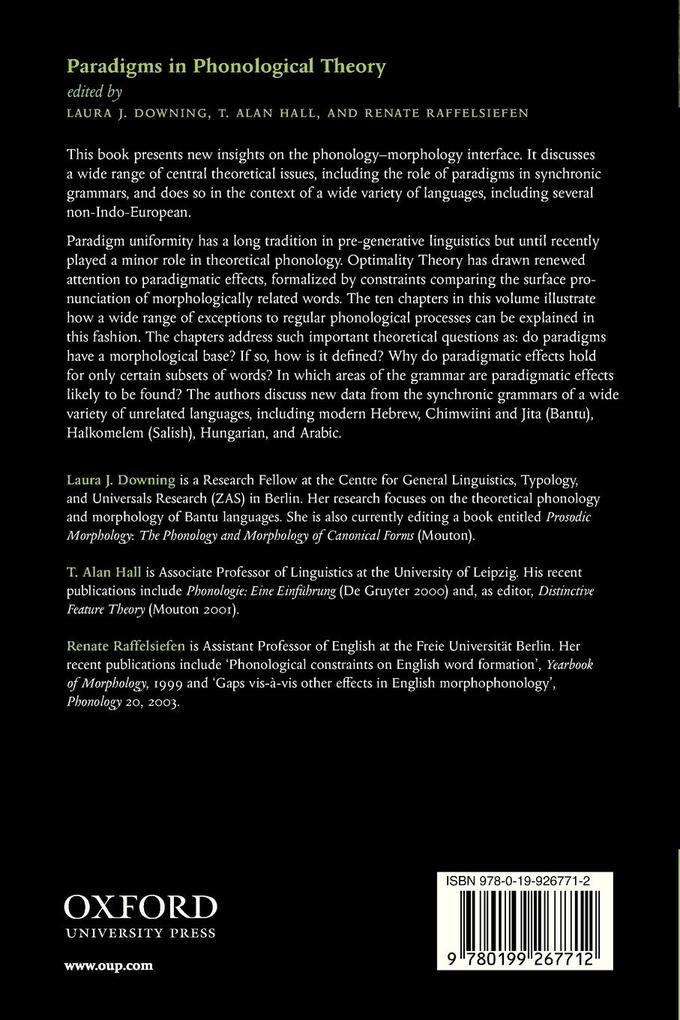
This book presents new insights on the phonology-morphology interface. It discusses a wide range of central theoretical issues, including the role of paradigms in synchronic grammars, and does so in the context of a wide variety of languages including several non-Indo-European languages.
Inhaltsverzeichnis
- 1: Laura J. Downing, T.A. Hall, and Renate Raffelsiefen: Introduction: The Role of Paradigms in Phonological Theory
- 2: Adam Albright: The Morphological Basis of Paradigm Leveling
- 3: Outi Bat-El: Competing Principles of Paradigm Uniformity: Evidence From the Hebrew Imperative Paradigm
- 4: Luigi Burzio: Sources of Paradigm Uniformity
- 5: Stuart Davis: "Capitalistic" vs "Militaristic": The paradigm Uniformity Effect Reconsidered
- 6: Laura Downing: Jita Causative Doubling Provides Optimal paradigms
- 7: Michael Kenstowicz: Paradigmatic Uniformity and Contrast
- 8: John J. McCarthy: Optimal Paradigms
- 9: Renate Raffelsiefen: Paradigm Uniformity Effects Versus Boundary Effects
- 10: Péter Rebrus and Miklós Törkenczy: Uniformity and Contrast in the Hungarian Verbal paradigm
- 11: Suzanne Urbanczyk: A Note on Paradigm Uniformity and Priority of the Root