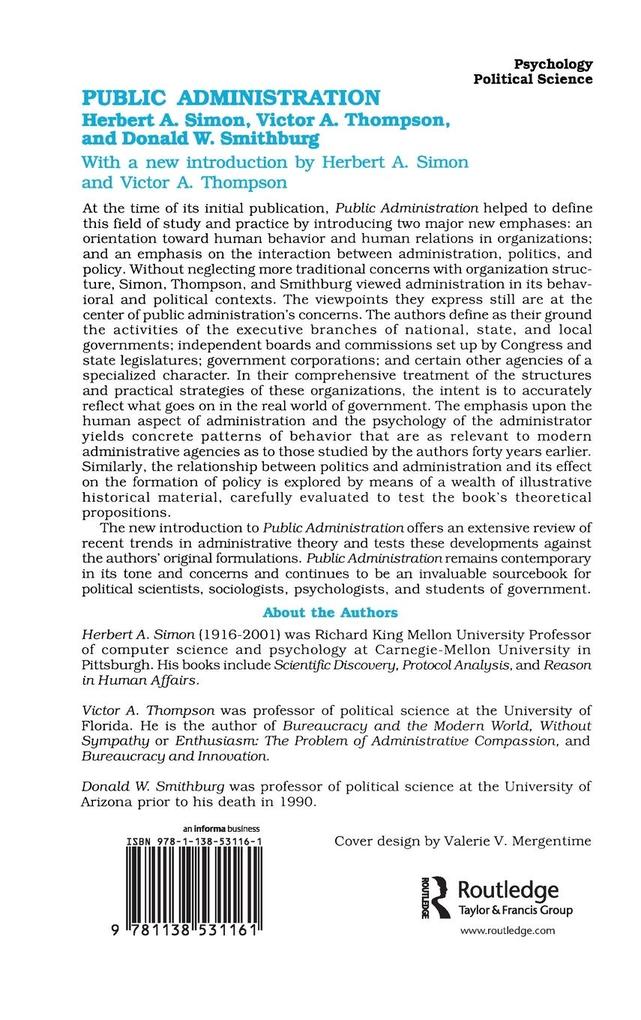
At the time of its initial publication, Public Administration helped to define this field of study and practice by introducing two major new emphases: an orientation toward human behavior and human relations in organizations, and an emphasis on the interaction between administration, politics, and policy
Inhaltsverzeichnis
One: What Is Public Administration?; Two: How Governmental Organizations Originate; Three: Human Behavior and Organization; Four: Building Blocks of Organization: Formation of Groups; Five: Building Blocks of Organization: Group Values; Six: Dividing the Work: Assigning Jobs to Individuals; Seven: Dividing the Work: Specialization Among Organization Units; Eight: Securing Teamwork: Authority; Nine: Securing Teamwork: The Structure of Authority and Status; Ten: Securing Teamwork: The Communication Process; Eleven: Securing Teamwork: The Organization of Communication; Twelve: Large-Scale Organization: The Trend Toward Centralization; Thirteen: Large-Scale Organizations; The Consequences of Centralization; Fourteen: Large-Scale Organizations: Intergroup Relations; Fifteen: Selection of the Team: Civil Service and Recruitment; Sixteen: Selection of the Team: Careers in Government; Seventeen: Selection of the Team: Personnel Processes; Eighteen: The Struggle for Existence: Organizational Equilibrium; Nineteen: The Struggle for Existence: The Tactics of Survival; Twenty: The Strategy of Planning; Twenty-One: The Tactics of Execution: Reducing the Costs of Change; Twenty-Two: The Tactics of Execution: Securing Compliance; Twenty-Three: Evaluating Administration; Efficiency; Twenty-Four: Administrative Responsibility: Formal Controls; Twenty-Five: Administrative Responsibility: Informal Controls