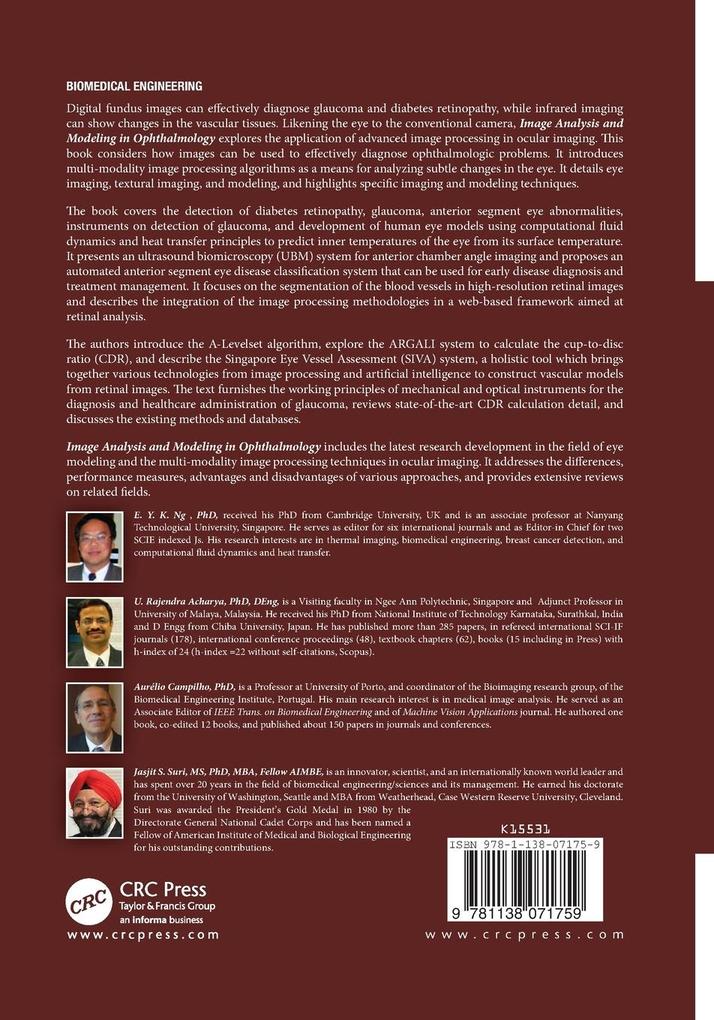
Successful thermal modeling of the human eye helps in the early diagnosis of eye abnormalities such as inflammation, cataracts, diabetic retinopathy, and glaucoma-all leading causes of blindness. This book presents a unified work of eye imaging and modeling techniques that have been proposed and applied to ophthalmologic problems. It delves into various morphological, texture, higher order spectra, and wavelet transformation techniques used to extract important diagnostic features from images, which can then be analyzed by a data scientist for automated diagnosis.
Inhaltsverzeichnis
Ultrasound Biomicroscopic Imaging of the Anterior Chamber Angle. Automated Glaucoma Identification Using Retinal Fundus Images: A Hybrid Texture Feature Extraction Paradigm. Ensemble Classification Applied to Retinal Blood Vessel Segmentation: Theory and Implementation. Computer Vision Algorithms Applied to Retinal Vessel Segmentation and Quantification of Vessel Caliber. Segmentation of the Vascular Network of the Retina. Automatic Analysis of the Microaneurysm Turnover in a Web-Based Framework for Retinal Analysis. A-Levelset-Based Automatic Cup-to-Disc Ratio Measurement for Glaucoma Diagnosis from Fundus Image. The Singapore Eye Vessel Assessment System. Quantification of Diabetic Retinopathy Using Digital Fundus Images. Diagnostics Instruments for Glaucoma Detection. Automated Cup-to-Disc Ratio Estimation for Glaucoma Diagnosis in Retinal Fundus Images. Arteriovenous Ratio Calculation Using Image-Processing Techniques. Survey on Techniques Used in Iris Recognition Systems. Formal Design and Development of an Anterior Segment Eye Disease Classification System. Modeling of Laser-Induced Thermal Damage to the Retina and the Cornea. Automatization of Dry Eye Syndrome Tests. Thermal Modeling of the Ageing Eye. A Perspective Review on the Use of In Vivo Confocal Microscopy in the Ocular Surface. Computational Modeling of Thermal Damage Induced by Laser in a Choroidal Melanoma.