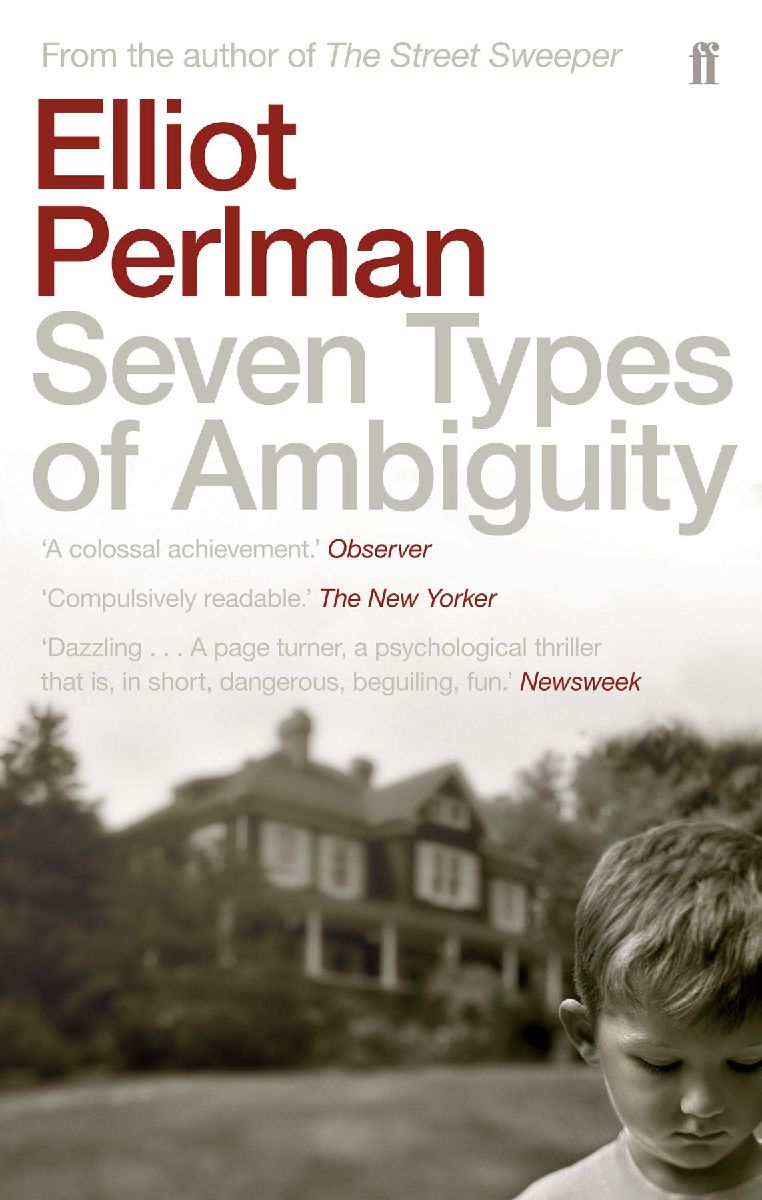
Cheekily swiping the title of William Empson's seminal work of literary criticism, this second novel by Perlman, an Australian writer, presents seven first-person narrators - whose lives are all nudged off course by a man's abduction of his ex-girlfriend's young son - in a compulsively readable tangle. At the center is a psychiatrist who treats several of the characters, and whose narrative provides some basis for assessing the partial perspectives of the six others. The abductor's self-justifying rants about truth, literature, and poststructuralist theory win over his shrink and, it seems, everyone else. Still, if the individual stories of these characters are compelling, their attempts at Empsonian hermeneutics are less so.
- The New Yorker
By copping the title of William Empson's classic of literary criticism, Australian writer Perlman (Three Dollars) sets a high bar for himself, but he justifies his theft with a relentlessly driven story, told from seven perspectives, about the effects of the brief abduction of six-year-old Sam Geraghty by Simon Heywood, his mother Anna's ex-boyfriend. Charismatic, unemployed Simon is still obsessed with Anna nine years after their breakup - to the dismay of his present lover, Angelique, a prostitute. Anna's stockbroker husband, Joe, is one of Angelique's regulars, which feeds Simon's flame. When Angelique turns Simon in to the cops, he claims he had permission to pick Sam up; his fate hinges on whether Anna will back up his lie. Most of the perspectives are linked to Simon's shrink, Alex Klima, who writes to Anna and counsels Simon, Angelique and Joe's co-worker, Dennis. The most successful voices belong to Joe, who's spent his career on the edge of panic, and Dennis, whose bitter rants provide a corrective to Klima's unctuous psychological omniscience. Perlman, a lawyer, aims for a literary legal novel - think Grisham by way of Franzen - and the ambition is admirable though the product somewhat uneven. Simon's obsessions, his self-righteousness and his psychological blackmail, give him a perhaps unintended creepiness, and the novel, as big and juicy as it is, may not offer sufficient closure.
- Publishers Weekly
... all of this material is clearly dear to Perlman's heart, which brings me to what may be the most important aspect of his novel - what would once have been called its soul. Perlman has been compared to Jonathan Franzen and Philip Roth, but he strikes me as less like them - or like most contemporary writers, for that matter - than like one of those energetic Victorian novelists who had ''the art of seeing all the world as the potentiality of fiction,'' to quote Nabokov again. There are traces of Dickens's range in Perlman and of George Eliot's generous humanist spirit. No, he's not there yet. He could use more humor, and he doesn't have to tell us everything he's ever heard or seen or read. All the same, this is an exciting gamble of a novel, one willing to lose its shirt in its bid to hold you. Be prepared to give it time. Be prepared to skim when you come to a particularly annoying digression. But most of all be prepared to stay with it for the long haul. It's worth it.
- The New York Times