Inhaltsverzeichnis
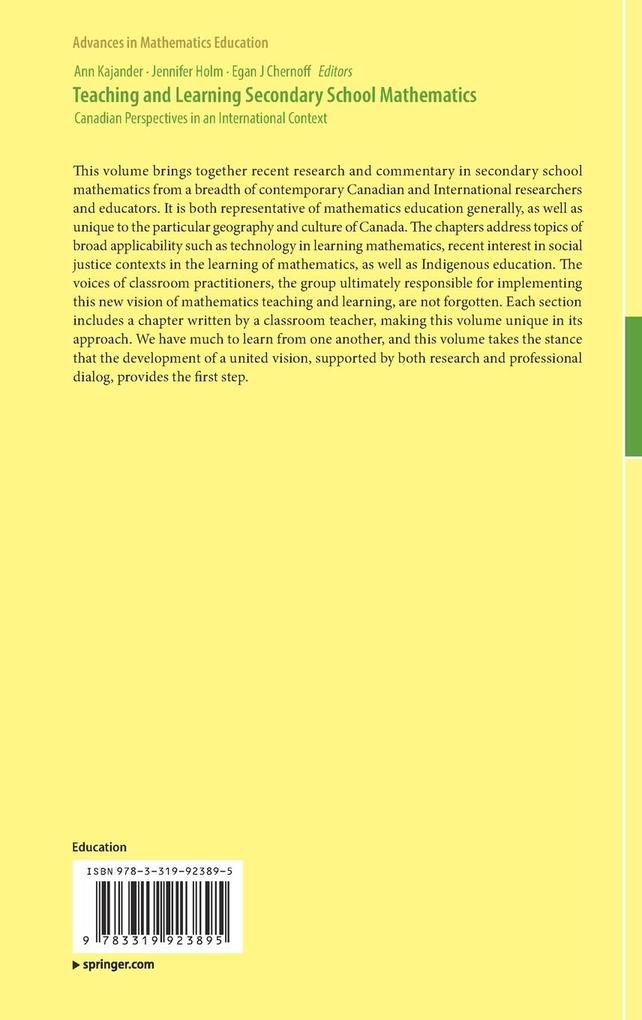
Front matter. - Series Preface (Gabriele Kaiser and Bharath Sriraman). - Preface. A northern vision of mathematics education (Ann Kajander, Jennifer Holm and Egan J. Chernoff). - Foreword (Edward Doolittle). - Part I. The Changing Landscape of Teaching and Learning Mathematics. - Part I preface. On changing the landscape: Ecclesiastes vs. Heraclitus (Rina Zazkis and Nathalie Sinclair). - Part I preface (Walter Whiteley). - Powerful stories: The hitchhiker s guide to the secondary mathematics curriculum landscape (Peter Taylor, Divya Lala, Kariane Ouellet, and Stefanie Knebel ). - On teaching and learning mathematics from a cultural-historical perspective (Luis Radford, Isaias Miranda, and Gilbert Lacroix). - Indigenous perspectives in school mathematics: From intellect to wisdom (Glen Aikenhead). - Live(d) topographies: The emergent and dynamical nature of ideas in secondary mathematics classes (Jennifer S. Thom and Florence Glanfield). - Drawing upon Indigenous knowledges to transform the secondary mathematics classroom (Lisa Lunney Borden). - A teacher s view It s a path, not a gap: A relationship-based approach to math and well-being (Tom Boland and David Tranter). - Part I commentary. The changing landscape of teaching and learning mathematics (Luckson M. Kaino (South Africa). - Part II. Shifting to a culture of inclusion . - Part II preface. The particular, the generic and the general once more:. - Looking into aspects of Canadian mathematics classrooms (David Pimm). - Steps toward a more inclusive mathematics pedagogy (Brent Davis, Jo Towers, Rohan Karpe, Michelle Drefs, Olive Chapman, and Sharon Friesen). - Learning mathematics when students are new to schooling and new to English (Richard Barwell, Kathryn Kubota-Zarivnij, and Debbie Culotta). - Introduction to students at risk: Case studies of often unheard students (Ann Kajander). - Building capacity in grade 9 mathematics: Case studies from a Collaborative Inquiry Project in Applied level mathematics (Douglas McDougall andSue Ferguson). - Success in Grade 9 Applied mathematics courses (Alison Macaulay). - Reflecting on good mathematics teaching: Knowing, nurturing, noticing (Susan Oesterle). - Mathematical mindsets for the teaching and learning of mathematics (Jamie S. Pyper). - Considering Indigenous perspectives and mathematics education: Stories of our experiences as teachers and teacher educators (Gladys Sterenberg and Kevin O Connor). - A teacher s view. - An unexpected adventure (Jarron Childs and Jennifer Holm). - Part II commentary. - Shifting to a culture of inclusion (Kim Beswick (Australia)). - Part III: Fostering Relationships . - Part III preface. Building relationships through an ethic of care: Insights from the work of Julie Long (Elaine Simmt). - Culturing affect, affective cultures
(
Wolff-Michael Roth). - Support to thrive: Raising resilience in students in secondary schools (Kingsley Hurlington). - Digital technology in teaching mathematical competency: A paradigm shift (Sean Chorney). - Considering both academic and social domains: Increasing student engagement in at-risk classrooms (Limin Jao). - A teacher s view. - My favourite mistakes: Experiences teaching Cree students in northern communities (Michael Newell). - Part III commentary. - Fostering relationships in the work of teaching mathematics (Reidar Mosvold (Norway)). - Part IV: Enhancing Problem-based learning . - Part IV preface . - Enhancing problem-based learning (Tom Kieren). - Building thinking classrooms (Peter Liljedahl). - Teaching mathematics and developing citizenship: How to use contexts to enhance problem-based learning (Annie Savard). - Teaching probability in junior high school through problem solving: Construction and analysis of a probabilistic problem (Vincent Martin, Izabella Oliveira, and Laurent Theis ). - Bottles and bridges: Sample classroom tasks created by beginning teachers (Abrahim Abu Atiya, Natasha Luca, and Ann Kajander). - Promoting students reasoning about statistical inference through engagement with a problem-based instructional activity involving the use of TinkerPlots
©
software (Luis Saldanha and Mathieu Thibault). - Supporting mathematical creativity through problem solving (Richard Hoshino). - Exploring math through social justice context problems (Ami Mamolo, Kevin Thomas, and Michael Frankfort). - Social justice and the teaching and learning of mathematics (Gale Russell ). - A teacher s view. - Problem solving in the secondary classroom (Shawn Godin). - Part IV commentary. - Developing mathematical reasoning through problem solving (Roza Leiken (Israel)). - Part IV commentary. - Doing is not the same as thinking or construing (John Mason (United Kingdom)). - Part V: Planning and Assessment . - Part V preface. - Planning and assessment: Teachers and students as central actors (Carolyn Kieran). - Planning a unit by starting with the end it mind: Unit and lesson planning (Jennifer Holm). - Observing for mathematical proficiency in secondary mathematics education(Priscila Dias Corrêa). - Re-framing testing to better fit within problem solving classrooms: Ways to create and review tests (Tina Rapke, Jennifer Hall, and Richelle Marynowski). - Enhancing mathematics teaching and learning through sound assessment practices (Christine Suurtamm). - Improving students approaches to learning high school mathematics (P. Janelle McFeetors ). - A teacher s view. - Assessment: Broadening our conceptions to improve our practice (Jimmy Pai). - Part V commentary. - Planning and assessment from a South African perspective (Vijay Reddy (South Africa)). - Part V commentary . - On measures of measurement and mismeasurement: A commentary on planning and assessment (Bharath Sriraman (The United States of America)). - Part VI: Broadening mathematical understanding through content. - Part VI preface. - Broadening mathematical understanding through content (Gila Hanna). - Canada is better An unexpected reaction to the order of operations in arithmetic (Rina Zazkis). - Modelling in mathematics education: Moving beyond curve fitting exercises (France Caron). - Learning algebra with models and reasoning (Ann Kajander). - In no uncertain terms: Encouraging a critical stance toward probability in school (Nat Banting, Ilona Vashchyshyn, and Egan J. Chernoff). - Composition of linear polynomials (Edward J. Barbeau). - Transition from secondary to tertiary mathematics. - Culture shock: Mathematical symbols, language, and reasoning (Andrijana Burazin and Miroslav Lovric). - A teacher s view. - Teaching a university bound statistics course (Jeff Gardner). - Part VI commentary. - Broadening mathematical understanding through content (Plinio Cavalcanti Moreira (Brazil)). - END MATTER. - Final commentary: The challenge continues (Jennifer Holm, Ann Kajander, and Egan J. Chernoff). - INDiCES. -
Es wurden noch keine Bewertungen abgegeben. Schreiben Sie die erste Bewertung zu "Teaching and Learning Secondary School Mathematics" und helfen Sie damit anderen bei der Kaufentscheidung.