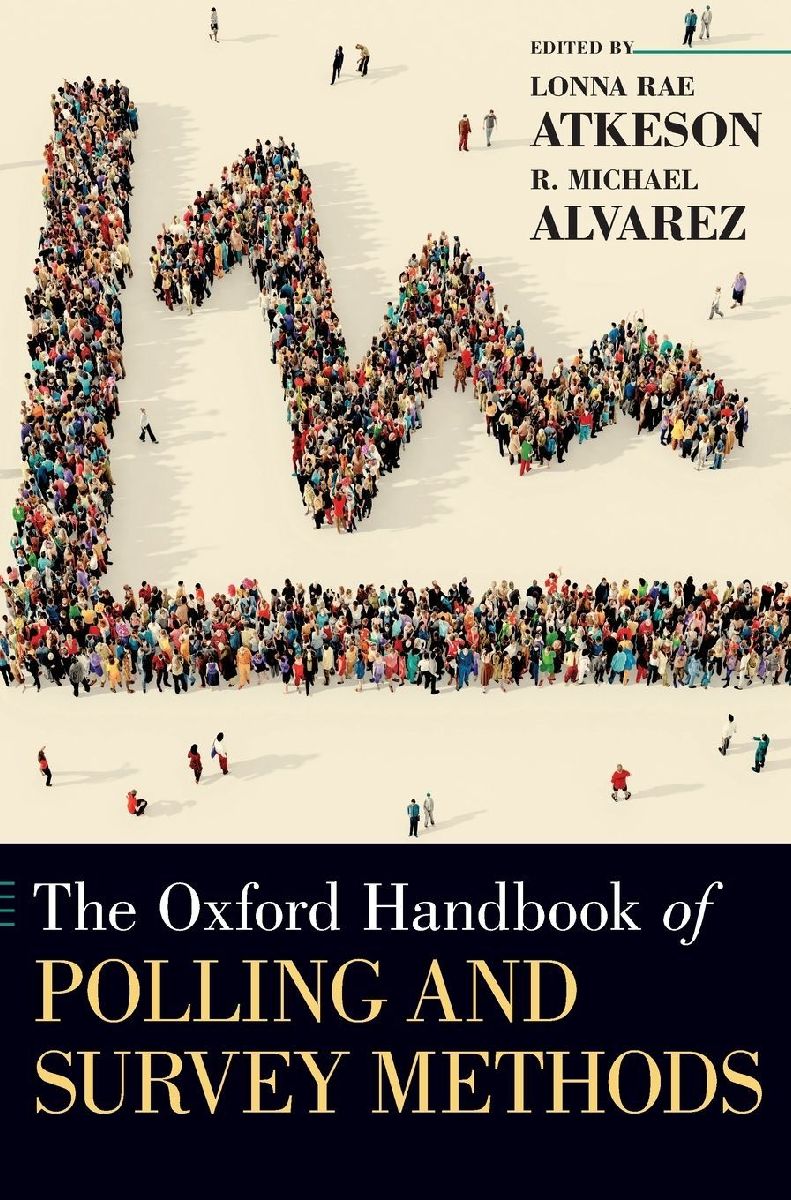
The methodologies used to study public opinion are now in flux. The primary polling method of the last half-century, the telephone survey, is rapidly becoming obsolete as a data collection method. At the same time, new methods of contacting potential respondents and obtaining their response are appearing, providing a variety of options for scholars and practitioners. Generally speaking, we are moving from a polling world that was largely interviewer driven over the phone and face-to-face to predominantly interviewer driven self-administered poll environments, New methods of data collection, however, must still deal with fundamental questions to polling methodology and total survey error including sampling, selection bias, non-response error, poststratification weighting, and questionnaire design features. The Oxford Handbook on Polling and Survey Methods brings together a unique mixture of academics and practitioners, from various backgrounds, academic disciplines, and experiences. In some sense, this is reflective of the interdisciplinary nature of the polling and survey industry: polls and surveys are widely used in academia, government, and the private sector. Designing, implementing, and analyzing high quality, accurate, and cost-effective polls and surveys requires a combination of skills and methodological perspectives. Despite the well-publicized issues that have cropped up in recent political polling, a great deal is known today about how to collect high quality polling and survey data even in complex and difficult environments. Divided into four main sections, the Handbook draws on the existing research and explores data collection methods. It then addresses data analysis and the methods available for combining polling data with other types of data. The next section covers analytic issues, including the new approaches to studying public opinion (ie social media, the analysis of open-ended questions using text analytic tools, and data imputation). The final section focuses on the presentation of polling results, an area where there is a great deal of innovation. A comprehensive overview of the topic, this volume highlights current polling trends provides ideas for the development of new and better approaches for measuring, modeling, and visualizing public opinion and social behavior.
Inhaltsverzeichnis
- Introduction
- 1. Survey Design
- Total Survey Error
- Herb Weisberg
- Longitudinal Surveys: Issues and Opportunities
- Sunshine Hillygus and Steve Snell
- The Advantages and Disadvantages of Mode
- Lonna Atkeson and Alex Adams
- Taking the Study of Political Behavior Online
- Stephen Ansolabehere and Brian Shaffner
- Sampling for Studying Context: Traditional Surveys and New Directions
- James Gimpel
- Questionnaire Science
- Daniel Oberski
- 2. Data Collection
- Exit Polling Today and What the Future May Hold
- Anthony Salvanto
- Sampling Hard to Reach Populations: Lessons from Sampling Internally Displaced Persons (IDPs)
- Prakash Adkihari and Lisa Bryant
- Reaching Beyond Low-Hanging Fruit: Surveying Low-Incidence Populations, Justinlamazoo College
- Youssef Chouhound and Jane Junn
- Survey Research in the Arab World
- Lindsay Benstead
- The Language-Opinion Connection
- Efren O. Perez
- 3. Analysis and presentation
- Causal Inference with Complex Survey Designs: Generating Population Estimates Using Survey Weights
- Ines Levin and Betsy Sinclair
- Cross-National Surveys and the Comparative Study of Electoral Systems
- Jeffrey A. Karp and Jack Vowles
- Aggregating Survey Data to Estimate Subnational Public Opinion
- Paul Brace
- Public Opinion at the State and Local Level
- Chris Warshaw
- Using Graphical Displays for Presenting Polling Data and Analytic Results
- William Jacoby and Saundra Schneider
- Graphical Visualization of Polling Results
- Susanna Makela, Yajuan Si, and Andrew Gelman
- Measuring Group Consciousness: Actions Speak Louder than Words
- Kim Proctor
- Issues in Polling Methodologies: Inference and Uncertainty
- Jeff Gill and Jonathan Homola
- 4. New frontiers
- Survey Experiments: Managing the Methodological Costs and Benefits
- Yanna Krupnikov and Blake Findley
- Using Qualitative Methods in a Quantitative Survey Research Agenda
- Kinsey Gimbel and Jocelyn Newsome
- Integration of Contextual Data: Challenges and Opportunities
- Armando Razo
- Twitter and Measuring Public Opinion
- Jonathan Nagler et al.
- Expert Surveys as a Measurement Tool
- Cherie Maestas
- The Rise of Poll Aggregation and Election Forecasting
- Natalie Jackson