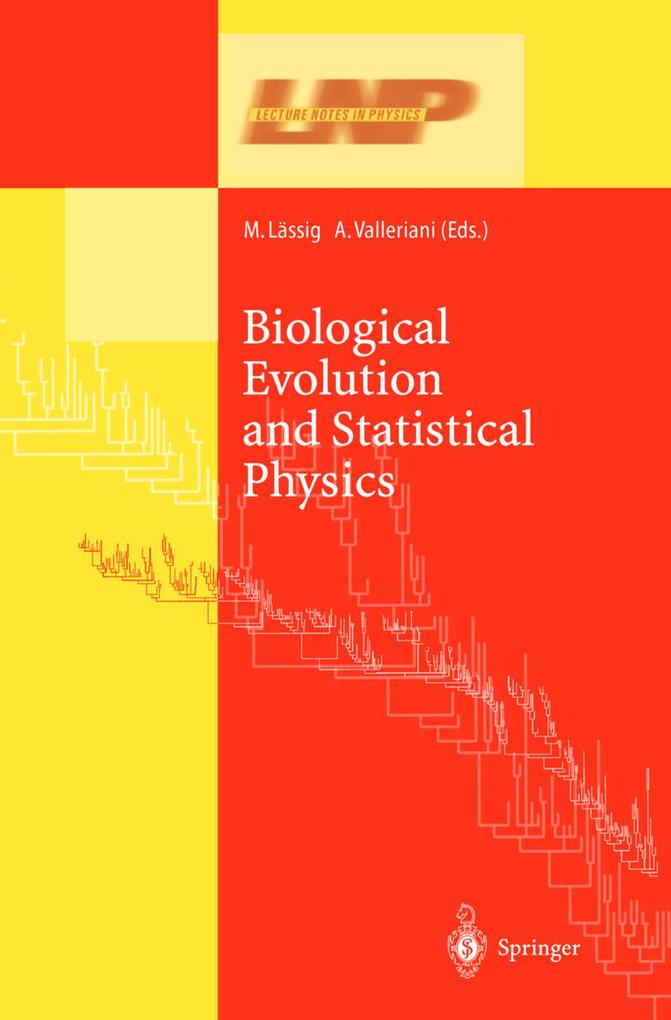
This set of lecture notes gives a first coherent account of a novel aspect of the living world that can be called biological information. The book presents both a pedagogical and state-of-the art roadmap of this rapidly evolving area and covers the whole field, from information which is encoded in the molecular genetic code to the description of large-scale evolution of complex species networks. The book will prove useful for all those who work at the interface of biology, physics and information science.
Inhaltsverzeichnis
Molecular information and evolution. - Statistical significance and extremal ensemble of gapped local hybrid alignment. - On the design of optimization criteria for multiple sequence alignment. - Red queen dynamics and the evolution of translational redundancy and degeneracy. - A testable genotype-phenotype map: modeling evolution of RNA molecules. - Evolutionary perspectives on protein structure, stability, and functionality. - Phylogeny. - The statistical approach to molecular phylogeny: Evidence for a nonhyperthermophilic common ancestor. - Principles of cophylogenetic maps. - Accounting for phylogenetic uncertainty in comparative studies of evolution and adaptation. - The` shape of phylogenies under simple random speciation models. - The evolution of populations and species. - Fitness landscapes. - Tempo and mode in quasispecies evolution. - Multilevel processes in evolution and development: Computational models and biological insights. - Evolutionary strategies for solving optimization problems. - Review of biological ageing on the computer. - Spatio-temporal modes of speciation. - Large-scale evolution. - Food web structure and the evolution of ecological communities. - Dynamics and topology of species networks. - Modelling macroevolutionary patterns: An ecological perspective.