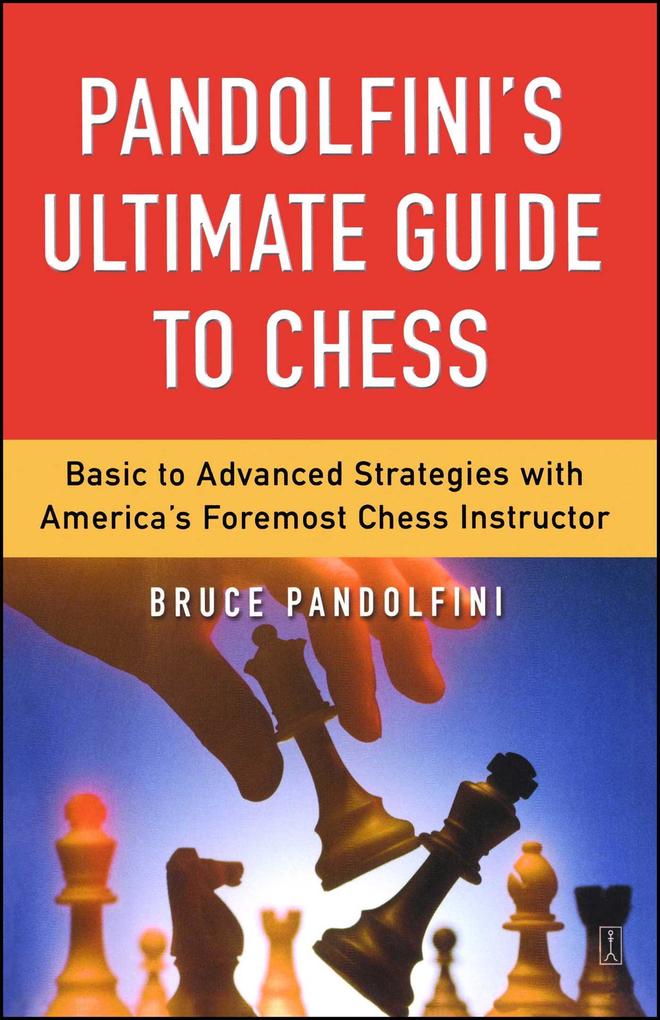
From America’s foremost chess coach and game strategist for Netflix’s The Queen’s Gambit comes a comprehensive guide covering all aspects of the game, to improve your technique whether you are a newcomer or a longtime fan.
One of America's best-known chess masters, Bruce Pandolfini has helped millions learn the intricacies of chess through his acclaimed books and workshops. In this exciting volume, he presents a complete overview of the entire game and its culture. Structured as a dialogue between a beginning student and an expert teacher, Pandolfini's Ultimate Guide to Chess takes the student step-by-step from fundamentals to advanced, highly strategic play. Combining easy-to-follow diagrams with trenchant and up-to-date analysis, Pandolfini puts a new twist on accepted chess theory, offering a seamless beginning-to-end approach, including:
• a short introductory history of the game
• the moves, rules, and contemporary notation forms
• the basic principles of chess
• how to develop an opening repertoire
• the art of tactical play
• pattern recognition and memory aids
• traps and pitfalls to be avoided
• middlegame play, strategy, and planning
• defense and counterattack
• transitions to the endgame and the endgame itself
• computers and the future of chess
• the best websites for playing chess online
With Pandolfini's expert insight into the history and modern world of chess, as well as several appendices to enhance play and appreciation, Pandolfini's Ultimate Guide to Chess makes the perfect gift for players of all ages and will be the benchmark title for chess players for years to come.
Inhaltsverzeichnis
< BR> Contents< BR> < BR> Prologue: Chess, The Universal Game< BR> < BR> Lesson 1: In the Beginning< BR> < BR> The Moves and Rules< BR> < BR> Lesson 2: Arming for Attack< BR> < BR> Non-mating Tactics< BR> < BR> Lesson 3: Defining the Goal< BR> < BR> Mating Patterns< BR> < BR> Lesson 4: Terms of Engagement< BR> < BR> The Elements< BR> < BR> Lesson 5: Staking out Territory< BR> < BR> Opening Principles and the First Move< BR> < BR> Lesson 6: Establishing the Neutral Zone< BR> < BR> Black's Response< BR> < BR> Lesson 7: Determining Priorities< BR> < BR> Development and the Center< BR> < BR> Lesson 8: Starting the Campaign< BR> < BR> Comparing Minor Pieces< BR> < BR> Lesson 9: Digging the Trenches< BR> < BR> Trades, Pins, and More on Minor Pieces< BR> < BR> Lesson 10: Accumulating Advantages< BR> < BR> Pawn Play and Weaknesses< BR> < BR> Lesson 11: Forming Plans< BR> < BR> Doubled Pawns, Castling, and Open Lines< BR> < BR> Lesson 12: Evaluating and Calculating< BR> < BR> The Middlegame, Exchange Values, How to Analyze< BR> < BR> Lesson 13: Breaking Through< BR> < BR> Strategy and Tactics, the Importance of Material, Avoiding Errors< BR> < BR> Lesson 14: The Beginning of the End< BR> < BR> Endgame Principles, Centralization, the Active King, and Pawn Promotion< BR> < BR> Lesson 15: Approaching the Goal< BR> < BR> The Passed Pawn and Pawn Majorities< BR> < BR> Lesson 16: All Good Things Come to an End< BR> < BR> The Seventh Rank, Invasion, and Simplification< BR> < BR> Epilogue: Chess = mc2< BR> < BR> Appendix 1: Glossary< BR> < BR> Appendix 2: Opening Moves< BR> < BR> Appendix 3: Chess on the Web< BR> < BR> Appendix 4: World Champions< BR> < BR> Appendix 5: Significant Dates in Chess History< BR> < BR> Appendix 6: Quotes< BR> < BR> Appendix 7: Chess in Movies and Books< BR> < BR> Appendix 8: The Most Famous Chess Game of All Time< BR> < BR> Bibliography< BR> < BR> Index< BR> < BR> Acknowledgments