In the second edition of Being (book I of the Science of Logic) Hegel makes extensive use of the term plastisch. Hegelian critics and commentators from Catherine Malabou to Pierre-Jean Labarriere read his use of this term as a wish to override the Logic's pure forms and rigid conceptualizations of universality. Other readers of Hegel's Logic, like Stanley Rosen, warned against this plastic model of 'universal effectuality' and the scholarly danger of straying away from 'the idea of Hegel's science of logic.' Contemporary Hegelian studies have been marked by this double turn to the logical foundation and speculative core of Hegel's system, that is, to his logic as 'science'.
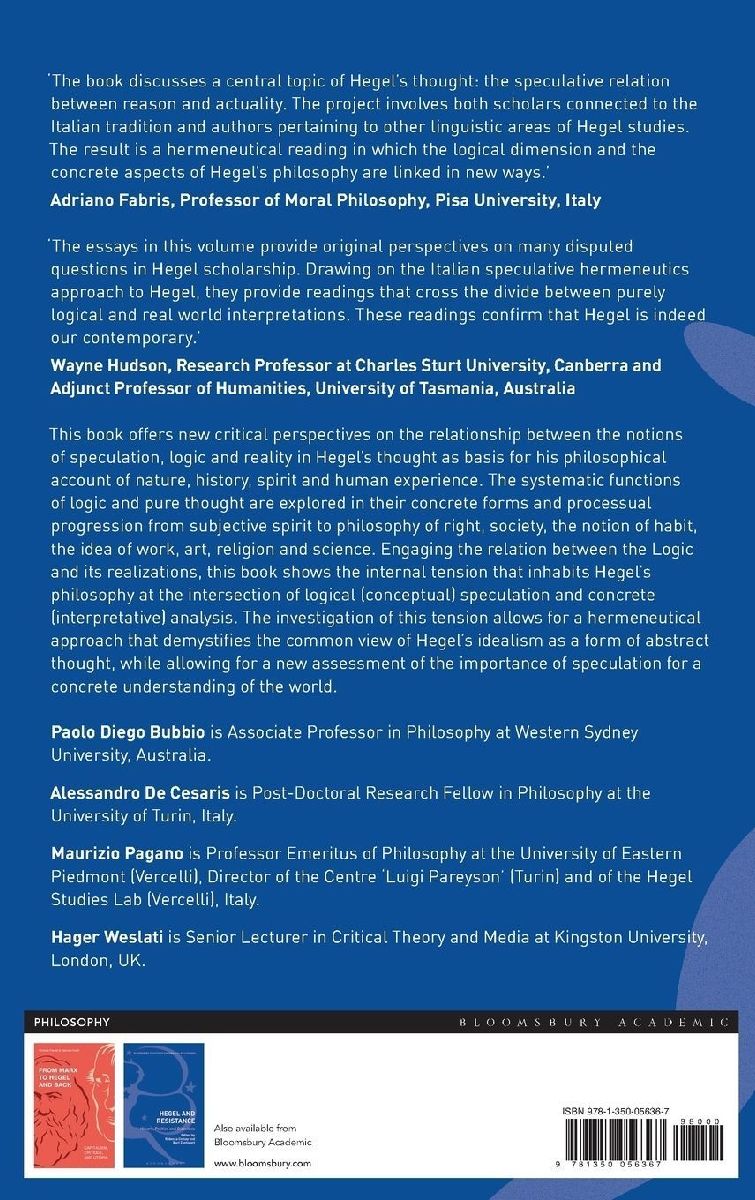
This is the first book to introduce Italian and subaltern interpretations of the Hegelian Wirklichkeit (often translated as actuality), and to examine its implications throughout Hegel's thought, taking Hegel's Science of Logic as the basis for his philosophy. The volume's understanding of effectual reality situates itself in a Machiavellian-Gramscian genealogy of ideas, and with an emphasis on the practical element of Wirklichkeit, beyond plasticity and actuality, it systematically considers the applications of Hegel's logic to his philosophy of nature and the human world.
Analyzing the relation between the Logic and its realizations, this book shows the internal tension that inhabits Hegel's philosophy at the intersection of logical (conceptual) speculation and concrete (interpretative) analysis.
Inhaltsverzeichnis
Notes on Contributors< BR> Acknowledgements< BR> List of Abbreviations< BR> < BR> Introduction: Speculation and Hermeneutics of Effectual Reality< BR> Maurizio Pagano, University of Eastern Piedmont, Vercelli, Italy and Hager Weslati, Kingston University, London, UK< BR> < BR> 1 Empowering Forms: Hegel's Conception of 'Form' and 'Formal'< BR> Elena Ficara, University of Paderborn, Germany < BR> < BR> 2 Essence as Reflection< BR> Riccardo Dottori, University of Rome Tor Vergata, Italy< BR> < BR> 3 Effectual Contingency: The Ontological Problem of Modality in Hegel's Science of Logic< BR> Alessandro De Cesaris, University of Naples "Federico II", Italy< BR> < BR> 4 Self-Consciousness and the Idea: from Logic to Subjective Spirit < BR> Guido Frilli, University of Florence, Italy< BR> < BR> 5 The Concept of Habit and the Function of Immediacy in Hegel's Logic< BR> Sean McStravick, Panthéon-Sorbonne University, Paris, France< BR> < BR> 6. Singularity of the Concept - Singularity of the Will: the Logical Ground of Hegel's Philosophy of Right< BR> Antonios Kalatzis, Centre Marc Bloch / Humboldt-University of Berlin, Germany< BR> < BR> 7. Subverting Practical Philosophy: Hegel's Science of Spirit< BR> Myriam Bienenstock, Université François Rabelais, Tours-Paris, France< BR> < BR> 8. Work and Need, Particular and Universal< BR> Campbell Jones, University of Auckland, New Zealand< BR> < BR> 9. Hegel's Conception of Personality and the Tension between Logic and Realphilosophy< BR> Lauri Kallio, University of Helsinki, Finland< BR> < BR> 10 Mind of God, Point of View of Man, or Something Not Quite Either? < BR> Paul Redding, The University of Sydney, Australia< BR> < BR> 11 Logic and Theology in Hegel< BR> Roberto Morani, University of Eastern Piedmont, Vercelli, Italy< BR> < BR> 12 The Concept of Religion and its Hermeneutic Function< BR> Maurizio Pagano, University of Eastern Piedmont, Vercelli, Italy< BR> < BR> 13 A Speculative Logic for Images in Hegel's Philosophy< BR> Haris Ch. Papoulias, University of Eastern Piedmont, Vercelli, Italy< BR> < BR> 14 The Silence of Logik: Hegel after Kojève< BR> Hager Weslati, Kingston University, London, UK< BR> < BR> < BR> Index