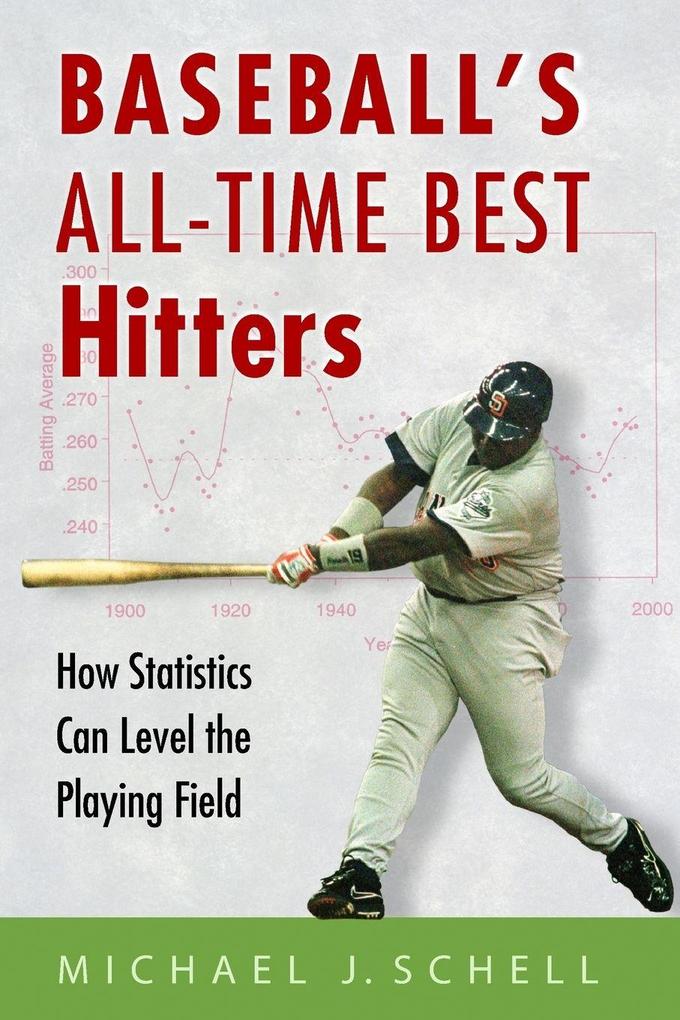
Tony Gwynn is the greatest hitter in the history of baseball. That's the conclusion of this engaging and provocative analysis of baseball's all-time best hitters. Michael Schell challenges the traditional list of all-time hitters, which places Ty Cobb first, Gwynn 16th, and includes just 8 players whose prime came after 1960. Schell argues that the raw batting averages used as the list's basis should be adjusted to take into account that hitters played in different eras, with different rules, and in different ballparks. He makes those adjustments and produces a new list of the best 100 hitters that will spark debate among baseball fans and statisticians everywhere.
Schell combines the two qualifications essential for a book like this. He is a professional statistician--applying his skills to cancer research--and he has an encyclopedic knowledge of baseball. He has wondered how to rank hitters since he was a boy growing up as a passionate Cincinnati Reds fan. Over the years, he has analyzed the most important factors, including the relative difficulty of hitting in different ballparks, the length of hitters' careers, the talent pool that players are drawn from, and changes in the game that raised or lowered major-league batting averages (the introduction of the designated hitter and changes in the height and location of the pitcher's mound, for example). Schell's study finally levels the playing field, giving new credit to hitters who played in adverse conditions and downgrading others who faced fewer obstacles. His final ranking of players differs dramatically from the traditional list. Gwynn, for example, bumps Cobb to 2nd place, Rod Carew rises from 28th to 3rd, Babe Ruth drops from 9th to 16th, and Willie Mays comes from off the list to rank 13th. Schell's list also gives relatively more credit to modern players, containing 39 whose best days were after 1960.
Using a fun, conversational style, the book presents a feast of stories and statistics about players, ballparks, and teams--all arranged so that calculations can be skipped by general readers but consulted by statisticians eager to follow Schell's methods or introduce their students to such basic concepts as mean, histogram, standard deviation, p-value, and regression. Baseball's All-Time Best Hitters will shake up how baseball fans view the greatest heroes of America's national pastime.
Inhaltsverzeichnis
List of Figures Pt. IThe Method 1On Deck with the Qualifying Players 2First Base - Adjusting for Late Career Declines 3Second Base - Adjusting for Hitting Feasts and Famines 4Third Base - Adjusting for League Batting Talent 5Home - Adjusting for Ballpark Pt. IIThe Findings 6The Adjusted Top 100 Hitters 7Top Hitters by Position 8Best Single-Season Batting Averages 9The Ballparks 10On Base Percentage 11The Hall of Fame 12Where Would the Current Stars Rank? Afterword: Post-Game Wrap-Up App. I: Abbreviations and Glossary App. IIRight- vs. Left-Handed Hitting App. IIILeague Batting Averages App. IVBallpark Effect Batting Averages App. VLeague Base on Balls Averages References Index