Unlike the competition this book is problem rather than tool oriented
Provides simple a set of simple systematic heuristic methods for a general course in decision making
Accompanied by an Instructor s Guide. Contact rexvbrown@aol. com. .
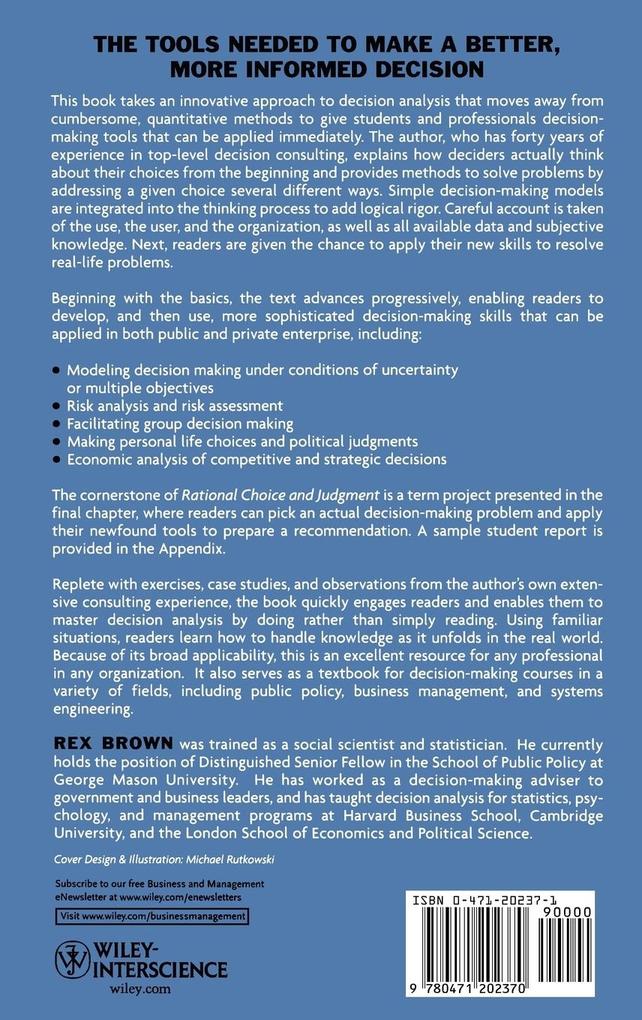
The tools needed to make a better, more informed decision This book takes an innovative approach to decision analysis that moves away from cumbersome, quantitative methods to give students and professionals decision-making tools that can be applied immediately. The author, who has forty years of experience in top-level decision consulting, explains how deciders actually think about their choices from the beginning and provides methods to solve problems by addressing a given choice several different ways. Simple decision-making models are integrated into the thinking process to add logical rigor. Careful account is taken of the use, the user, and the organization, as well as all available data and subjective knowledge. Next, readers are given the chance to apply their new skills to resolve real-life problems.
Beginning with the basics, the text advances progressively, enabling readers to develop, and then use, more sophisticated decision-making skills that can be applied in both public and private enterprise, including:
- Modeling decision making under conditions of uncertainty or multiple objectives
- Risk analysis and risk assessment
- Facilitating group decision making
- Making personal life choices and political judgments
- Economic analysis of competitive and strategic decisions
The cornerstone of Rational Choice and Judgment is a term project presented in the final chapter, where readers can pick an actual decision-making problem and apply their newfound tools to prepare a recommendation. A sample student report is provided in the Appendix.
Replete with exercises, case studies, and observations from the author's own extensive consulting experience, the book quickly engages readers and enables them to master decision analysis by doing rather than simply reading. Using familiar situations, readers learn how to handle knowledge as it unfolds in the real world. Because of its broad applicability, this is an excellent resource for any professional in any organization. It also serves as a textbook for decision-making courses in a variety of fields, including public policy, business management, and systems engineering.
Inhaltsverzeichnis
Preface. Who Might Use This Book.
Background.
Substance of this Book.
Pedagogy.
Demands on Students and Instructor.
Other Approaches, Other Materials.
Author Background.
Acknowledgments.
Prolog: A Baby Delivery Dilemma.
1. Basics and Overview.
2. Uses of Decision Analysis.
Appendix 2A: Decision Analysis Reflects on His Work.
3. Evaluating a Choice Qualitatively.
4. Quantitative Aid to Rational Choice.
Appendix 4A: Business Decision Tree Example.
Appendix 4B: Private Example: Study or Play?
5. Describing Outcomes.
6. Taking Preference Into Account.
7. Choice Under Uncertainty.
Appendix 7A. Technical Notes.
8. Decision Aiding Strategy.
Appendix 8A. Influence Sketches.
9. Aiding the Professional Decider.
Appendix 9A. Environmental Regulation Case Study.
10. Assessing and Inferring Probabilities.
11. Eliciting Preferences.
12. Applied Term Project.
Appendix 12A. Student Project Report.
Epilog.
References.
Glossary of Concepts and Terms.
Index.