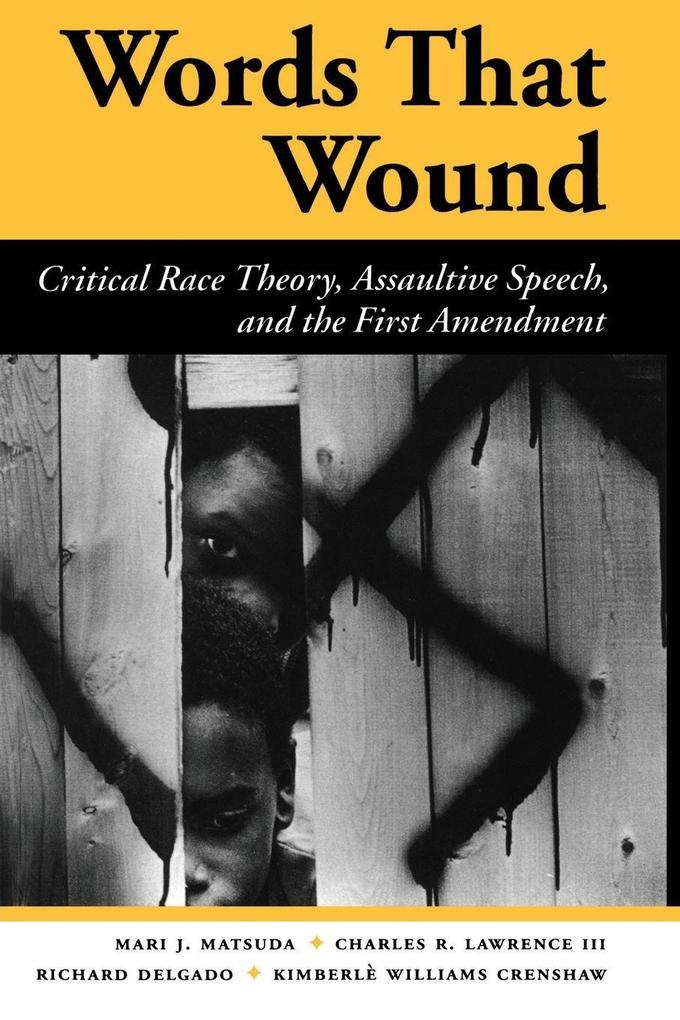
The authors draw on the experience of injury from racist hate speech to develop a first amendment interpretation that recognizes such injuries, demonstrating how critical race theory can be brought to bear against both conservative and liberal ideology to motivate a regulation of hate speech.
Words, like sticks and stones, can assault; they can injure; they can exclude. In this important book, four prominent legal scholars from the tradition of critical race theory draw on the experience of injury from racist hate speech to develop a first amendment interpretation that recognizes such injuries. In their critique of ? first amendment orthodoxy, ? the authors argue that only a history of racism can explain why defamation, invasion of privacy, and fraud are exempt from free-speech guarantees while racist and sexist verbal assaults are not. The rising tide of verbal violence on college campuses has increased the intensity of the ? hate speech? debate. This book demonstrates how critical race theory can be brought to bear against both conservative and liberal ideology to motivate a responsible regulation of hate speech. The impact of feminist theory is also evident throughout. The authors have provided a rare and powerful example of the application of critical theory to a real-life problem. This timely and necessary book will be essential reading for those experiencing the conflicts of free-speech issues on campus? students, faculty, administrators, and legislators? as well as for scholars of jurisprudence. It will also be a valuable classroom tool for teachers in political science, sociology, law, education, ethnic studies, and women's studies.
Inhaltsverzeichnis
Introduction -- Public Response to Racist Speech: Considering the Victim's Story -- If He Hollers Let Him Go: Regulating Racist Speech on Campus -- Words That Wound: A Tort Action for Racial Insults, Epithets, and Name Calling -- Beyond Racism and Misogyny: Black Feminism and 2 Live Crew -- Epilogue: Burning Crosses and the R. A. V. Case