








Das eBook.de Hörbuch Abo - jederzeit, überall, für nur 7,95 € monatlich!
Jetzt entdecken
mehr erfahren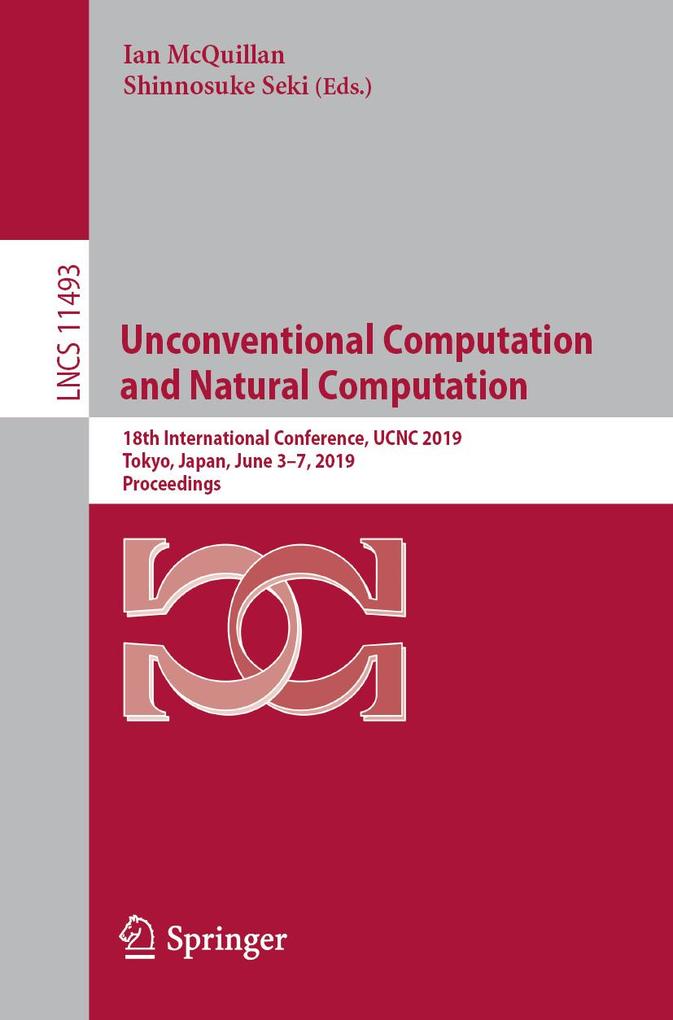
The 19 full papers presented were carefully reviewed and selected from 32 submissions. The papers cover topics such as hypercomputation; chaos and dynamical systems based computing; granular, fuzzy and rough computing; mechanical computing; cellular, evolutionary, molecular, neural, and quantum computing; membrane computing; amorphous computing, swarm intelligence; artificial immune systems; physics of computation; chemical computation; evolving hardware; the computational nature of self-assembly, developmental processes, bacterial communication, and brain processes.
Inhaltsverzeichnis
Invited Paper. -
Co-designing the computational model and the computing substrate. -
Contributed Papers. -
Generalized Membrane Systems with Dynamical Structure, Petri Nets, and Multiset Approximation Spaces. - Quantum Dual Adversary for Hidden Subgroups and Beyond. - Further Properties of Self-assembly by Hairpin Formation. - The Role of Structure and Complexity on Reservoir Computing Quality. - Lindenmayer Systems and Global Transformations. - Swarm-based multiset rewriting computing models. - DNA Origami Words and Rewriting Systems. - Computational Limitations of Affine Automata. - An Exponentially Growing Nubot System Without State Changes. - Impossibility of Sufficiently Simple Chemical Reaction Network Implementations in DNA Strand Displacement. - Quantum Algorithm for Dynamic Programming Approach for DAGs. Applications for Zhegalkin Polynomial Evaluation and Some Problems on DAGs. - Viewing rate-based neurons as biophysical conductance outputting models. - The Lyapunov Exponents of Reversible Cellular Automata Are Uncomputable. - Geometric Tiles and Powers and Limitations of Geometric Hindrance in Self-Assembly. - DNA Computing Units Based on Fractional Coding. - The role of the representational entity in physical computing. - OIM: Oscillator-based Ising Machines for Solving Combinatorial Optimisation Problems. - Relativizations of Nonuniform Quantum Finite Automata Families. - Self-stabilizing Gellular Automata.
Es wurden noch keine Bewertungen abgegeben. Schreiben Sie die erste Bewertung zu "Unconventional Computation and Natural Computation" und helfen Sie damit anderen bei der Kaufentscheidung.